3.5.1 - Photosynthesis
Photosynthesis transfers light energy into chemical energy in two linked stages. The light-dependent reaction makes ATP and reduced NADP; the light-independent reaction, or Calvin cycle, uses them to make carbohydrate from carbon dioxide. Trace that link and limiting-factor questions become a search for the bottleneck. All photoautotrophs, organisms that use light energy to make organic compounds, share this process, which is indirect evidence for evolution.
Chloroplasts and light absorption
The two stages of photosynthesis need different surroundings, and one organelle provides both.
In plants and algae, photosynthesis takes place in chloroplasts, whose parts you met in 3.2.1.1:
- The thylakoid membranes contain chlorophyll, electron carriers and ATP synthase, so they are the site of the light-dependent reaction.
- Thylakoids are stacked into grana, which provide a large surface area for absorbing light.
- The stroma, the fluid around the grana, contains the enzymes for the Calvin cycle, including rubisco, which catalyses its first step.
The light-dependent reaction needs a membrane because protons build up on one side of it. That side is the thylakoid space, the fluid-filled inside of each flattened thylakoid sac. The Calvin cycle is a series of enzyme-controlled reactions, so it runs in the enzyme-rich stroma.
Chloroplast
A chloroplast is a plant organelle with a double membrane. It contains thylakoid membranes for the light-dependent reaction and stroma for the Calvin cycle.
Which colours drive photosynthesis
Chlorophyll absorbs strongly in the blue and red regions and less in the green. Two graphs show whether that absorbed light drives photosynthesis:
- An absorption spectrum plots light absorbed against wavelength.
- An action spectrum plots photosynthetic rate against wavelength.
Their peaks broadly correspond, which supports the role of absorbed light. Accessory pigments, other light-absorbing pigments in the chloroplast, broaden useful light absorption. To compare spectra, control light intensity, temperature and carbon dioxide concentration, so wavelength is the intended changing factor.
Exam tip
When describing rate against colour, name each colour, including green: the rate is high in blue and red light and lower in green. “No photosynthesis in green light” can lose the mark, because the rate is low, not zero.
The light-dependent reaction
Light energy goes in; ATP, reduced NADP and oxygen come out. Follow the electrons and the protons separately.
Oxidation is loss of electrons and reduction is gain of electrons. NADP is a reusable carrier: it accepts electrons and protons to become reduced NADP, then returns to its oxidised form when it supplies reducing power to the Calvin cycle.
Following the electrons
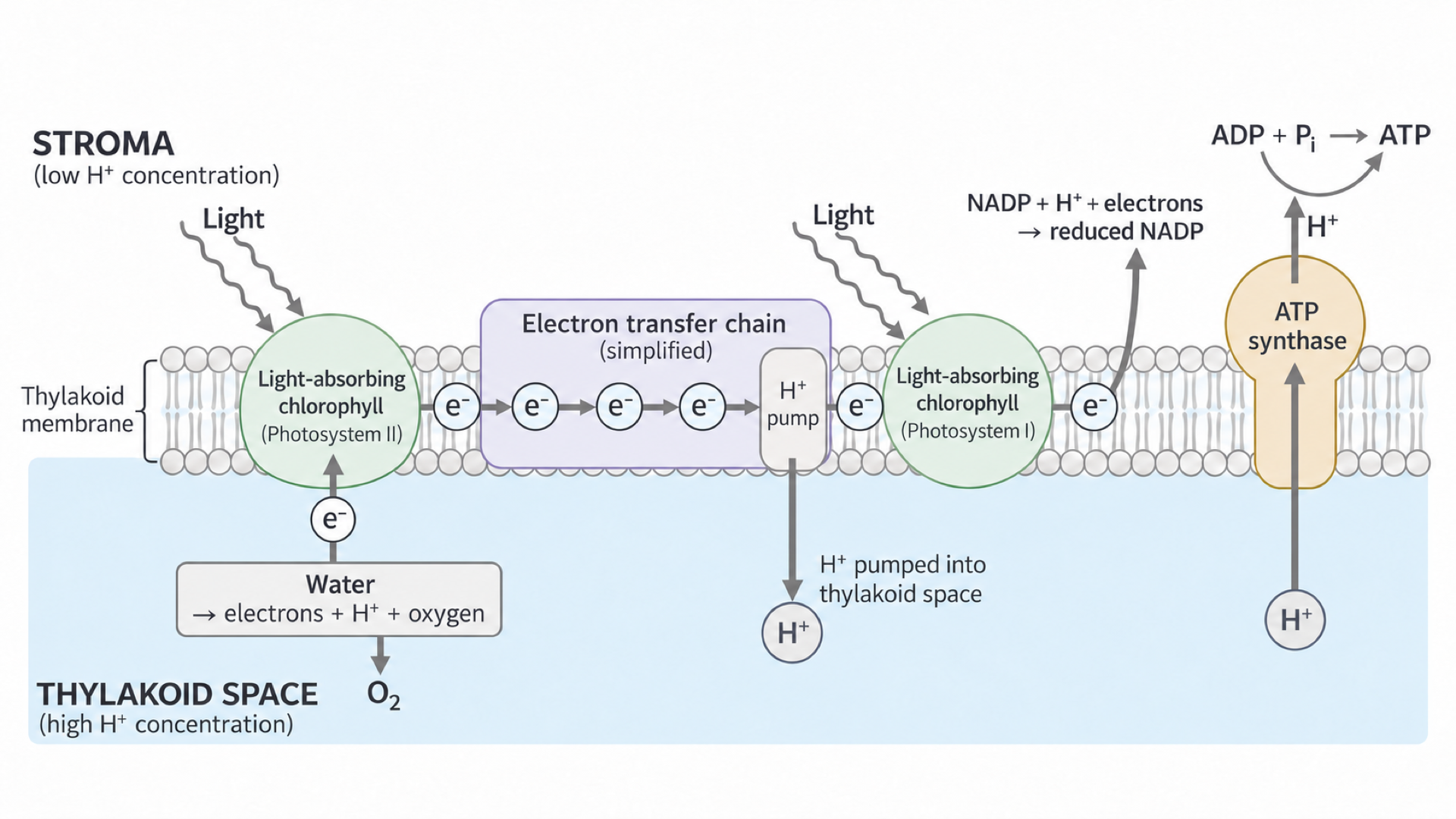
Chlorophyll is grouped with proteins and other pigments into two light-capturing clusters called photosystems. Electrons reach Photosystem II first, then Photosystem I: the numbers show the order of discovery, not of electron flow.
- Chlorophyll in Photosystem II absorbs light energy, so its electrons gain energy.
- These electrons leave the chlorophyll molecule. This is photoionisation.
- The electrons pass along an electron transfer chain in the thylakoid membrane, losing energy as they go.
- Some of that energy pumps H⁺ ions from the stroma into the thylakoid space.
- Light absorbed at Photosystem I re-energises the electrons.
- The electrons pass to NADP, which, together with H⁺, forms reduced NADP.
Photoionisation
Photoionisation is the loss of electrons from chlorophyll after it absorbs light energy.
Photoionisation leaves Photosystem II short of electrons. Photolysis of water replaces them:
Photolysis of water
Water is split in the thylakoid space, and each product has its own fate:
- electrons replace those lost from chlorophyll
- H⁺ ions add to the high H⁺ concentration there
- oxygen is released as a by-product, so the oxygen from photosynthesis comes from water, not carbon dioxide
How ATP is made
H⁺ concentration is now high in the thylakoid space, because electron transfer has pumped H⁺ in and photolysis releases more there. The thylakoid membrane restricts free proton movement, so the gradient holds. H⁺ ions are charged, so this is an electrochemical gradient: a difference in concentration and charge.
H⁺ ions diffuse back into the stroma through ATP synthase, an enzyme embedded in the thylakoid membrane, not free in the stroma. This flow provides the energy to combine ADP with to form ATP. Chemiosmosis is this coupling of the proton gradient to ATP synthesis, as the chemiosmotic theory explains.
If the membrane became freely permeable to protons, the gradient would dissipate even if light absorption continued, and ATP production would fall.
In the diagram, follow the electrons from water, bottom left, through Photosystem II, the chain and Photosystem I, up to NADP. Then find the two H⁺ routes: pumped down into the thylakoid space and back up through ATP synthase. Electrons do not pass through ATP synthase.
[DIAGRAM: asset_name: photosynthesis-chemiosmosis; asset_slug: photosynthesis-chemiosmosis; recommended_method: imagegen; caption: Simplified light-driven electron transfer pumps protons into the thylakoid space, return to the stroma through ATP synthase produces ATP.; description: Simplified light-driven electron transfer pumps protons into the thylakoid space; return to the stroma through ATP synthase produces ATP.]
Some of the energy from those electrons is now conserved in two products for the Calvin cycle:
- ATP, which supplies energy
- reduced NADP, which supplies reducing power
The light-independent reaction
The Calvin cycle builds sugar from carbon dioxide in the stroma, using ATP and reduced NADP from the thylakoids.
It does not use light directly, but it depends on those two products.
Three steps around the cycle
- Carbon dioxide fixation. Carbon dioxide combines with ribulose bisphosphate (RuBP), a 5-carbon compound, in a reaction catalysed by rubisco. The unstable 6-carbon product immediately splits into two molecules of glycerate 3-phosphate (GP).
- Reduction of GP. GP is reduced to triose phosphate (TP), a 3-carbon simple sugar with a phosphate group. Hydrolysis of ATP to ADP and inorganic phosphate supplies energy. Reduced NADP supplies hydrogen/electrons and is oxidised back to NADP.
- Regeneration of RuBP. Most of the TP is rearranged, using ATP, back into RuBP, so fixation can continue.
Rubisco
Rubisco is the enzyme that catalyses the reaction between carbon dioxide and RuBP in the first step of the Calvin cycle.
So ATP is used in steps 2 and 3, and reduced NADP in step 2.
Watch out
Writing that reduced NADP oxidises GP, or that it provides energy in the same way as ATP, can lose marks. ATP supplies energy; reduced NADP supplies hydrogen, which reduces GP.
Where the TP goes
A smaller proportion of TP leaves the cycle and is used to make useful organic substances:
- hexose sugars, then starch and cellulose
- lipids
- amino acids and nucleotides, once mineral ions such as nitrate supply the extra elements
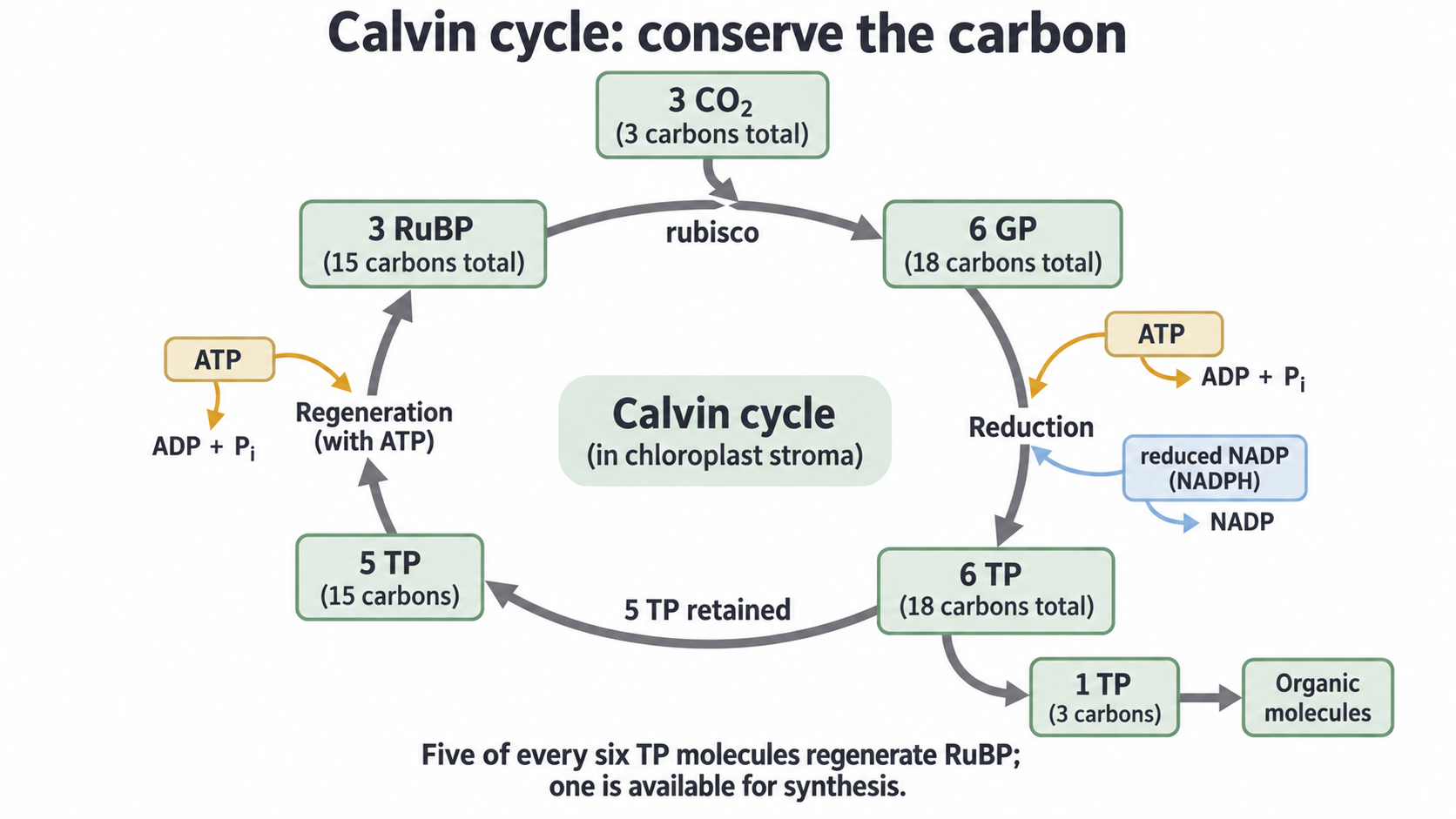
Follow the diagram clockwise from the top. For every three carbon dioxide molecules fixed:
- With those 3 carbons, three 5-carbon RuBP molecules produce six 3-carbon GP molecules, then six TP molecules: 18 carbons in all.
- Five TP molecules, containing 15 carbons, regenerate the three RuBP molecules.
- One TP molecule, containing 3 carbons, is the net carbohydrate available for synthesis. Two net TP molecules supply one hexose sugar.
[DIAGRAM: asset_name: calvin-carbon-balance; asset_slug: calvin-carbon-balance; recommended_method: imagegen; caption: Three carbon dioxide plus three RuBP form six GP and six TP, five TP regenerate three RuBP and one TP leaves the cycle.; description: Three carbon dioxide plus three RuBP form six GP and six TP; five TP regenerate three RuBP and one TP leaves the cycle.]
Worked example: carbon dioxide to hexose
Question. A chloroplast fixes 6 carbon dioxide molecules. How many hexose molecules can the net TP supply?
Plan. Work in groups of three carbon dioxide molecules.
- Two groups form 12 TP.
- 10 TP regenerate RuBP, leaving 2 TP.
- 2 TP contain 6 carbons.
Answer. 1 hexose molecule.
Check. 6 carbons fixed, 6 carbons in the hexose.
Continue this lesson.
You’re previewing NovaLearn without an account. Create a free account to read the rest.
Create free account