3.3.4.2 - Mass transport in plants
Plants have no heart or pump, yet water reaches their highest leaves and sucrose reaches their roots and fruits. Xylem carries water and dissolved mineral ions from roots to leaves by a passive, tension-driven mechanism. Phloem carries organic solutes such as sucrose from sources to sinks by pressure-driven mass flow, which depends on ATP-powered loading. This lesson explains both systems and the evidence used to test them.
Xylem and the transpiration stream
Xylem vessels are dead, hollow and reinforced, and each feature helps water travel from root to leaf.
Transpiration
The loss of water vapour from the aerial parts of a plant, mainly through the stomata of leaves.
Water lost this way is replaced through xylem, the tissue that transports water in the stem and leaves:
- Water enters the roots and rises through the xylem to the leaf veins.
- It leaves the xylem and enters mesophyll cells by osmosis, down a water potential gradient.
- It evaporates from the moist mesophyll cell walls into the air spaces of the leaf.
- The vapour diffuses out through the stomata, which you met in 3.3.2.
Transpiration stream
The continuous movement of water from the roots, through the xylem, to the leaves, where it evaporates and diffuses out into the atmosphere.
How vessel structure suits water flow
In the diagram, follow the water up the hollow lumen (the space inside the vessel). The faint rings mark where end walls have broken down.
[DIAGRAM: asset_name: 3.4.2 - Mass transport in plants - Diagram 1; asset_slug: 3.4.2 - Mass transport in plants - Diagram 1; recommended_method: retained_png; caption: Longitudinal section of xylem vessels showing dead hollow cells with no end walls, lignified thickening, pits, and the path of water from root to leaf.; description: Longitudinal section of xylem vessels showing dead hollow cells with no end walls, lignified thickening, pits, and the path of water from root to leaf.]
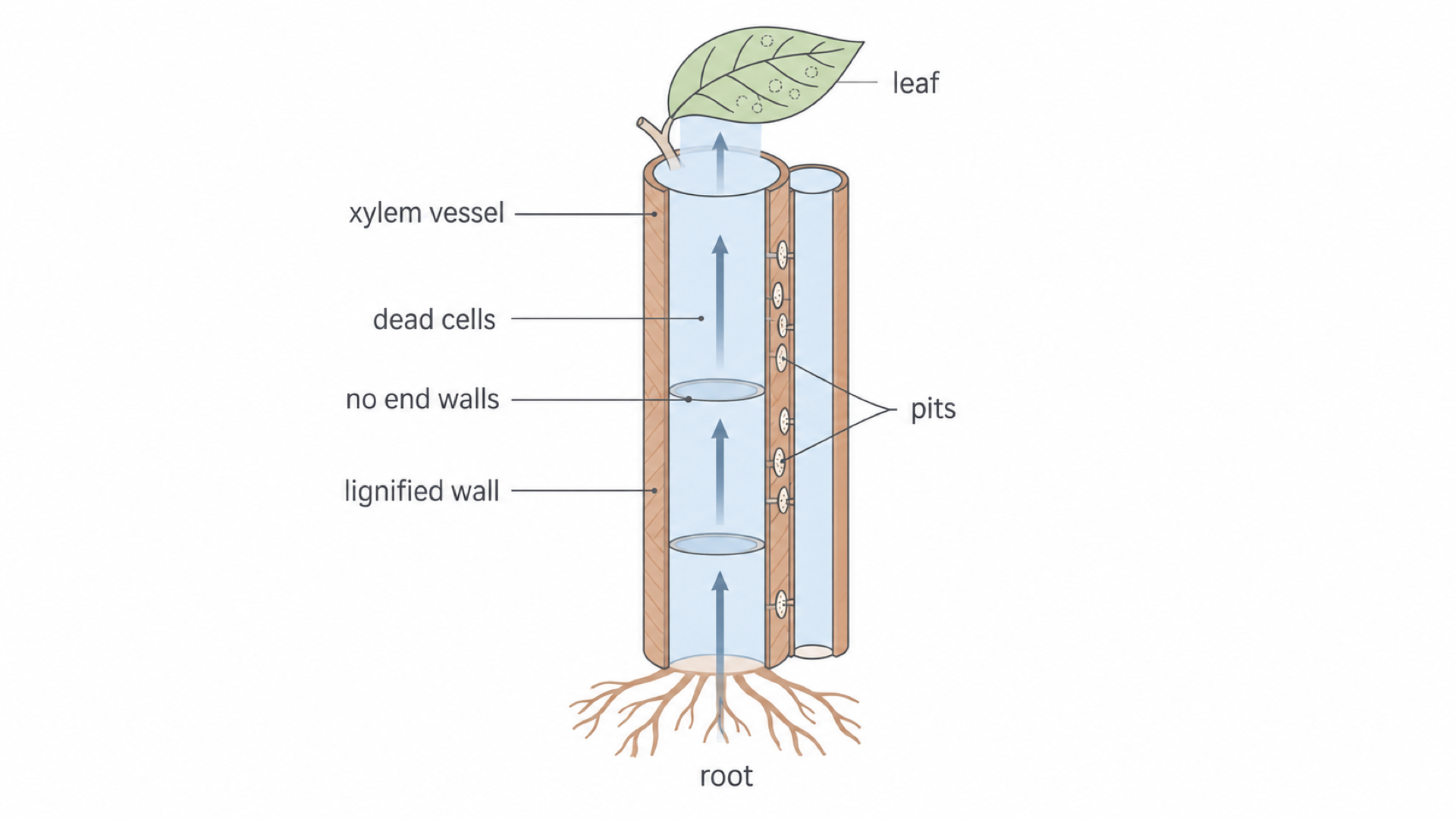
- Dead cells: vessels form from columns of dead cells, so no cytoplasm obstructs movement through the lumen.
- No end walls: the end walls have broken down, producing long hollow tubes with little resistance to flow.
- Lignified walls: lignin thickens the walls, which strengthens the vessel and prevents it from collapsing when the water column is under tension (a pull, explained in the next section).
- Pits: these allow water to move sideways between neighbouring vessels, so flow can continue if one route is blocked.
The cohesion-tension theory
The pull that lifts water through xylem starts at the wet cell walls inside leaves.
Cohesion-tension theory
The accepted model for water transport in xylem, in which evaporation of water from the leaves creates tension that pulls a continuous column of water upward, with cohesion between water molecules keeping the column unbroken.
In the diagram, start at the leaf on the left, then trace the pull down the xylem column to the roots.
[DIAGRAM: asset_name: transport-cohesion-tension; asset_slug: transport-cohesion-tension; recommended_method: retained_png; caption: Evaporation from leaf cell walls creates tension in the continuous xylem water column.; description: Evaporation from leaf cell walls creates tension in the continuous xylem water column.]
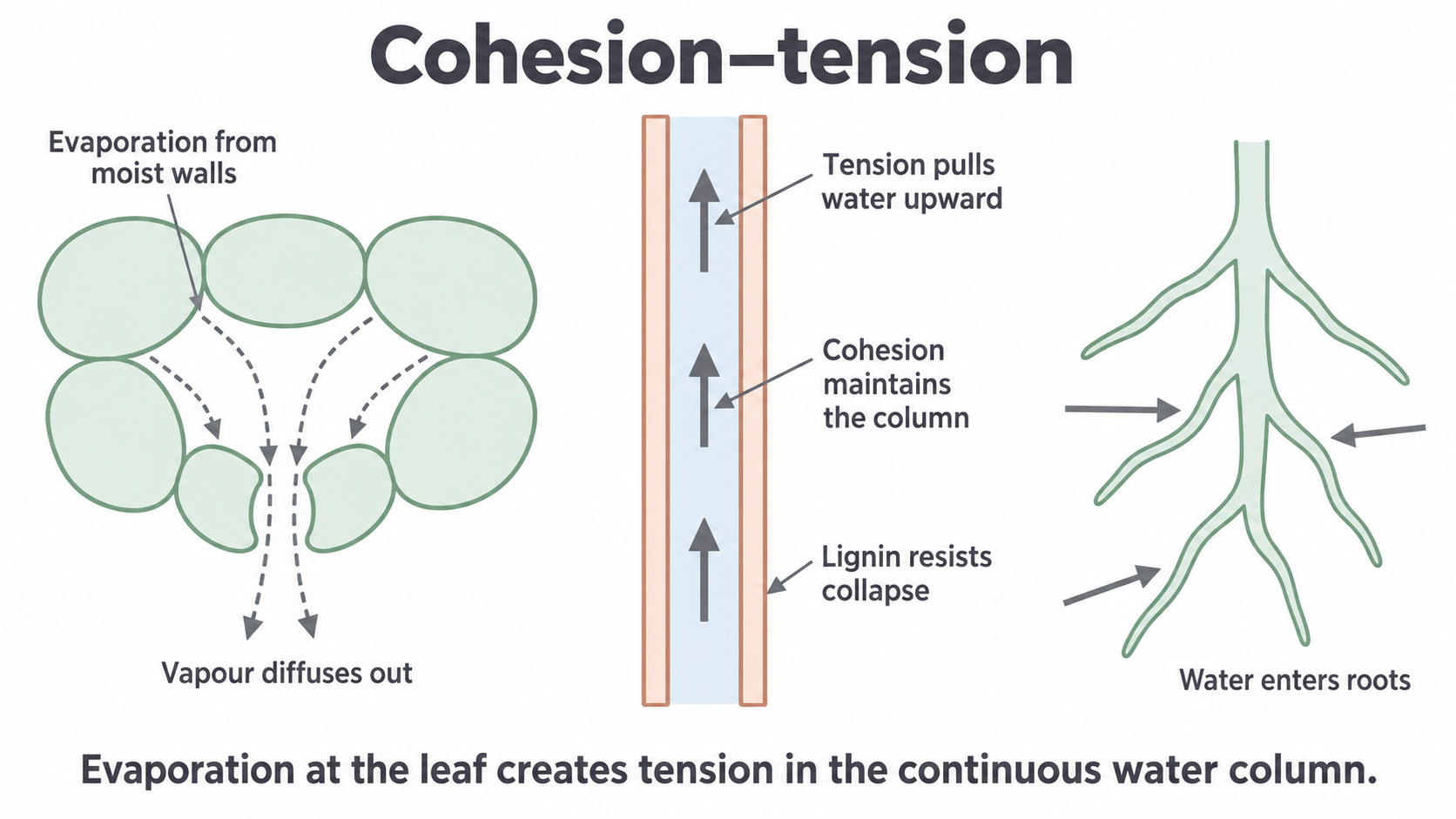
From evaporation to tension
- Water evaporates from the moist walls of mesophyll cells, so their water potential falls.
- Water is drawn by osmosis from neighbouring cells, and eventually from the xylem in the leaf veins.
- Removing water from the top of the xylem creates a negative pressure, or tension.
- Water molecules cohere by hydrogen bonding (3.1.7), so the tension is transmitted down the xylem: each molecule pulled upward pulls the next one with it.
- The continuous column moves up, and water enters at the roots to replace it.
Water also adheres to the hydrophilic walls of xylem vessels, which helps support the column, but the main upward force is transpiration pull.
Evidence supporting the theory
- Trunks shrink by day. Tree trunks shrink slightly when transpiration is high and expand again at night. Water adheres to the vessel walls, so tension pulls them slightly inwards, and this narrowing of many vessels reduces the trunk's diameter.
- Broken vessels draw air in. If a xylem vessel is broken, air is drawn in rather than water spurting out, which indicates negative pressure.
- Living cells aren't needed. Xylem vessels are dead, and by 1891 Eduard Strasburger had shown that water still rises when poison kills the living cells of woody stems. The mechanism is physical rather than metabolic.
Phloem structure and translocation
Sucrose made in a leaf can end up in a root, a fruit or a shoot tip, carried there through the phloem.
Translocation
The transport of dissolved organic substances, especially sucrose and amino acids, through the phloem from sources to sinks.
Sources and sinks
Phloem is the tissue that transports organic substances. Two kinds of region set the direction:
- A source loads sucrose into the phloem, such as a photosynthesising leaf or a storage organ releasing sugars.
- A sink removes sucrose from the phloem, such as a growing root tip, a developing fruit, a meristem (a region of dividing cells) or a storage organ filling with starch.
Sources and sinks can lie above or below each other. So, unlike xylem transport, translocation can run in different directions in different sieve tubes.
Exam tip
Write sucrose, not glucose. AQA examiners reported essays that outlined translocation as only the movement of glucose.
Sieve tubes and companion cells
In the diagram, compare the broad sieve tube pathway with the smaller companion cell beside it, then find the perforated sieve plate and the mitochondria.
[DIAGRAM: asset_name: transport-phloem-structure; asset_slug: transport-phloem-structure; recommended_method: retained_png; caption: Sieve plates link sieve tube elements and plasmodesmata connect their side walls to companion cells.; description: Sieve plates link sieve tube elements and plasmodesmata connect their side walls to companion cells.]
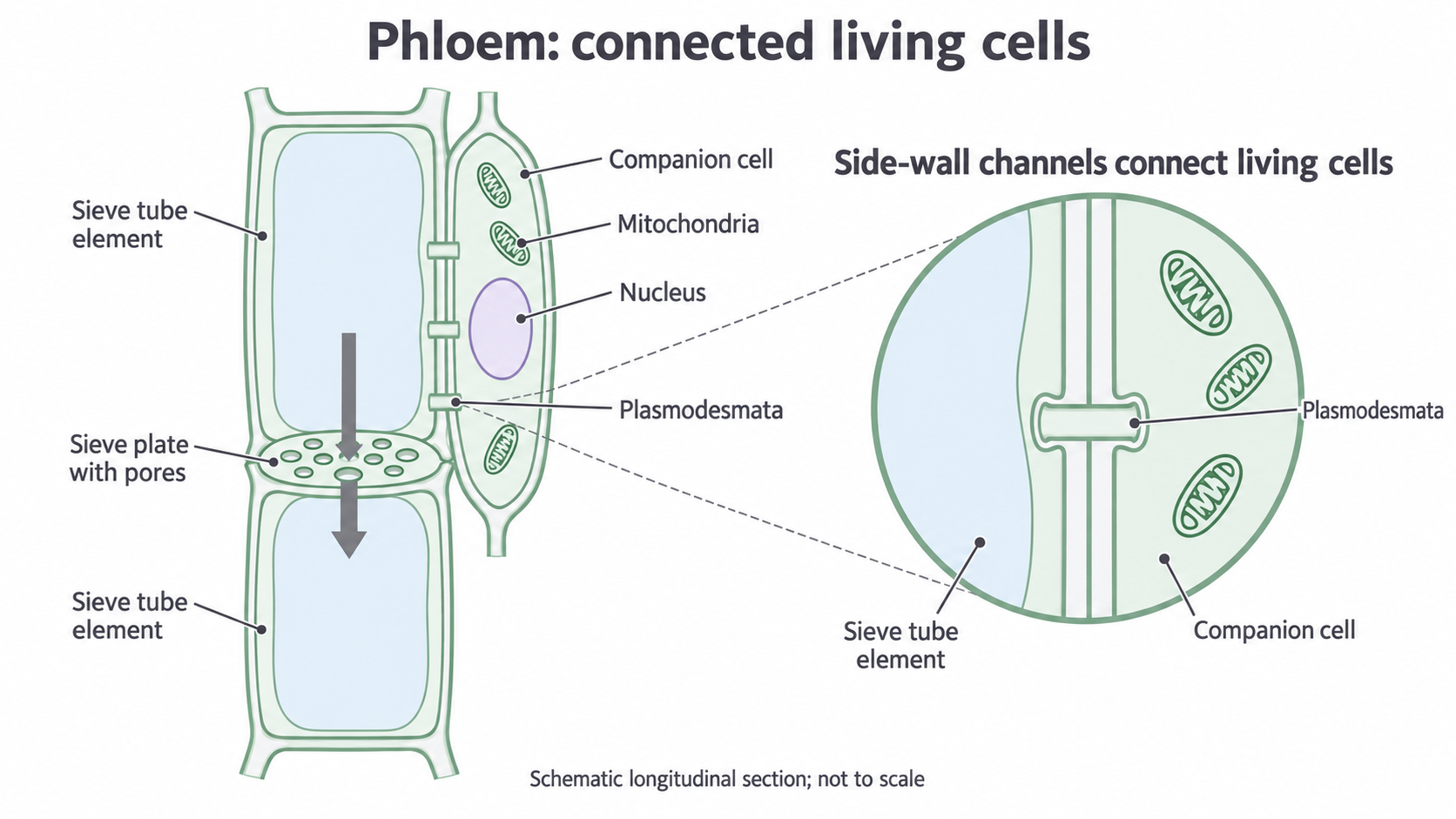
- Sieve tube elements are living cells, arranged end to end, that form the transport pathway.
- Sieve plates are their end walls, and their pores let sap pass between elements.
- Mature sieve tube elements have very little cytoplasm and no nucleus, which helps reduce resistance to flow.
- Companion cells lie alongside them, linked by plasmodesmata (channels through the walls that join the cytoplasm of neighbouring cells). Their many mitochondria provide the ATP needed for active loading.
Cover the table, then rebuild each row from memory.
| Feature | Xylem vessels | Phloem sieve tubes |
|---|---|---|
| Main cargo | Water and mineral ions | Organic substances, especially sucrose and amino acids |
| Cells | Dead, with no cytoplasm | Living, with little cytoplasm and no nucleus |
| End walls | Broken down | Sieve plates with pores |
| Direction | Roots to leaves | Source to sink, so up or down |
The mass flow hypothesis
Loading sucrose at one end and removing it at the other creates the pressure difference that drives translocation.
Mass flow hypothesis
The model proposing that phloem sap moves by bulk flow from source to sink because loading at the source and unloading at the sink create a hydrostatic pressure gradient.
In mass flow the whole liquid moves together, as water does along a hose. This bulk movement is passive, but the pressure difference behind it is created by active loading at the source and removal of sucrose at the sink.
Follow the numbers in the diagram: sucrose in, water in, sucrose out, water out.
[DIAGRAM: asset_name: transport-mass-flow; asset_slug: transport-mass-flow; recommended_method: retained_png; caption: Source loading and sink unloading establish the hydrostatic pressure gradient that drives phloem mass flow.; description: Source loading and sink unloading establish the hydrostatic pressure gradient that drives phloem mass flow.]
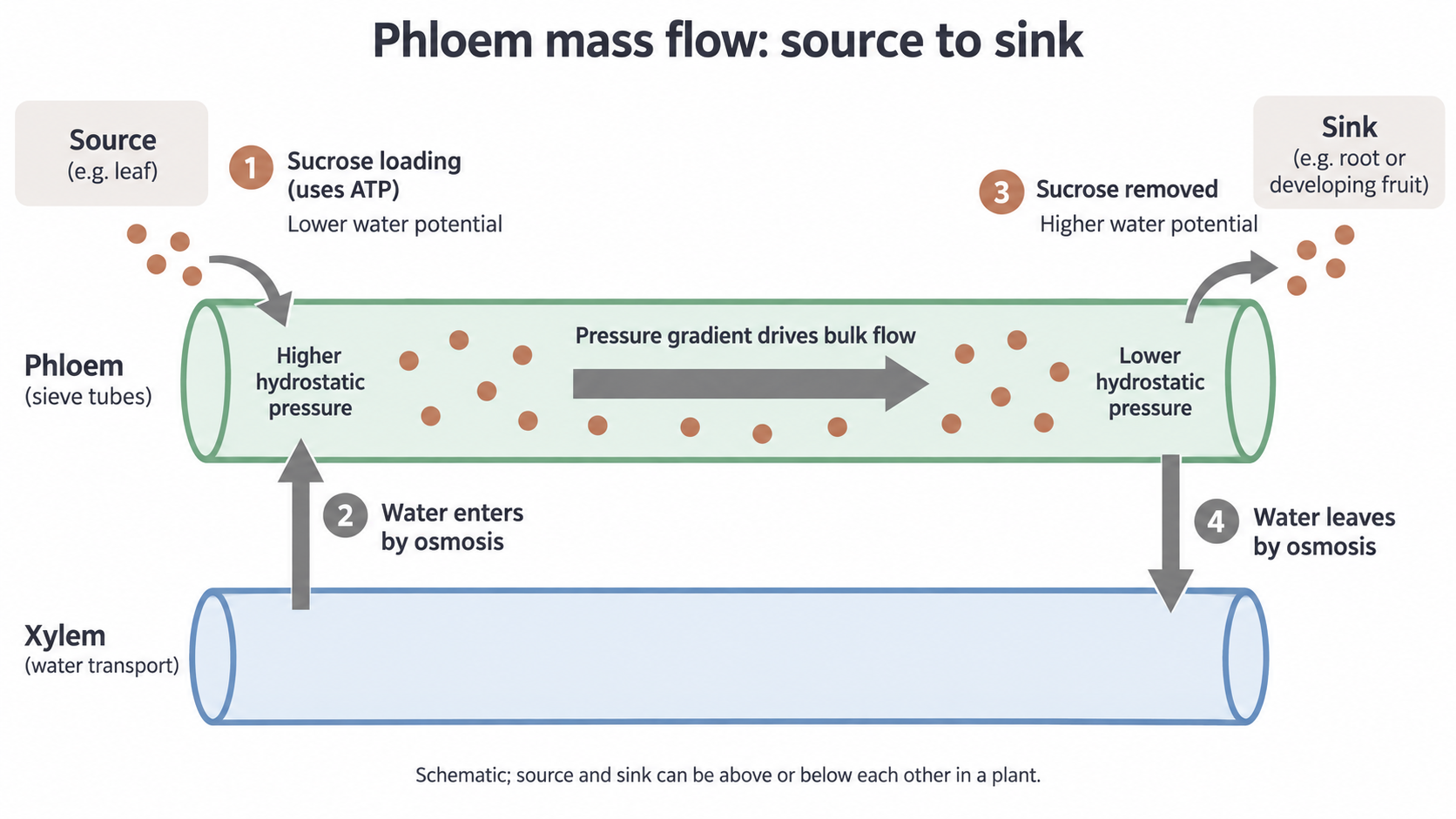
Loading at the source raises pressure
- Companion cells use ATP to pump hydrogen ions out of their cytoplasm.
- Hydrogen ions move back in, down their concentration gradient, through co-transporter proteins, bringing sucrose with them. You met co-transport with sodium ions in 3.3.3.
- The sucrose enters the sieve tube elements through plasmodesmata.
- This lowers the water potential inside the sieve tube, so water enters from the nearby xylem by osmosis.
- As water enters, hydrostatic pressure rises.
Unloading at the sink lowers pressure
- Sucrose is removed from the phloem, in many sinks by active transport, although diffusion can contribute.
- Sink cells use the sucrose in respiration or convert it to insoluble starch for storage. This keeps the sucrose concentration in the sink low, so removal can continue.
- Removing sucrose raises the water potential in the sieve tube, so water moves back into the xylem by osmosis.
- Hydrostatic pressure therefore falls at the sink end.
High hydrostatic pressure at the source and lower pressure at the sink drive the mass flow of phloem sap, which carries sucrose along. Diffusion alone doesn't explain this long-distance movement.
Continue this lesson.
You’re previewing NovaLearn without an account. Create a free account to read the rest.
Create free account