3.6.4.1 - Homeostasis and negative feedback
Learn why mammals keep temperature, pH and glucose stable, how negative feedback corrects a change, and how to tell it from positive feedback.
What homeostasis means
Step from a cold street into a warm classroom and your core temperature barely moves: that is homeostasis.
In mammals, the internal environment is mainly the tissue fluid surrounding cells. It forms from blood plasma, so controlling the blood largely controls conditions around cells. Physiological control systems do this by detecting a change and correcting it.
Homeostasis
The maintenance of the internal environment within restricted limits.
“Restricted limits” does not mean fixed values. Each variable fluctuates slightly around a norm, also called the set point or optimum.
Typical human values are about 37 °C for core temperature, 7.35 to 7.45 for blood pH and 5 mmol dm⁻³ for blood glucose. What matters is that departures are corrected before cell function is harmed.
Regulating these conditions gives mammals a degree of independence from the external environment.
Why stable internal conditions matter
Enzymes depend on stable temperature and pH; cells depend on enough glucose, but not so much that they lose water.
How temperature and pH affect enzymes
Metabolism is enzyme-controlled, so changing enzyme activity changes what a cell can do (3.1.4.2):
- Temperature falls: molecules have less kinetic energy, so fewer collisions have enough energy for reaction and reactions slow down. This is not denaturation.
- Temperature rises too high: stronger vibration breaks the hydrogen and ionic bonds that maintain tertiary structure, so enzymes and other proteins change shape. Active sites are no longer complementary to their substrates, so fewer enzyme–substrate complexes form.
- pH changes: a change in hydrogen ion concentration alters charges and can disrupt ionic and hydrogen bonds. Active sites change shape, so the rate falls, and a large change can denature the enzyme.
Two reasons blood glucose must stay stable
- Too low: glucose is a respiratory substrate, so a low supply limits respiration and ATP production.
- Too high: glucose is a solute, so more of it lowers the water potential of the blood. Water moves by osmosis from cells and tissue fluid into the blood, so cells lose water and cannot function normally.
In an exam, name water potential and osmosis: answers giving only “diffusion” or “a concentration gradient” can lose marks.
How a control system is organised
Homeostasis reuses the chain from 3.6.1.1, stimulus to response, and adds one step: the result feeds back.
- Stimulus: a change moves a variable away from the norm.
- Receptor: detects the change.
- Coordinator: processes this information and signals effectors.
- Effector: changes its activity.
- Response: this moves the variable back towards the norm.
- Feedback: receptors detect the new value, so the response changes.
In mammals, coordinators are often regions of the brain or endocrine glands, which secrete hormones into the blood. Effectors are usually muscles or glands. Signals travel by nerves, hormones or both.
The chain in temperature control
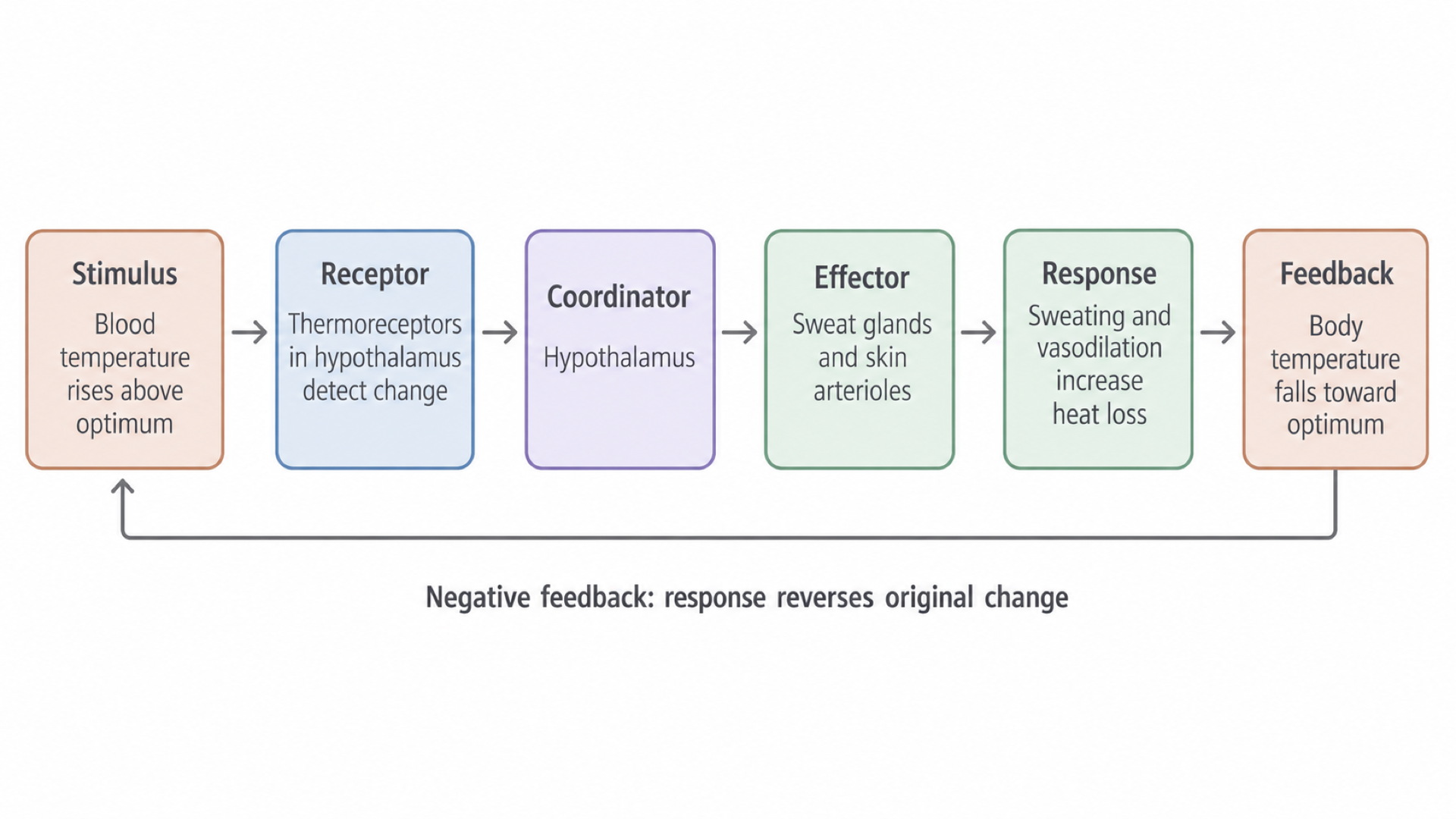
If blood temperature rises, thermoreceptors in the hypothalamus, a region of the brain, detect the change. The hypothalamus is also the coordinator, and it stimulates two effectors in the skin:
- Sweat glands: sweat evaporates, which transfers heat away from the body.
- Skin arterioles: muscle in their walls relaxes, so they widen. This is vasodilation: more warm blood flows near the surface and loses heat.
Read the diagram left to right, then follow the arrow back underneath.
[DIAGRAM: asset_name: 6.4.1 - Principles of homeostasis and negative feedback - Diagram 1; asset_slug: 6.4.1 - Principles of homeostasis and negative feedback - Diagram 1; recommended_method: retained_png; caption: Stimulus -> receptor -> coordinator -> effector -> response -> feedback, with temperature regulation shown as the example.; description: Stimulus -> receptor -> coordinator -> effector -> response -> feedback, with temperature regulation shown as the example.]
Continue this lesson.
You’re previewing NovaLearn without an account. Create a free account to read the rest.
Create free account