3.1.5.2 - DNA replication
A cell copies its DNA before it divides, and each new molecule keeps one old strand. Follow the copying mechanism, track old strands through generations, and see how heavy nitrogen tested the competing models.
Why DNA must be copied
Without copying its DNA first, a cell would give each daughter only part of its genome.
The genome is the cell’s full set of DNA, so each daughter would lack some genetic information, so it could not make all the proteins it needs.
Replication prevents this: each DNA molecule is copied to produce two, so in a normal mitotic division each daughter cell receives a complete genome with the same information as the parent. This preserves genetic continuity, passing the base sequence from one generation of cells to the next.
Replication happens before nuclear division, during the S phase of interphase in eukaryotic cells. Interphase is the period between divisions, and S phase is the part of it when DNA is synthesised. Replication is distinct from transcription, which makes an RNA copy of selected information, and from the later physical separation of chromosomes.
DNA also replicates before meiosis, but not between its two divisions. Meiosis halves the chromosome number by sharing out chromosomes, not by incomplete copying.
Copying is highly accurate, not infallible. A change in base sequence is a mutation, so “produces identical DNA” describes the normal outcome when no copying error occurs.
How semi-conservative replication happens
The bases sit inside the double helix, so no new nucleotide can pair with them until the strands separate.
Copying therefore starts by opening the molecule:
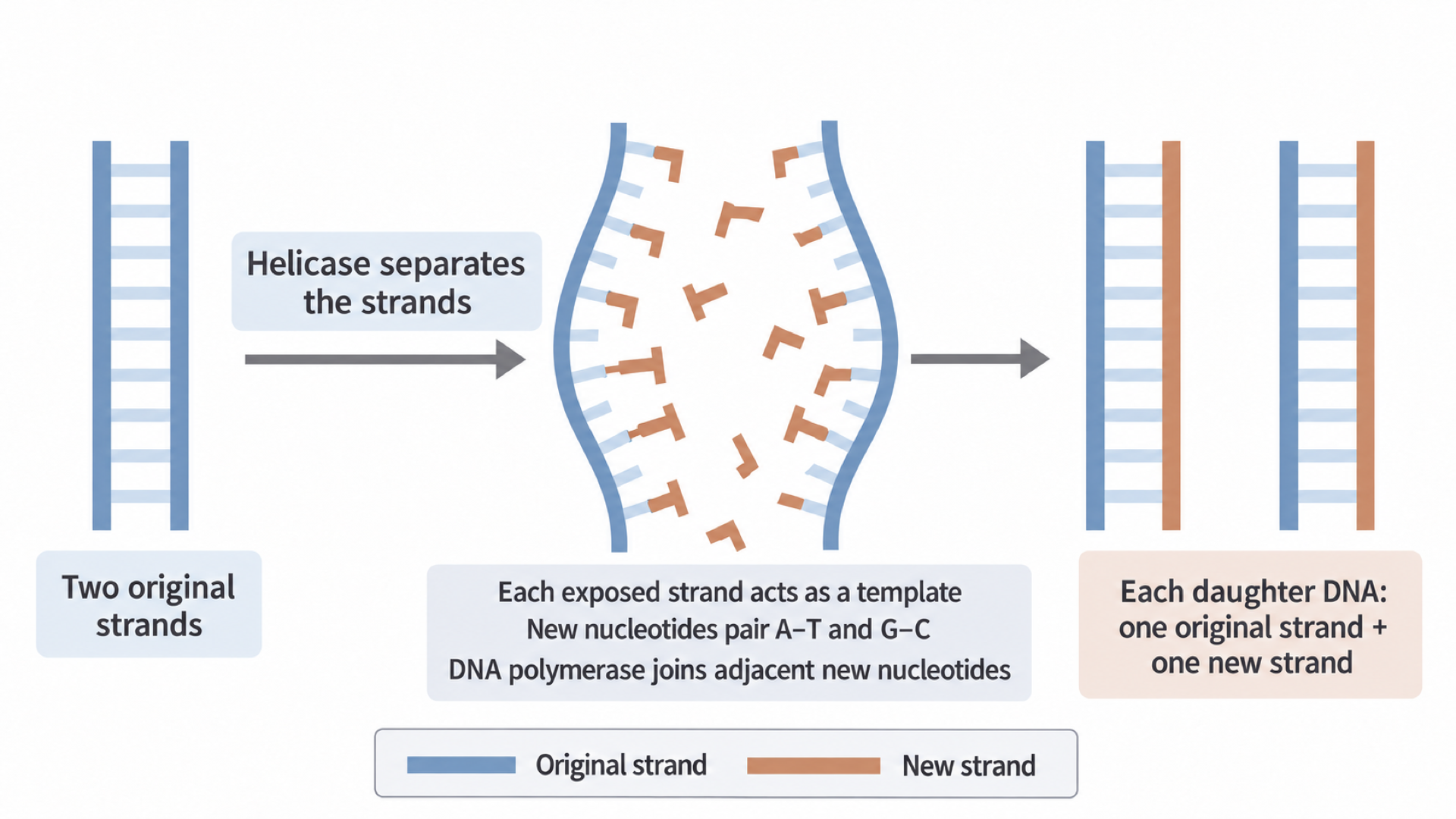
- DNA helicase unwinds the double helix and breaks the hydrogen bonds between complementary bases. The two polynucleotide strands separate, exposing their bases. Helicase does not cut the phosphodiester backbone, so each strand’s sequence stays intact.
- Each exposed strand acts as a template. Free DNA nucleotides are attracted to its exposed bases.
- Nucleotides align with complementary bases: a template A pairs with T, and G pairs with C. Hydrogen bonds between these bases help position each nucleotide, so the template, not chance, determines the new order.
- DNA polymerase catalyses condensation reactions that join adjacent nucleotides, forming phosphodiester bonds in a new sugar–phosphate backbone. Until then, paired nucleotides are held only across the strands, not joined along them.
Watch out
Don’t write that DNA polymerase “joins complementary bases” or “forms hydrogen bonds”: those bonds hold bases together across the strands. Write that it joins adjacent nucleotides along the new strand in a condensation reaction, forming phosphodiester bonds.
Take strands C A T G and G T A C. Opposite the template C A T G, new nucleotides give G T A C, matching the original partner strand. Opposite G T A C, they give C A T G. So both new molecules carry the original sequence, assuming no mutation.
Why it is called semi-conservative
The name records what happens to the old strands: each daughter molecule conserves half of the original.
Semi-conservative replication
Semi-conservative replication produces DNA molecules that each retain one complete original strand and contain one newly synthesised strand.
It does not mean that half the genes are copied, or that each strand is a patchwork of old and new material.
Each conserved strand keeps its base sequence and acts as the template for its new partner, so each daughter has the parent’s sequence. This is how semi-conservative replication ensures genetic continuity between generations of cells.
Follow the diagram from left to right: the blue original strands separate, and each daughter ends with one blue strand and one orange new strand.
Tracking strands through generations
Now suppose one molecule has both strands labelled and all new nucleotides are unlabelled.
- Round 1: the labelled strands separate and each gains an unlabelled partner, giving two molecules with one labelled strand each.
- Round 2: every strand is a template, so each gains a new unlabelled partner, giving four molecules: two with one labelled strand and two with none.
Every round doubles the molecules, but there are still only two original labelled strands. After rounds there are molecules, and two of them contain an original strand.
Watch out
Keep molecules and strands separate. After two rounds, half of the four molecules contain an original strand, but only one-quarter of the eight strands are original.
These counts assume every molecule replicates once per round and labelled material is not recycled.
The Meselson–Stahl experiment
Watson and Crick’s DNA model suggested that complementary strands could act as templates.
Testing that meant telling old strands from new, which the Meselson–Stahl experiment did with nitrogen isotopes.
Telling old DNA from new
- Bacteria were grown for many generations with nitrogen-15, a heavier stable isotope. They used it to make the bases of new DNA nucleotides, so many generations labelled their DNA thoroughly, making it denser than normal.
- They were transferred to a nitrogen-14 medium, so every strand made after transfer was light and could be distinguished from original DNA.
- DNA samples extracted after successive generations were separated by density-gradient centrifugation. DNA settles at a position matching its density, so heavy DNA forms a lower band than light DNA, with intermediate-density DNA between them.
- Known heavy-DNA and light-DNA samples set reference positions, so each band could be identified.
Band position shows density, whereas band amount or intensity shows how much DNA has that density. A band is not a single DNA molecule.
What each model predicted
Three models predicted different bands after transfer, so the results could separate them.
| Model | After one generation in light medium | After two generations |
|---|---|---|
| Conservative: original double helix stays together | Separate heavy and light bands | Heavy and light bands; proportion heavy decreases |
| Semi-conservative: one original strand per first-generation daughter | One intermediate band | Intermediate and light bands |
| Dispersive: both strands contain interspersed old and new material | One intermediate band | One band shifted closer to light as old material is diluted |
| Actual result | One intermediate band | Intermediate and light bands |
Each first-generation molecule in the semi-conservative model is a hybrid: one heavy original strand paired with one new light strand. Its density lies between heavy and light DNA, which is why it forms an intermediate band.
The single intermediate band after one generation contradicts conservative replication. It cannot distinguish semi-conservative from dispersive replication, because both predict it.
The intermediate and light bands after two generations can: semi-conservative replication predicts hybrid and wholly light molecules, whereas the simple dispersive model predicts that every molecule still contains some heavy material.
The diagram shows the idealised semi-conservative result, with percentages for the amount of DNA in each band; drawn thickness is not to scale.
After generation two the bands hold equal amounts of DNA. By generation three, one-quarter of the molecules are hybrid and three-quarters are light, because the same original strands are spread through twice as many molecules.
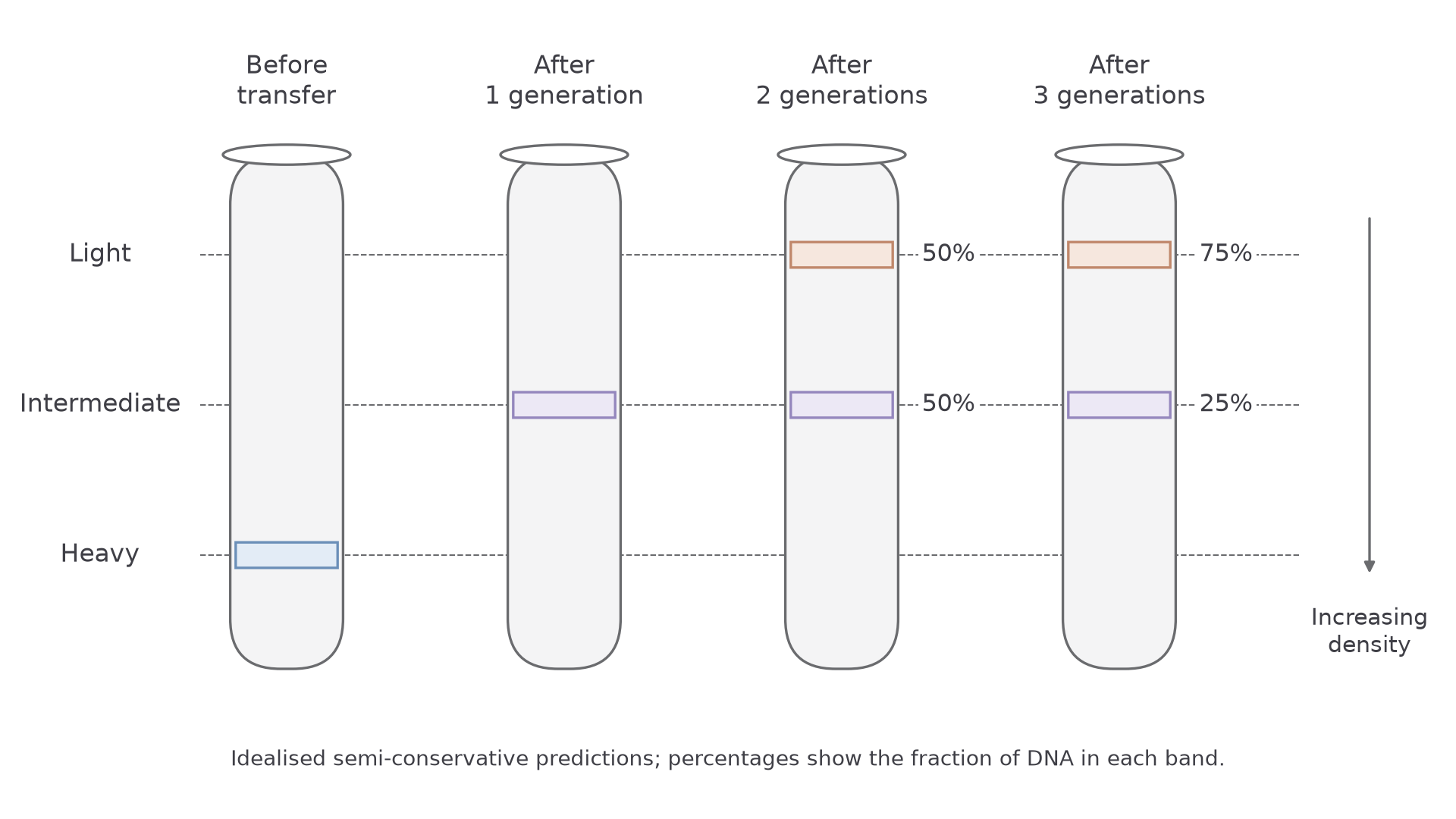
The combined observations strongly support semi-conservative strand inheritance, as Watson and Crick’s template idea predicted. The evidence has limits:
- It does not directly identify helicase or polymerase, or establish every enzyme step.
- It does not prove that copying is error-free.
- It comes from bacteria, so alone it does not show that every organism copies DNA this way.
A strong evaluation connects each observation to the predictions it supports or contradicts, then states what the evidence cannot show.