3.7.3 - Evolution and speciation
Fifteen species of Darwin's finch descend from one ancestor that reached the Galápagos about two million years ago. Follow how variation, selection, chance and barriers to gene flow can turn one species into many.
Variation within populations
Clones can grow to different heights, so a difference in phenotype does not by itself show a difference in alleles.
Individuals in a population of a species can vary widely in phenotype, the expression of their genotype interacting with the environment. That variation has genetic and environmental causes, and many characteristics involve both:
- Environmental: plants of one genotype grow shorter in nitrate-poor soil.
- Both: human height depends on many loci as well as nutrition and health, so a continuous range of heights does not mean genes are unimportant.
Where genetic variation comes from
Mutation, a change in DNA base sequence, is the primary source of genetic variation, because it creates new alleles. It is not directed towards what an organism needs. To reach offspring in a sexually reproducing organism, a mutation must be in cells that form gametes.
Meiosis and random fertilisation add further variation by making new combinations of existing alleles (3.4.3):
- Crossing over in meiosis exchanges sections between non-sister chromatids of homologous chromosomes.
- Independent segregation of homologous pairs gives gametes different chromosome combinations.
- Random fertilisation joins alleles from two gametes, and chance decides which two.
Why heritable variation matters
Selection can cause lasting genetic change only where variation is heritable. A plant that grows taller because it received fertiliser has changed phenotype, but evolution is a change in allele frequency (3.4.4), and none has been shown.
Natural selection and allele frequencies
Alleles spread when their carriers leave more offspring, not merely when they live longer.
Organisms often produce more offspring than can survive and reproduce. Predation, disease and competition for the means of survival (food, water, light, space) or for mates therefore cause differential reproductive success. Natural selection occurs when heritable phenotypic differences affect that success, and a phenotype that raises it gives a selective advantage.
From advantage to gene pool
Rock pocket mice show the chain. Most have sandy fur and live on pale rock, but on dark lava in Arizona, dark fur conceals mice from predators such as owls.
- Variation: random mutation has produced a dark-fur allele alongside the light-fur allele.
- Selection pressure: on lava, owls are more likely to catch light mice, which stand out.
- Differential reproductive success: dark mice are more likely to survive to breed, so they leave more offspring.
- Inheritance: those offspring inherit the favourable allele.
- Allele frequency: the dark-fur allele becomes a greater proportion of the gene pool, generation after generation.
Evolution
Evolution is a change in the allele frequencies in a population.
Individuals are selected; the population evolves.
What selection does not do
Selection acts on variation that already exists: a bacterial resistance mutation can arise before any antibiotic exposure. Bacteria become resistant, not “immune”.
Watch out
“Mutate to adapt” and “mutation caused by selection” lost the mutation mark in AQA's June 2024 mark scheme. Mutation is random. Selection then changes how common the new allele becomes.
Selection also has no universal direction towards “better” organisms. A mutation can be advantageous in one environment and neutral or harmful in another.
A rising allele frequency shows evolution, not its cause. A rising phenotype frequency points to selection only if the phenotype is inherited and its carriers reproduce more. Migration can bring alleles in, genetic drift (chance change, from 3.7.2) can shift them, and the environment can alter phenotype without changing genotype.
Types of selection
Selection can shift a distribution, narrow it or split it in two, depending on which phenotypes leave most offspring.
You met stabilising and directional selection in 3.4.4; disruptive selection is new. Each panel below plots phenotype value against relative frequency of individuals, with grey before selection and blue after. The curves describe the whole population, not the chance that one individual survives.
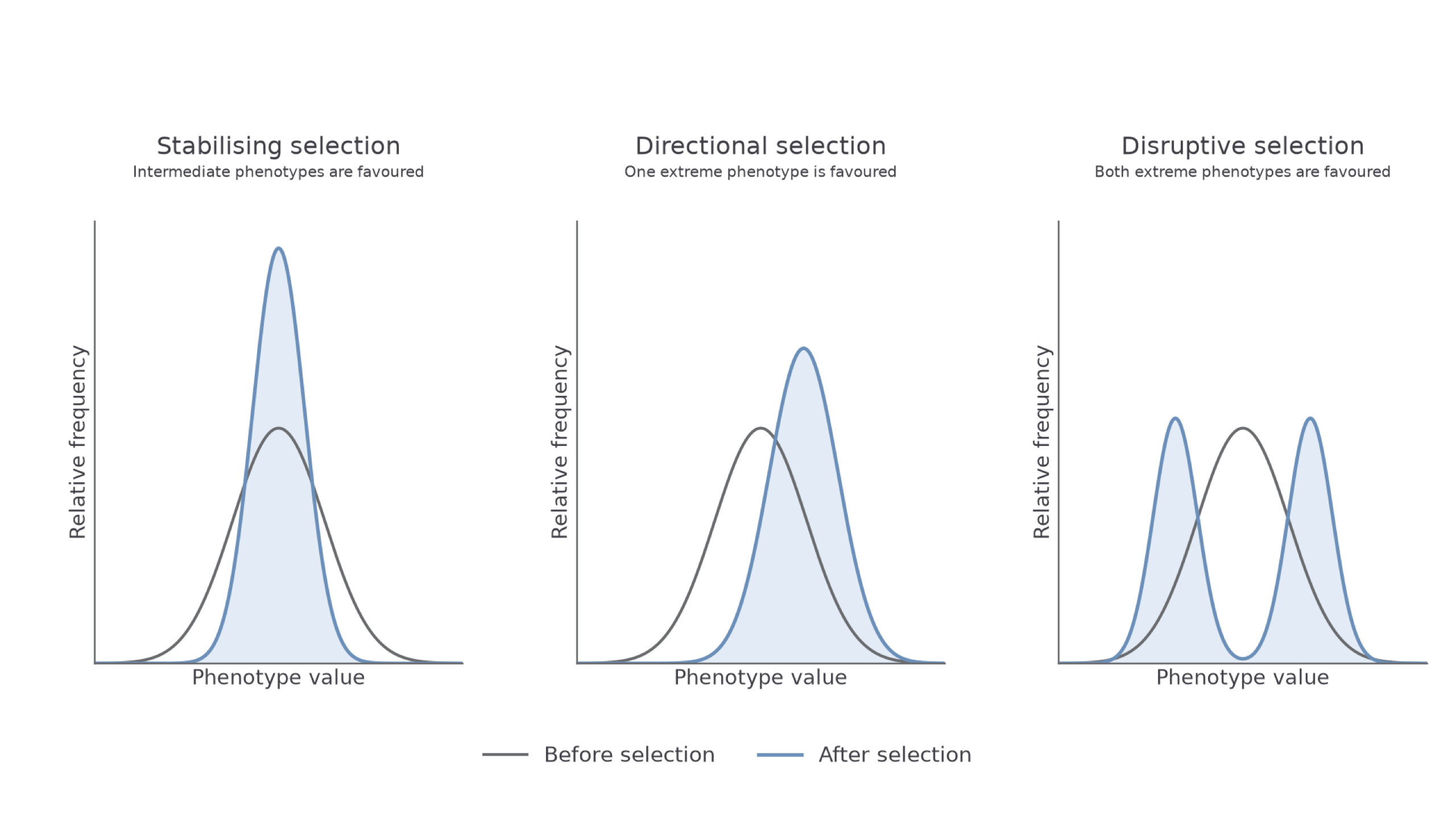
- Stabilising selection favours intermediate phenotypes over both extremes, as with human birth mass. Both tails decline, so the left panel narrows around a similar mean.
- Directional selection favours one extreme. If larger seeds become the main food, birds with larger beaks may feed better and leave more offspring, so alleles for larger beaks become more frequent and the mean rises (centre panel).
- Disruptive selection favours both extremes over intermediates. The intermediate frequency falls and two peaks may develop, as in the right panel.
Two peaks, one species
The black-bellied seedcracker, an African finch, is a textbook case of disruptive selection. Its small-billed and large-billed forms differ in diet and in how well they feed on seeds of different hardness. Yet they breed randomly with respect to bill size, so two peaks do not prove two species.
In disruptive selection the overall mean need not change, so the mean alone can hide a major change in variation. When you interpret a graph, say what has changed: the mean, the spread or the number of peaks.
| Favours | Mean | Shape | |
|---|---|---|---|
| Stabilising | Intermediates | Stays similar | Narrows |
| Directional | One extreme | Shifts towards it | Moves along the axis |
| Disruptive | Both extremes | May stay similar | Two peaks may form |
Cover the table, then sketch all three patterns, labelling phenotype value, relative frequency and the before and after curves.
Allopatric and sympatric speciation
A new species forms when accumulated genetic differences stop two groups producing fertile offspring together.
Speciation is the formation of new species from existing species. For sexually reproducing organisms, populations have become different species when genetic differences prevent their members interbreeding to produce fertile offspring. That inability is reproductive isolation. A change in colour or allele frequency is not enough by itself.
Watch out
When describing a species, “cannot interbreed” is incomplete: horses and donkeys mate, but mules are almost always infertile. Write “cannot interbreed to produce fertile offspring”.
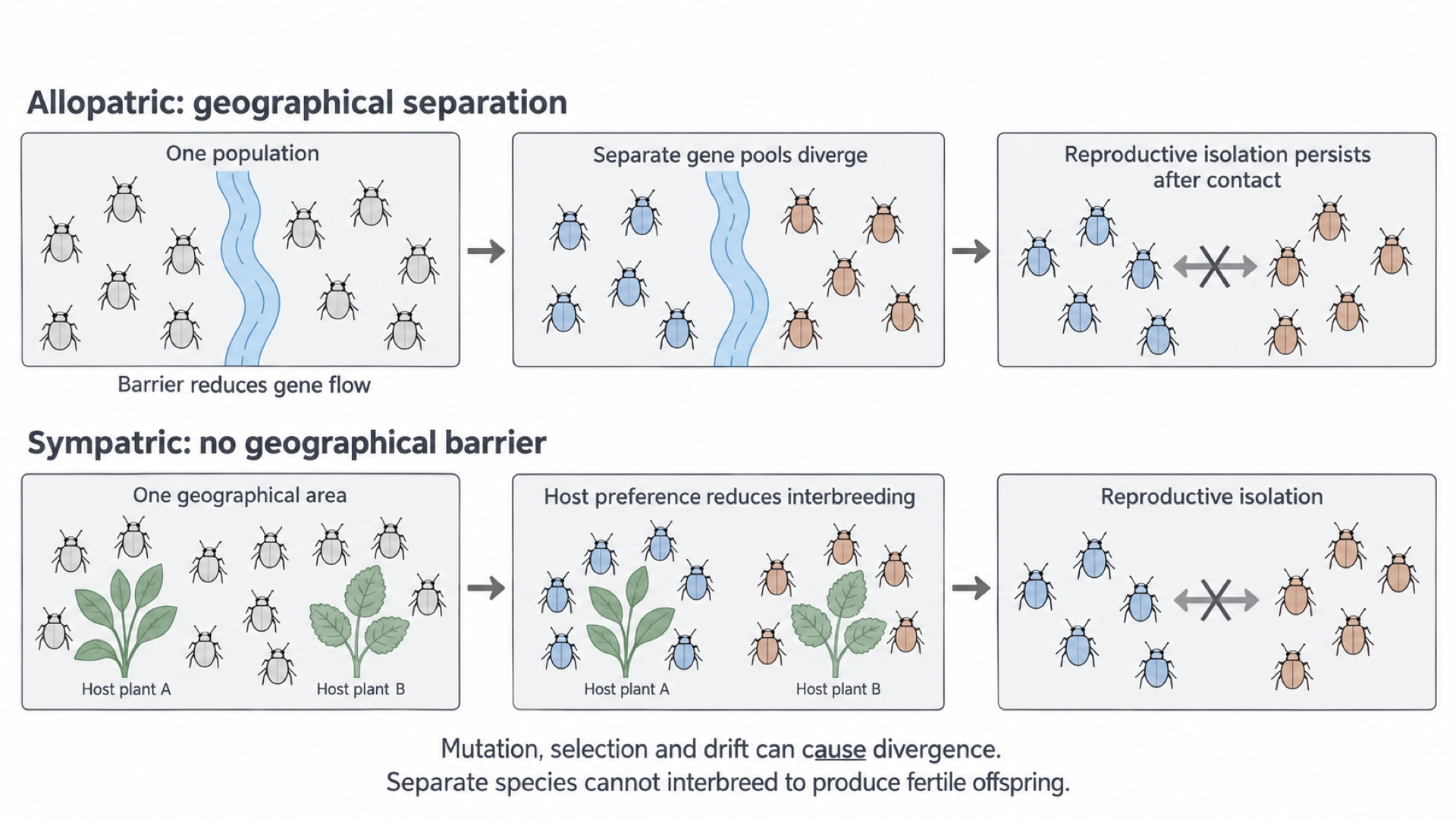
Gene flow, the movement of alleles between interbreeding populations, keeps gene pools similar. Reproductive separation of two populations reduces it, so differences can accumulate in their gene pools. The two routes differ in what first cuts gene flow. Read each row of the diagram from left to right: separation, diverging gene pools, then reproductive isolation.
Allopatric speciation
In allopatric speciation, a geographical barrier such as a new river, mountain range or sea channel separates populations.
- The barrier prevents mating or gamete transfer, so gene flow falls or stops.
- Mutations arise independently, so each gene pool gains different alleles.
- Different environments favour different phenotypes, so selection changes allele frequencies differently, and genetic drift shifts them independently.
- Over many generations these genetic differences accumulate, so allele and phenotype frequencies diverge.
- Eventually behavioural, physiological or genetic differences block fertile offspring, so the groups stay isolated even if the barrier disappears.
Continue this lesson.
You’re previewing NovaLearn without an account. Create a free account to read the rest.
Create free account