3.8.2.1 - Cell specialisation and stem cells
Cells with essentially the same genes do very different jobs. Learn how gene expression causes this, what stem cells can become, and how to weigh stem-cell treatments.
Same genome, different cell types
An insulin-secreting cell and a gut lining cell hold essentially the same DNA, so what makes them different?
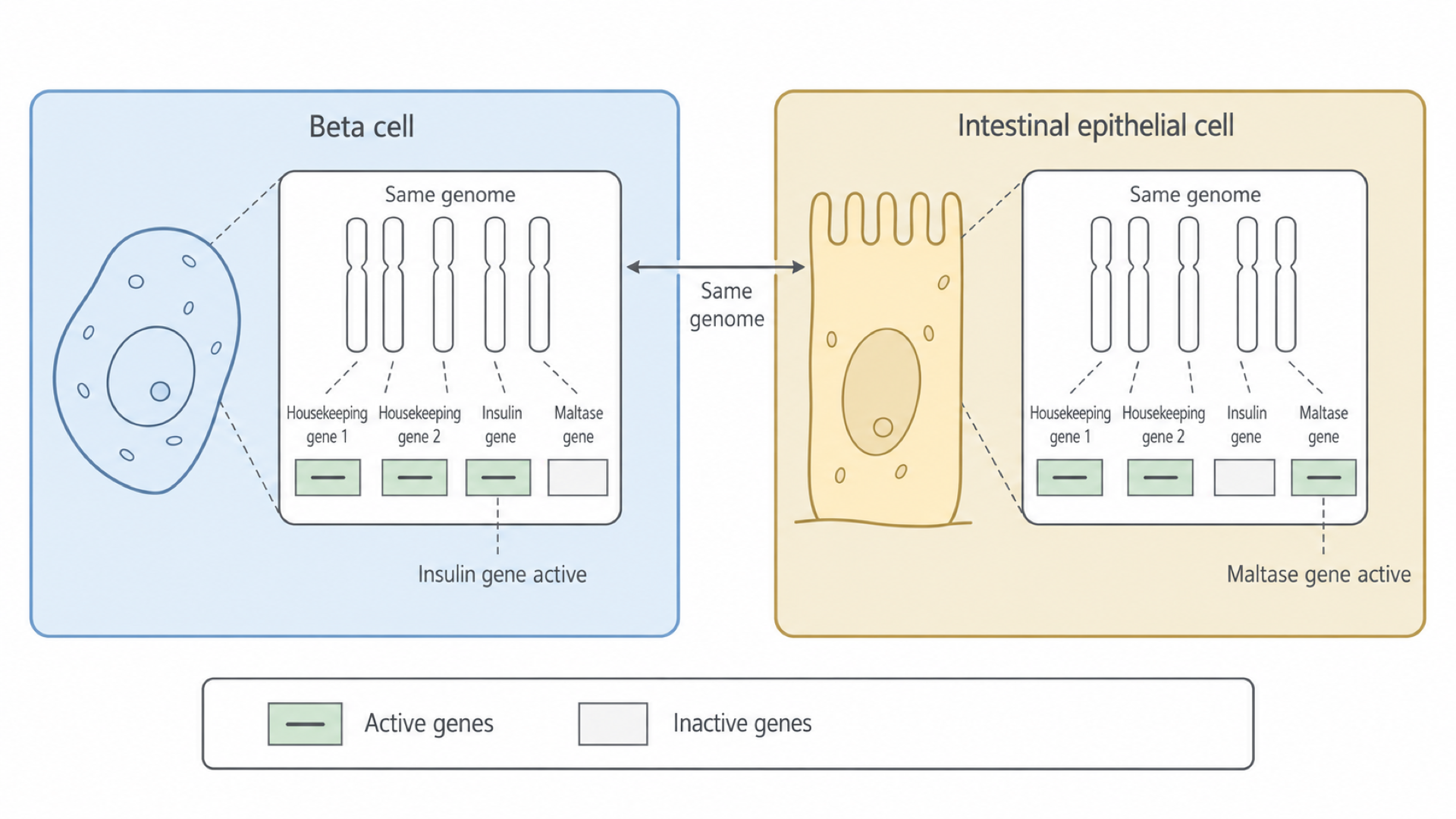
Both descend from the zygote by mitosis, so most nucleated somatic cells (body cells other than gametes) inherit essentially the same genome. A pancreatic beta cell secretes insulin and an intestinal epithelial cell makes maltase through selective gene expression: each uses a different subset of it.
Gene expression uses a gene's information to produce a functional product, usually by transcribing the gene and translating its mRNA into polypeptide.
How expression specialises a cell
During differentiation, cells become specialised:
- Different genes become active or inactive in different cells.
- Active genes are transcribed, so each cell type holds different mRNA.
- That mRNA is translated, giving each cell type different proteins.
- Those proteins produce specialised structures and functions.
In the diagram's white panels, both cells hold the same genes, but the insulin gene is active only in the beta cell and the maltase gene only in the intestinal cell. Housekeeping genes, for processes most cells share, are active in both.
[DIAGRAM: asset_name: 8.2.1 - Most of a cell's DNA is not translated - Diagram 1; asset_slug: 8.2.1 - Most of a cell's DNA is not translated - Diagram 1; recommended_method: local_png; caption: Two schematic nucleated cells with shared genetic information but different gene-expression patterns.; description: Two schematic nucleated cells with shared genetic information but different gene-expression patterns.]
Watch out
AQA's heading, "most of a cell's DNA is not translated", is shorthand for selective use of genes. DNA itself is never translated: ribosomes read mRNA.
Control can act at transcription, preventing an mRNA being made, or at translation, reducing protein production from existing mRNA. Differentiation usually retains the DNA rather than deleting unneeded genes.
Totipotency and why it is lost
The zygote can give rise to a whole organism, but its descendants soon lose that range.
Totipotent
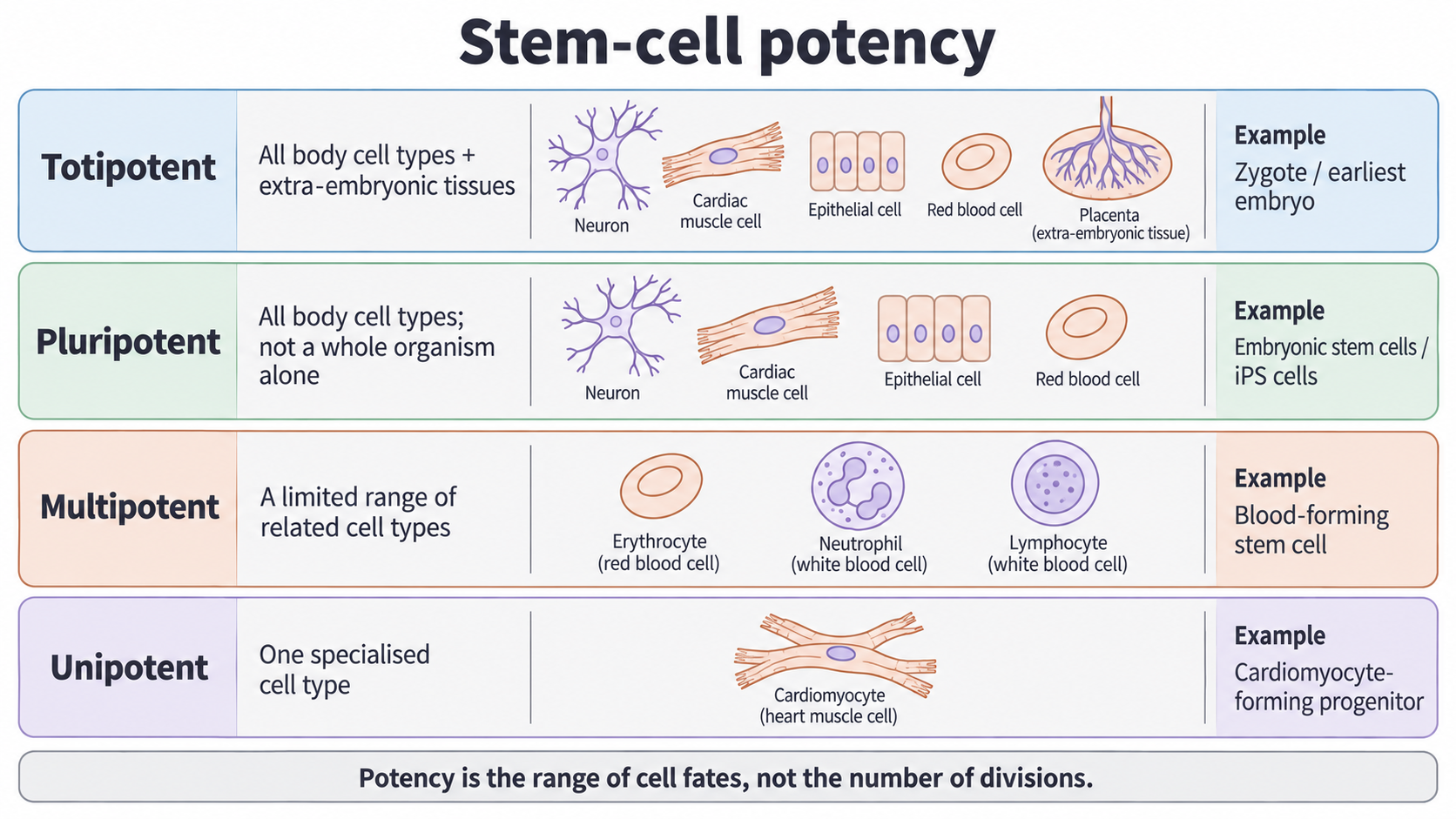
A totipotent cell can divide and produce any type of body cell, plus the extra-embryonic tissues needed for development, including tissues that contribute to the placenta.
The mammalian zygote and cells of the earliest embryo are totipotent, but only for a limited time: the first few days after fertilisation in humans.
Why totipotency is brief
- As the embryo's cells divide, they occupy different positions and receive different signals, which change gene expression.
- In AQA's words, totipotent cells translate only part of their DNA during development. Each cell makes only some proteins and becomes specialised.
- Cells become committed to particular fates, so their range of possible descendants narrows.
So a complete genome alone does not make a cell totipotent. A mature skin cell usually retains the genes for other cell types but does not express them in the combinations needed. The restriction lies largely in regulation, so it can sometimes be reversed.
Four levels of potency
Stem cells differ in what they can become, from every body-cell type down to a single one.
Stem cell
A stem cell can self-renew by division and can produce specialised descendants.
Potency is the range of cell types a cell can form. Self-renewal is a separate property: the continued production of stem cells.
Read the diagram as four separate categories, not one cell's journey. The range narrows going down.
[DIAGRAM: asset_name: stem-cell-potency-v2; asset_slug: stem-cell-potency-v2; recommended_method: local_png; caption: Independent potency categories with correct body, extra-embryonic and lineage-restricted outcomes.; description: Independent potency categories with correct body, extra-embryonic and lineage-restricted outcomes.]
Where each type is found
Pluripotent cells are found in embryos: embryonic stem cells come from inside a human embryo about five days after fertilisation. In suitable culture conditions, pluripotent stem cells can divide in unlimited numbers while retaining pluripotency.
Multipotent and unipotent cells are found in mature mammals and can divide to form a limited number of cell types. Blood-forming stem cells in bone marrow are multipotent: they produce different blood cells.
Unipotent cells are exemplified by the formation of cardiomyocytes, specialised heart muscle cells. The cell that forms them, a progenitor, is unipotent. A mature cardiomyocyte is not a stem cell, and the adult human heart regenerates poorly after injury.
| Potency | Can form | Found in | Example |
|---|---|---|---|
| Totipotent | All body-cell types and extra-embryonic tissues | Earliest embryo | Zygote |
| Pluripotent | All body-cell types, but not a whole organism alone | Embryos | Embryonic stem cells |
| Multipotent | A limited range of related cell types | Mature mammals | Blood-forming stem cells |
| Unipotent | One specialised cell type | Mature mammals | Cardiomyocyte-forming cells |
Cover the table, then compare the last three rows from memory.
Induced pluripotent stem cells
A specialised body cell can be turned back into a stem cell, using a few proteins rather than an embryo.
An adult somatic cell is a non-gamete body cell. Transcription factors are proteins that bind to specific DNA sequences and stimulate or inhibit transcription of target genes.
iPS cell
An induced pluripotent stem cell (iPS cell) is a pluripotent cell produced from an adult somatic cell using appropriate protein transcription factors.
How a somatic cell is reprogrammed
- Introduce the appropriate transcription factors into an adult somatic cell, such as a skin cell, or make the cell produce them.
- They bind target DNA sequences and change gene expression, activating genes that maintain a pluripotent state.
- The cell acquires self-renewal and the ability to form all body-cell types.
What reprogramming shows
The first iPS cells, made from mouse cells in 2006, needed only four transcription factors. These factors cannot supply the genes for every tissue, so those genes must already have been in the somatic cell, retained but not normally used.
Continue this lesson.
You’re previewing NovaLearn without an account. Create a free account to read the rest.
Create free account