RP08 - Dehydrogenase activity in chloroplasts
Measure how a named factor, here light intensity, affects electron transfer in a chloroplast extract, and learn how far that result can be taken.
How DCPIP tracks electron transfer
A blue dye stands in for NADP, so you can watch electrons leaving chlorophyll as a colour change.
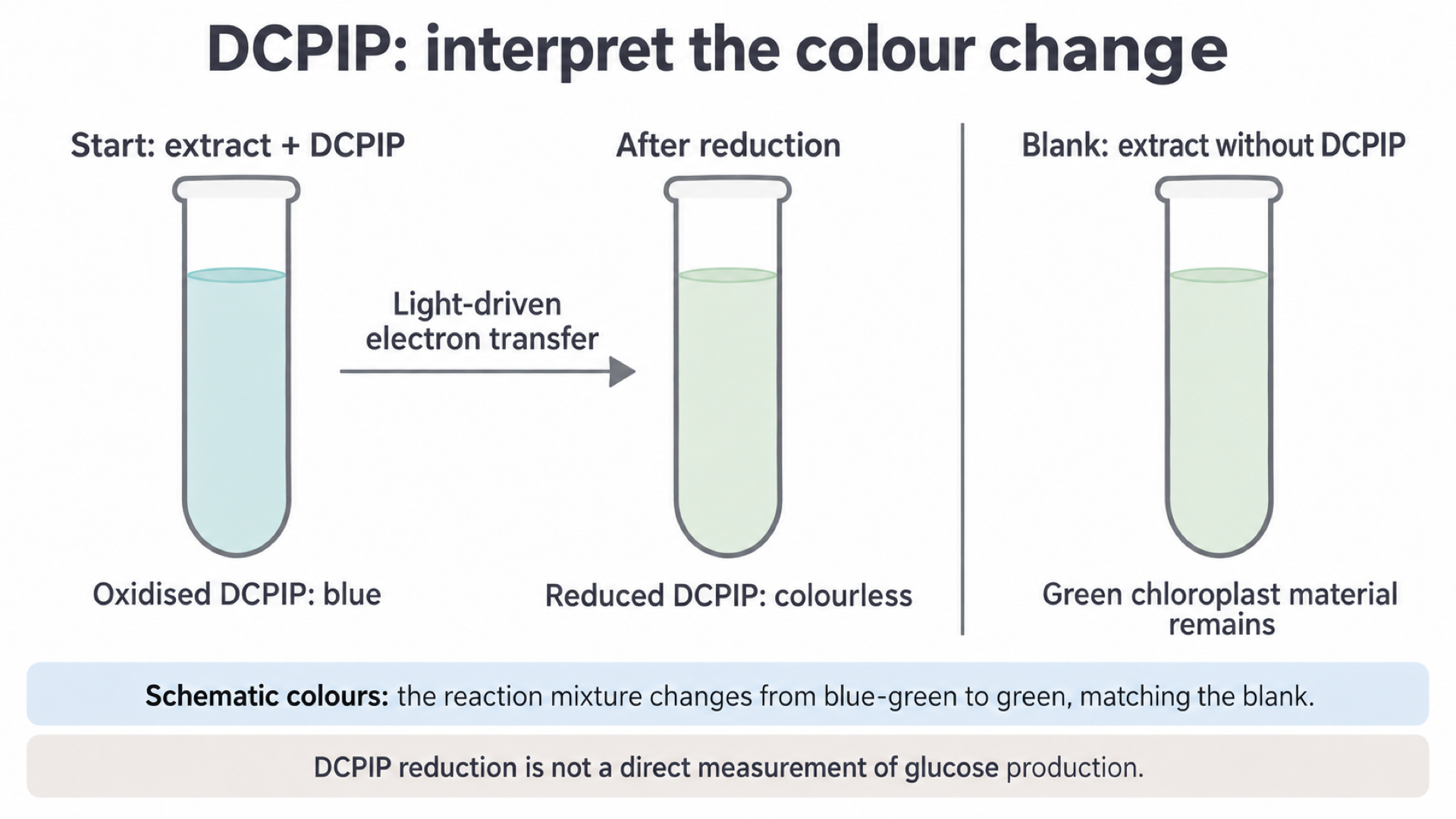
In 3.5.1, light caused photoionisation of chlorophyll, and the released electrons passed along carriers to NADP. DCPIP is an artificial electron acceptor: in a chloroplast extract it takes up those electrons.
Oxidised DCPIP is blue; reduced DCPIP is colourless. Read the diagram from the left: blue dye and green extract look blue-green, reduction removes the blue, and the green stays. So the mixture ends green, matching the blank on the right, which is extract without DCPIP.
[DIAGRAM: asset_name: dcpip-colour-control; asset_slug: dcpip-colour-control; recommended_method: imagegen; caption: Reduction removes the blue DCPIP colour while green chloroplast material remains, matching an extract-only blank.; description: Reduction removes the blue DCPIP colour while green chloroplast material remains, matching an extract-only blank.]
Why this is called dehydrogenase activity
Dehydrogenases catalyse removal of hydrogen in oxidation-reduction reactions: one substance loses hydrogen and electrons, and another gains them. A dehydrogenase catalyses the final transfer of electrons to NADP. DCPIP accepts them in place of NADP, so the faster electrons are released, the faster the blue colour disappears.
Watch out
DCPIP reduction indirectly measures electron transfer. It does not directly measure ATP, carbon dioxide fixation, glucose production or the photosynthetic rate of an intact plant.
With equal DCPIP and the same endpoint, a shorter time indicates faster average reduction. A tube with less dye may finish sooner without any faster biological process.
Making the extract and varying light
Chloroplasts torn from a leaf are fragile, so each preparation step protects their membranes or enzymes.
The electron transfer chain sits in the thylakoid membranes, so damaged membranes pass fewer electrons to DCPIP.
Preparing the extract
- Briefly blend or grind fresh leaves in cold isolation medium, which breaks cells open. Handle the blade only when the blender is disconnected.
- Filter through muslin into a beaker on ice, which removes large debris.
- Keep the extract on ice, and mix it gently before pipetting, because chloroplast material can settle.
The medium protects chloroplasts as in cell fractionation (3.2.1.3):
- Cold slows damaging enzyme reactions.
- Sucrose makes the medium isotonic: it has the same water potential as the chloroplasts, so there is no net osmosis, and the chloroplasts do not swell and burst or shrink.
- A buffer resists pH changes that could alter enzyme activity.
Exam tip
Writing cells instead of organelles can lose marks: a 2024 mark scheme on isolating nuclei rejected the isotonic point when it referred to cells.
Use one fresh batch for a comparison, so extract age is not confused with light intensity.
Varying one named factor
Light intensity is the factor used here; AQA's own example uses ammonium hydroxide, which mimics the effect of weedkiller. For temperature, pH or an inhibitor, the design is the same: change that one variable and keep everything else constant.
- Pipette equal volumes and concentrations of DCPIP and buffer into each tube, so every tube starts with the same amount of dye.
- Hold the tubes at one temperature, checked with a thermometer, in a water bath or in iced water as in AQA's example. Otherwise lamp heat could change enzyme activity.
- Set several light intensities, using a lamp at measured distances or neutral-density filters, which dim the light without changing its colour. Use a light meter at the tube when available, and keep background light and the illuminated area consistent.
- Add an equal volume of extract last, mix in the same way and start timing immediately, so every reaction is timed from the same point.
- Time to a predefined green endpoint, judged against a matched extract without DCPIP, or measure absorbance at fixed intervals.
- Repeat several times with fresh mixtures, because already-reduced dye cannot be reused.
- Randomise treatment order or interleave a standard intensity, so extract deterioration can be detected.
Distance from a point source gives an estimate:
Light intensity and distance
Doubling the distance quarters the intensity. To compare two distances, square their ratio: moving the lamp from 10 cm to 20 cm gives , so 25% of the intensity.
This is an approximation, not a measured intensity: a lamp is not a true point source, background light adds to it, and glass or water absorbs or reflects some light.
Record temperature, light intensity or distance and endpoint time in a table with units in the headings. Wear eye protection, avoid looking directly at the lamp, keep electrical connections dry, and dispose of dye and extract safely.
Continue this lesson.
You’re previewing NovaLearn without an account. Create a free account to read the rest.
Create free account