3.1.3 - Lipids
Why is butter solid when olive oil pours? How can a bird cross the Pacific on stored fat? Lipid structure explains both, as well as how membranes form and how to test for lipid.
Triglycerides
Pour oil into water and the two stay separate.
Lipids have large non-polar regions, which water molecules barely attract. Lipids therefore have low solubility in water, though they dissolve in organic solvents such as ethanol.
You need two groups of lipid in this topic: triglycerides, which store energy, and phospholipids, which build membranes.
Triglyceride
A triglyceride is a lipid made from one molecule of glycerol and three molecules of fatty acid.
A triglyceride forms by condensation, which you met in 3.1.1. Follow the top row of the diagram first.
[DIAGRAM: asset_name: 1.3 - Lipids - Diagram 1; asset_slug: 1.3 - Lipids - Diagram 1; recommended_method: retained_png; caption: glycerol plus three fatty acids forming a triglyceride, with three ester bonds and three water molecules labelled.; description: glycerol plus three fatty acids forming a triglyceride, with three ester bonds and three water molecules labelled.]
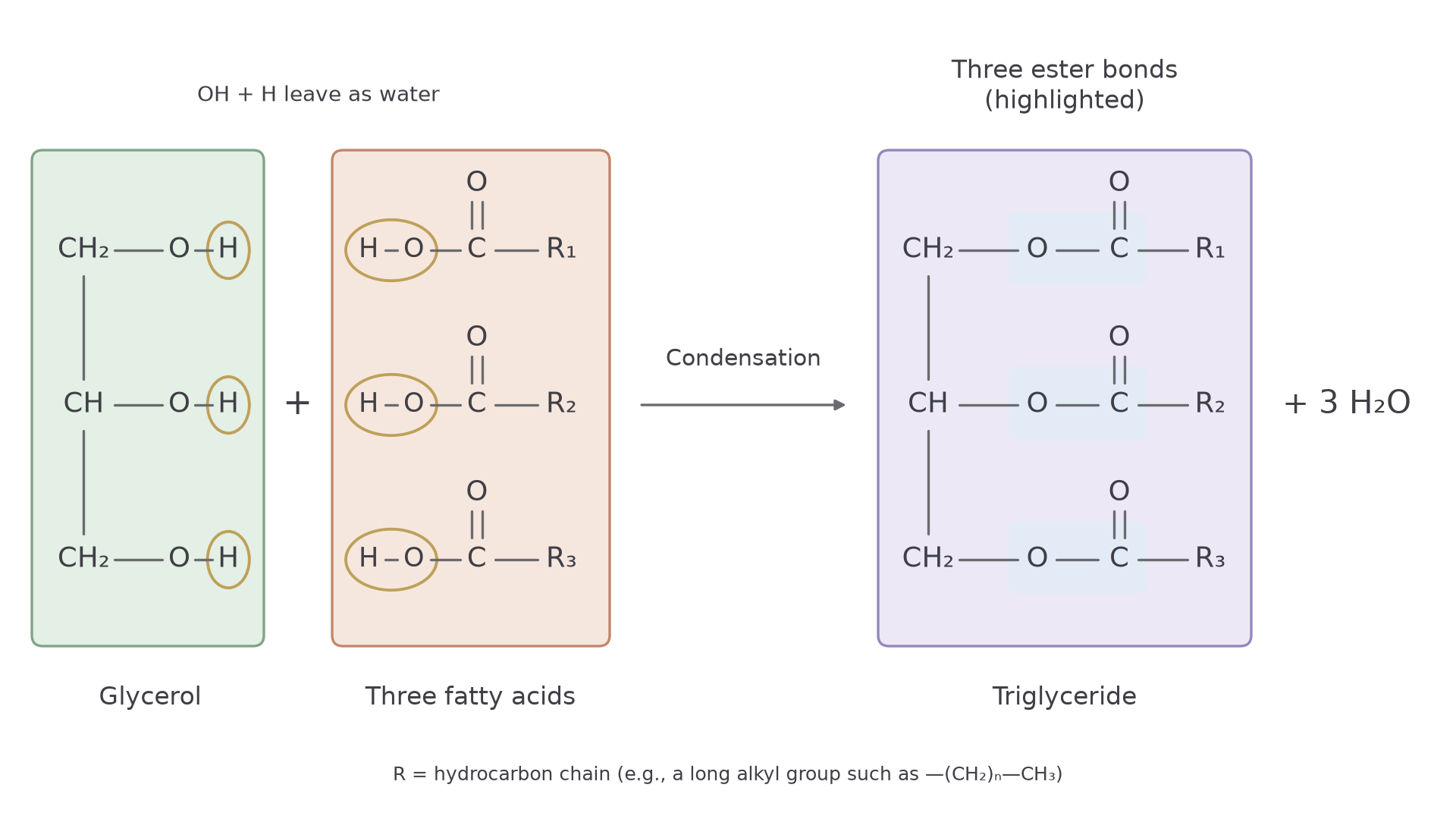
- A hydroxyl group (OH) of glycerol meets the carboxyl group (COOH) of a fatty acid.
- The OH of the carboxyl group and the H of glycerol’s hydroxyl group leave as water.
- The oxygen left on glycerol bonds to the carboxyl carbon. This new link is an ester bond.
Glycerol has three hydroxyl groups, so this happens three times, giving three ester bonds and three water molecules. The R in RCOOH is the fatty acid’s hydrocarbon chain, and the three chains need not be identical.
Watch out
A triglyceride is not a polymer. It is one glycerol joined to three fatty acids, not a long chain of similar repeating units.
Hydrolysis is the reverse: water breaks the ester bonds, releasing glycerol and fatty acids.
Saturated and unsaturated fatty acids
Why is butter solid at room temperature when olive oil pours?
Both are mostly triglycerides, so the difference must lie in their fatty acids. It comes down to the hydrocarbon chain, or R group: does it contain carbon-carbon double bonds?
Saturated and unsaturated fatty acids
A saturated fatty acid has no carbon-carbon double bonds. An unsaturated fatty acid has one or more carbon-carbon double bonds.
A monounsaturated fatty acid has one C=C bond; a polyunsaturated one has more than one.
To identify one from a diagram, look for a C=C bond, as in panel B. Ignore the C=O in the carboxyl group, because every fatty acid has one.
[DIAGRAM: asset_name: 1.3 - Lipids - Diagram 2; asset_slug: 1.3 - Lipids - Diagram 2; recommended_method: retained_png; caption: saturated fatty acid with no C=C bond beside unsaturated fatty acid with a C=C bond and bend in the chain.; description: saturated fatty acid with no C=C bond beside unsaturated fatty acid with a C=C bond and bend in the chain.]
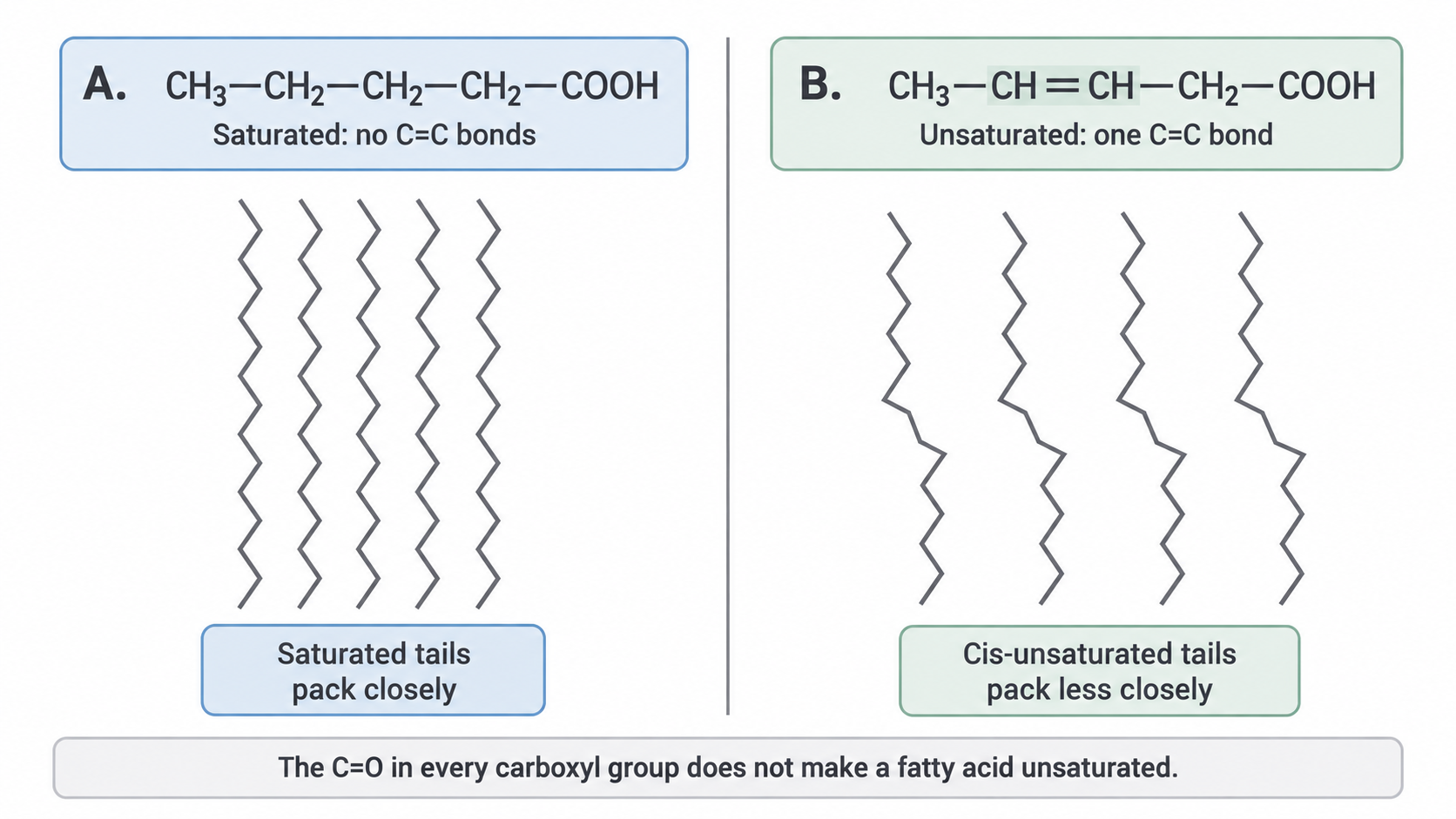
Why shape changes melting point
Now compare the lower sketches. Most natural unsaturated fatty acids have double bonds with cis geometry: the attached carbon chains sit on the same side of the bond, which produces a kink.
The kink decides how closely the chains pack:
- Saturated chains are straight enough to pack closely. Their intermolecular attractions add up, so more energy is needed to separate them and the melting point is higher.
- Cis-unsaturated chains cannot pack as closely. Their collective attractions are weaker, so less energy is needed and the melting point is lower.
So butter, rich in saturated fatty acids, holds its shape, while olive oil, mostly unsaturated, pours.
Triglyceride properties and structure
How can a bird fly from Alaska to New Zealand without stopping to eat or drink?
In 2007 a tracked bar-tailed godwit flew more than 11,000 km in about eight days without stopping. Birds on flights like this run mainly on stored fat, and the structure of triglycerides explains why.
More energy in less mass
The fatty acid chains contain many C–H bonds and relatively little oxygen. They are highly reduced molecules, so oxidising them to carbon dioxide and water releases more energy per unit mass than oxidising carbohydrate. Food labels count fat as 37 kJ per gram and carbohydrate as 17 kJ per gram.
So an animal can carry the same energy in less than half the mass, which matters when it has to move its reserves. That energy comes from the overall reaction, not from breaking bonds: breaking any chemical bond requires energy.
Storage without a water problem
Triglycerides are non-polar and insoluble, so they gather as lipid droplets rather than many dissolved solute particles. Storing them therefore does not directly lower water potential, as storing a comparable number of small soluble molecules would.
They also lack the large mass of water that hydrated carbohydrate stores carry. Their oxidation even releases water, a useful extra for a bird that cannot stop to drink.
In an exam, follow each property with why it helps. “Insoluble” earns one mark; “insoluble, so it does not affect water potential” earns two.
Phospholipids and bilayers
Why do phospholipids build membranes when triglycerides only form droplets?
One change to the structure makes the difference.
Phospholipid
A phospholipid is a lipid in which one of the fatty acids of a triglyceride is replaced by a phosphate-containing group.
That swap gives the molecule two regions with opposite attractions to water:
- The head contains a charged phosphate group, which attracts polar water molecules. It is hydrophilic.
- The two tails are non-polar hydrocarbon chains, which barely attract water. They are hydrophobic.
A molecule with both regions is described as amphipathic.
Forming a bilayer
Put many phospholipids in water. Water molecules attract the heads and each other far more strongly than the tails, so the tails end up grouped together, away from the water. The result is two layers back to back, with heads facing the aqueous environments on either side and tails facing inward.
[DIAGRAM: asset_name: 1.3 - Lipids - Diagram 3; asset_slug: 1.3 - Lipids - Diagram 3; recommended_method: retained_png; caption: phospholipid bilayer with hydrophilic heads facing outward and hydrophobic tails facing inward.; description: phospholipid bilayer with hydrophilic heads facing outward and hydrophobic tails facing inward.]
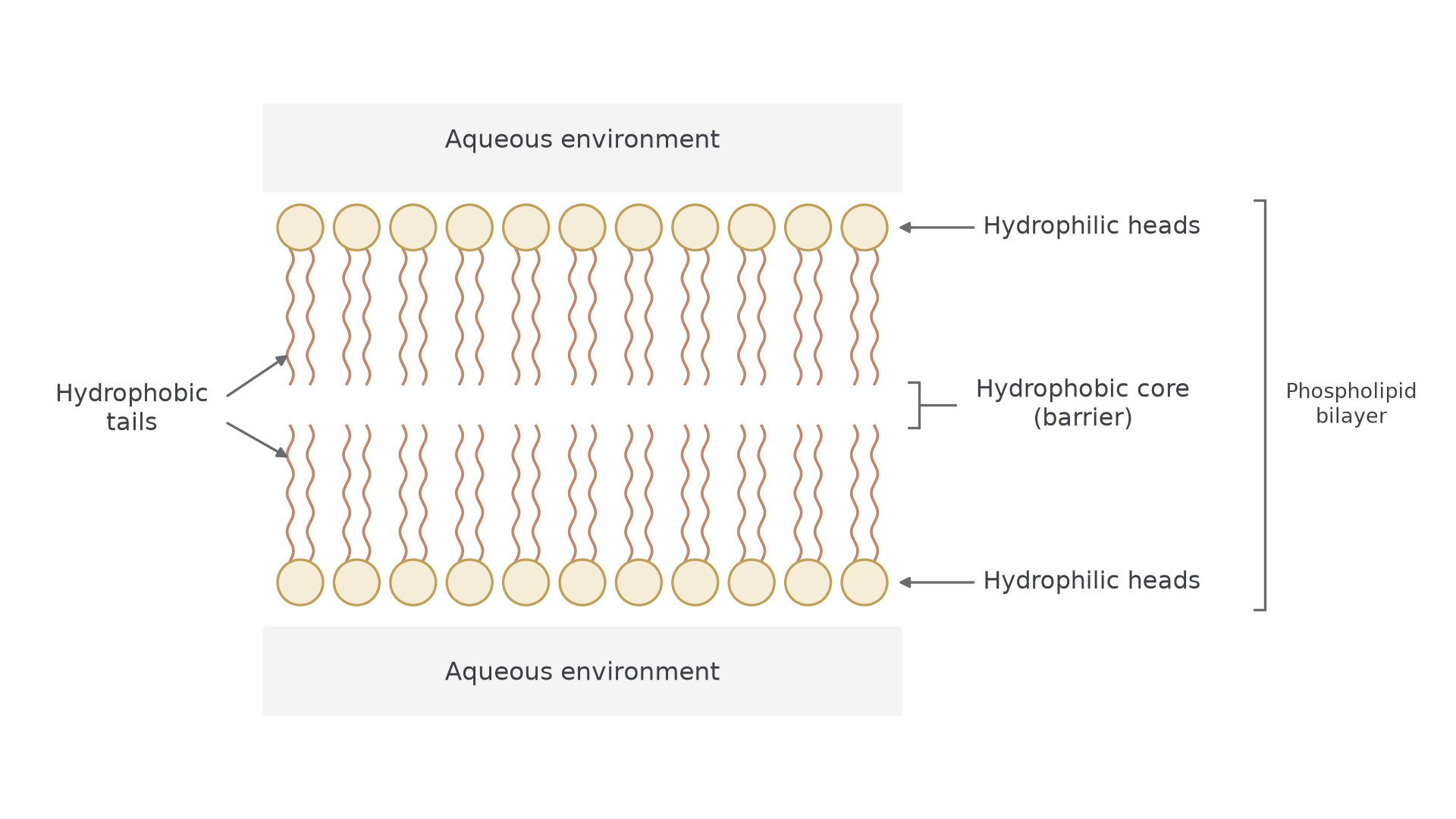
This bilayer forms cell-surface and organelle membranes, and its structure explains how they behave:
- The hydrophobic centre is a barrier that slows the movement of water-soluble substances and ions.
- The hydrophilic heads help the membrane interact with watery cytoplasm and tissue fluid.
- The kinks matter here too: cis-unsaturated tails pack less closely than saturated tails, so a bilayer rich in them is more fluid, with phospholipids moving more easily.
A triglyceride has no strongly hydrophilic region comparable to a phospholipid head, so no part of it is strongly attracted to water. Triglycerides therefore collect into droplets rather than forming a stable bilayer.
| Triglyceride | Phospholipid | |
|---|---|---|
| Built from | Glycerol and three fatty acids | Glycerol, two fatty acids and a phosphate-containing group |
| Hydrophilic head? | No | Yes |
| In water | Collects into droplets | Forms a bilayer |
| Main role | Energy storage | Membranes |
Cover the table, then explain the difference from memory.
The emulsion test for lipids
The emulsion test shows whether a food contains lipid.
It uses two facts you already know: lipid dissolves in ethanol but barely dissolves in water. So you dissolve any lipid in ethanol, then add that extract to water.
Method
- Place a small food sample in a dry, grease-free test tube. Crush a solid sample if needed.
- Add ethanol and shake thoroughly to dissolve any lipid. Allow solids to settle or filter, so solid debris is not mistaken for an emulsion.
- Pour some clear ethanol extract into water in a clean tube and mix gently.
When comparing samples, use the same sample mass and reagent volumes. Keep ethanol away from flames because it is flammable, and wear eye protection.
Watch out
A common error is to add water to the food first. Lipid has very low solubility in water, so it is not extracted and the test can miss it. Dissolve the sample in ethanol first, then mix with water.
Reading the result
If lipid is present, a cloudy white emulsion forms. If no lipid is present, the mixture stays clear.
The cloudiness is not a new white solid from a chemical reaction. It is the lipid itself: with very low solubility in the water-rich mixture, it disperses as tiny droplets that scatter light.
Emulsion
An emulsion is a mixture of tiny droplets of one liquid spread through another liquid. For example, milk is an emulsion of fat droplets in water.
A negative control follows the same ethanol-to-water sequence with no food sample and should stay clear. A positive control uses a known lipid such as a small oil sample and should turn cloudy, confirming that the method works.
The test is qualitative: it shows whether lipid is present, but different degrees of cloudiness alone do not give reliable lipid concentrations.