3.7.1 - Inheritance
How can two green-podded pea plants produce a yellow-podded offspring? Follow alleles from parents through gametes to offspring, and you can predict the ratios of a cross or work backwards from them.
Genes, alleles, genotype and phenotype
A pea plant with green pods may still carry the allele for yellow pods, and these terms explain how.
A gene is a DNA base sequence coding for a polypeptide or functional RNA. Alleles are different versions of a gene. They occupy the same locus (position) on homologous chromosomes, the matching pair inherited from the two parents.
So a diploid individual normally has two alleles at an autosomal locus (a position on any chromosome other than a sex chromosome), one on each homologue. A gamete has only one, because meiosis separates the homologous chromosomes. Follow one pair, and , from left to right.
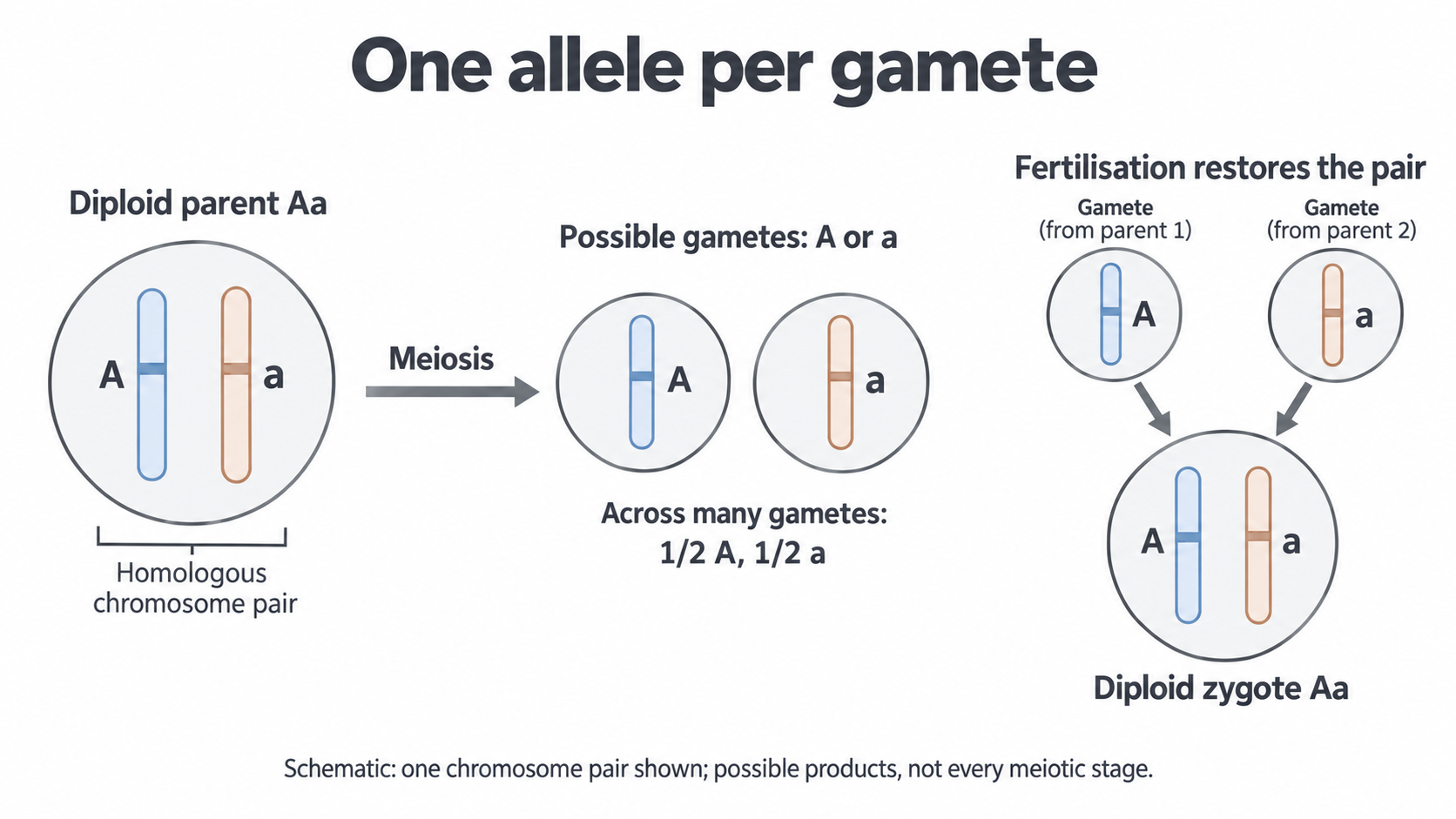
The two alleles separating into different gametes is called segregation. Each allele of the pair therefore has probability of entering a gamete, and fertilisation restores the pair.
Genotype and phenotype
Genotype and phenotype
The genotype is an organism's genetic constitution. The phenotype is the expression of that constitution in interaction with the environment.
For a cross, write only the alleles being considered, such as . Genetically identical plants can differ in height if one receives less light, so a visible difference does not, by itself, prove a genetic difference.
In an exam, "the appearance of a characteristic" alone can earn nothing: link it to the genotype and the environment.
Dominant, recessive and codominant alleles
Homozygous means two identical alleles at a locus, such as or ; heterozygous means two different alleles, . A heterozygote reveals how its alleles behave:
- Complete dominance: the dominant allele determines the heterozygote's phenotype. The recessive phenotype occurs only without a dominant allele at that locus.
- Codominance: both alleles are expressed in the heterozygote. Neither is recessive, so neither gets a lower-case letter; superscripts such as and show this.
Dominant does not mean common, beneficial, stronger or more likely to be inherited. It describes the heterozygote's phenotype only: in , the allele is as likely to enter a gamete as .
Multiple alleles means more than two allele versions occur in the population, though a diploid individual still has two at that locus.
Monohybrid crosses and test crosses
Follow one gene through two generations and the recessive phenotype disappears, then returns.
A genetic diagram tracks alleles from parental phenotype through genotype and gametes to offspring genotype and phenotype. It works in two directions: predict the offspring of a known cross, or interpret observed offspring to work out the parents. A Punnett square is only the fertilisation stage, not the whole explanation.
Exam tip
Don't stop at the ratio. AQA's 2024 genetic diagram question gave separate marks for the parental genotypes, the offspring genotypes, and the phenotypes with their ratio, so a square or a ratio alone can lose marks. Use the symbols the question gives you; if it gives none, state your key.
From pure-breeding parents to a segregating generation
A monohybrid cross follows one locus. A pure-breeding organism is homozygous at that locus, so it makes only one type of gamete. Bred with another like it, it gives offspring with the same feature.
Crossing two pure-breeding parents gives the (first filial generation). Crossing two plants gives the (second filial generation), called a segregating generation because the alleles separate again and both parental phenotypes reappear.
Worked example: a fully labelled genetic diagram
Question. Pure-breeding green-podded plants are crossed with pure-breeding yellow-podded plants, and two of the all-green plants are then crossed. Show this in a fully labelled genetic diagram and predict the phenotype ratio.
Plan. State a key, then work down one labelled line at a time: phenotype, genotype, gametes, offspring.
| Label | What you write | Reason |
|---|---|---|
| Key | = green pods, = yellow pods | Green shows in the , so the green allele is dominant and takes the capital letter |
| Parental phenotypes | green × yellow | These are the features you are given |
| Parental genotypes | Pure-breeding means homozygous | |
| Gametes | and | Each homozygous parent has only one type of allele to pass on |
| genotype | all | Each offspring receives one allele from each parent |
| phenotype | all green | is dominant, so is present but not expressed |
| cross | green × green, | Two plants are now the parents |
| gametes | or from each parent | Meiosis puts one allele of the pair into each gamete |
Fertilisation. Each cell combines one gamete from each parent.
| Gametes | from parent 2 | from parent 2 |
|---|---|---|
| from parent 1 | , green | , green |
| from parent 1 | , green | , yellow |
Answer. The genotypes are . and are green and only is yellow, so the predicted phenotype ratio is 3 green : 1 yellow. Yellow disappears in the and returns in the because needs a allele from both parents.
Check. The ratio adds up to 4, matching the four cells of the square, and every offspring has two alleles at this locus, one from each parent.
Read a cross backwards to find the dominant allele. If two parents with the same phenotype have an offspring with a different one, both carry an allele they do not show: both are heterozygous, and the hidden allele is recessive.
Parents sharing a recessive phenotype are homozygous, so they can pass on only that allele.
Turning a ratio into probabilities
A ratio is a set of probabilities. The 3 : 1 ratio has 4 parts, so the chance of green is and of yellow . Each cell of the square is a probability of , not a promise that four offspring include one of every cell.
To predict a count, multiply the probability by the total. Of Mendel's 580 pea plants, predicts 435 green; he counted 428 green and 152 yellow. Fertilisation is random, so real counts sit close to a ratio rather than exactly on it.
Successive fertilisations are independent in this model, which gives two rules:
- Multiply when one independent event and another must both happen. The probability of two yellow offspring is .
- Add when mutually exclusive routes lead to one outcome. Exactly one yellow in two offspring can come in either order: .
Revealing an unknown genotype
A green plant could be or , and looking at it cannot say which. A test cross pairs an individual showing the dominant phenotype with a homozygous recessive individual. This tester can only supply , which cannot mask anything, so each offspring's phenotype shows which allele it received from the unknown parent.
- If the unknown parent is , every offspring is green .
- If it is , its and gametes combine with the tester's , predicting 1 green : 1 yellow .
A yellow offspring establishes that the unknown parent carried . All-green offspring only support , because a small family could be all green by chance: six green offspring from the heterozygote test cross has probability .
In an answer, name the cross, then state what each result would show. AQA's 2024 examiners saw students give the right cross but not explain how the offspring reveal the genotype.
Continue this lesson.
You’re previewing NovaLearn without an account. Create a free account to read the rest.
Create free account