5.3 - Combining events
Two fair dice have eleven possible totals, but those totals are not equally likely. In this first part of 5.3, you will count equally likely elementary outcomes, combine alternatives without double counting, and distinguish independent events from mutually exclusive events.
Equally likely outcomes
Is a total of as likely as a total of when two fair dice are thrown independently? A total of requires , while a total of can be made in several ways. Listing totals alone hides this difference.
Record an elementary outcome as , where is the first die's score and the second die's score. There are equally likely ordered pairs. For example, and are different outcomes, although both have total .
Sample space and event
The sample space is the set of all possible elementary outcomes of an experiment. An event is a set of these outcomes. The probability of an event lies between and , inclusive: for an impossible event and for a certain event.
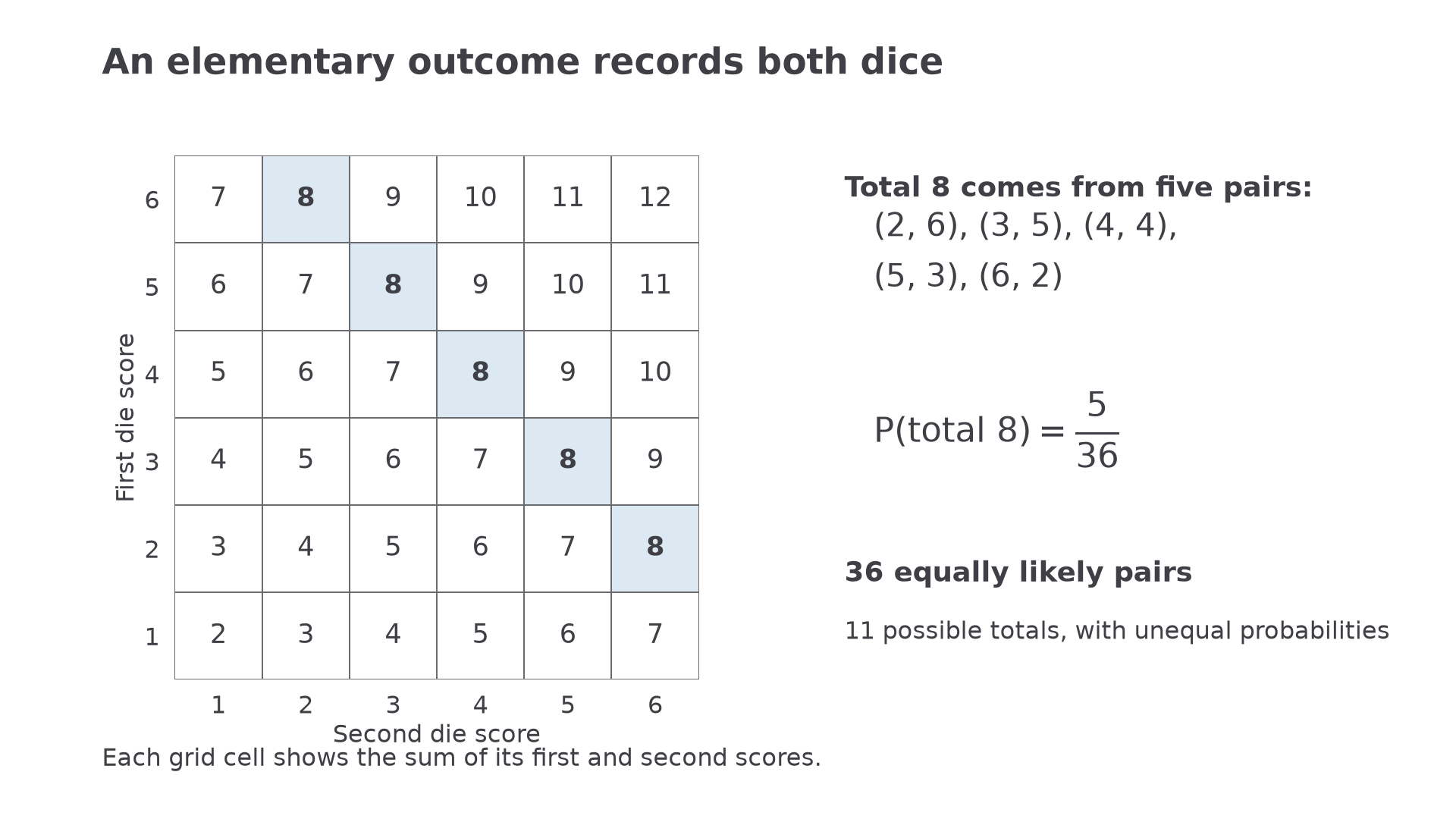
The grid keeps the two scores separate. Its cells are equally likely; the totals written inside them are not.
[DIAGRAM: asset_name: Two-dice elementary outcomes; asset_slug: probability-dice-outcomes; caption: Five of the 36 equally likely ordered pairs give a total of 8; description: A six by six grid records first die score on the vertical axis and second die score on the horizontal axis. Each cell shows the sum of its two scores. The five cells with total 8 are highlighted: first and second scores 2 and 6, 3 and 5, 4 and 4, 5 and 3, 6 and 2. A note distinguishes the 36 equally likely pairs from the eleven unequal-probability totals.]
Counting equally likely outcomes
If a finite sample space contains equally likely elementary outcomes, and of them belong to event , then
The equal-likelihood condition is essential.
Not in the formula booklet: learn it.
For a biased die, counting favourable faces and dividing by six would generally be wrong. The probabilities of the faces would have to be supplied or modelled.
Worked example 1: a total of eight
Question. Two fair dice are thrown independently. Find the probability that their total is .
Plan. Count the ordered pairs with the required total out of all pairs.
The favourable pairs are
Answer. .
Check. The first score can be any of , and each has exactly one matching second score. This confirms five favourable cells.
Change only the required total. Keeping the same sample space makes the probability comparison immediate.
Worked example 2: a total of nine
Question. The same two dice are thrown. Find the probability that their total is .
Plan. Find the ordered pairs with sum in the same -outcome space.
The favourable pairs are
Answer. .
Check. Reflecting the five sum- pairs by replacing each score with gives the five sum- pairs. Sum instead matches sum , which has four pairs: . The different counts confirm that totals cannot all have probability .
For a random selection of objects without replacement, unordered selections can give an equally likely sample space too. Distinguish the physical objects even when some share a colour: two different red balls are still two different balls.
Worked example 3: an unordered ball selection
Question. A bag contains three red and two blue balls. Two balls are selected at random without replacement. Find the probability of selecting one of each colour.
Plan. Count equally likely pairs of distinct balls, then count the pairs with one red and one blue.
Answer. .
Check. Label the balls . Each of the three red balls makes two favourable pairs, giving six. The other four pairs are three red-red pairs and one blue-blue pair, accounting for all ten.
Change only the replacement rule. If the first ball is returned and the bag mixed before the second draw, the same physical ball can appear twice. Ordered draw pairs are now a convenient equally likely sample space.
Worked example 4: returning the first ball
Question. From the same bag, select a ball at random, replace it, mix the bag and select again. Find the probability of one ball of each colour.
Plan. Count the ordered physical-ball pairs, including repeats.
There are red-blue pairs and blue-red pairs. These are disjoint outcomes.
Answer. .
Check. The remaining ordered pairs are red-red and blue-blue. The counts exhaust the sample space.
With replacement, an unordered pair containing one particular ball twice is not as likely as an unordered pair of two different balls: the latter can occur in two orders. Using ordered elementary outcomes avoids that trap.
Watch out
Red-red, red-blue and blue-blue are possible colour descriptions without replacement, but they are not three equally likely elementary outcomes. Count labelled objects first, or justify the probabilities by another valid method.
Use combinations for a new selection without replacement.
Adding alternatives
“Event A or event B” normally includes outcomes where both occur. You can add the probabilities directly only when the two events have no outcomes in common. Otherwise separate the shared outcomes so that they are counted once.
Union, intersection and complement
, the union, means A or B or both. , the intersection, means both A and B. , the complement of A, means A does not occur. Events are mutually exclusive if they have no outcomes in common.
For example, one card cannot simultaneously show an even number and an odd number. Those events are mutually exclusive. A card can show both an even number and a multiple of three, such as ; those events overlap.
Disjoint alternatives and complements
For mutually exclusive events A and B,
For any event A,
Not in the formula booklet: learn the counting reasoning.
The same addition principle applies to any finite list of disjoint alternatives. The complement is useful for “at least one”: remove the case “none”, rather than adding many possibilities.
Continue this lesson.
You’re previewing NovaLearn without an account. Create a free account to read the rest.
Create free account