4.5 - Work and energy
A force can act on a moving body yet do no work, or do negative work by opposing its displacement. You will calculate work using the force component along a displacement, find kinetic and gravitational potential energies, and build energy balances that include driving forces and resistance. Choose one consistent way to account for gravity.
Work by a constant force
A rope pulls a box partly upwards as the box moves horizontally. Does only a horizontal pull do work? The rope does work through its horizontal component; the vertical component has no displacement in its direction.
For a pull at above a rightward displacement, the component along the displacement is . Its work is .
Work done by a force
Work measures energy transferred by a force as its point of application moves. For a constant force and a straight displacement, multiply the displacement by the force component in that direction. One joule, , is .
Resolving the force along the displacement turns an angled work calculation into force times distance.
Work by a constant force
where is force magnitude, is displacement magnitude and is the angle between the force and the displacement. The sign of gives the work sign.
Not in the formula booklet: learn it.
If the force has a component in the same direction as the displacement, work is positive. If it opposes the displacement, work is negative. A perpendicular force does zero work; so does any force whose point of application has no displacement. Magnitudes and are non-negative: the angle already handles direction.
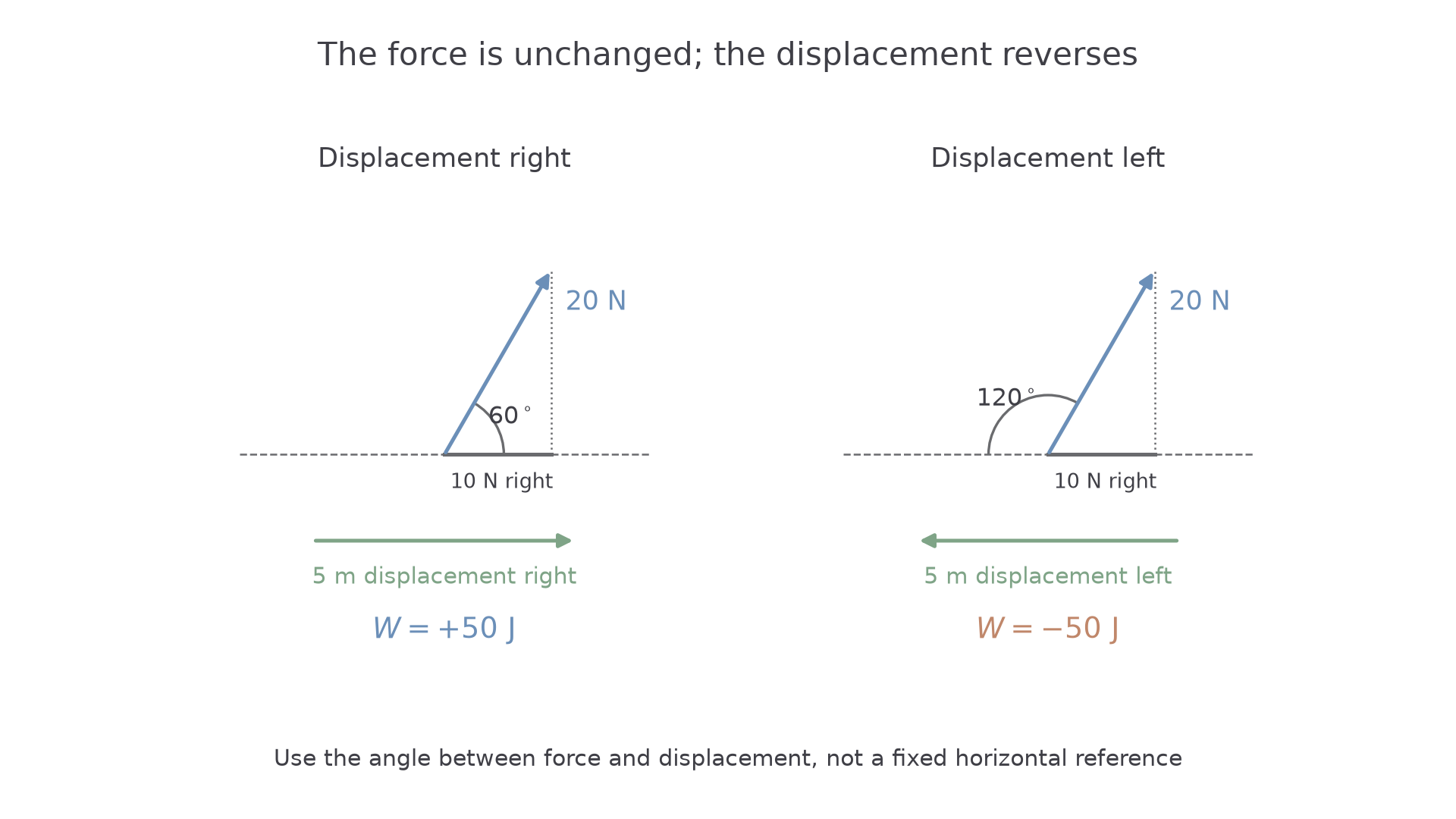
[DIAGRAM: asset_name: Work follows the displacement direction; asset_slug: work-force-angle; caption: Reversing the displacement reverses the work of the same force; description: Two panels show the same 20 newton force at 60 degrees above the rightward horizontal, with a horizontal component of 10 newtons right. In the left panel the displacement is 5 metres right, the angle to the force is 60 degrees, and work is plus 50 joules. In the right panel the displacement is 5 metres left, the angle to the force is 120 degrees, and work is minus 50 joules. The displacement arrows are separate from the force arrows.]
Worked example 1: a force helps the displacement
Question. A constant force of acts above the rightward horizontal. Its point of application moves horizontally right. Find the work done by the force.
Plan. Use the angle between the force and the rightward displacement.
Answer. The force does of positive work.
Check. Its horizontal component is , so component times displacement is . Its vertical component contributes zero work.
Reverse only the displacement. The force arrow stays fixed, but the angle in the work formula changes.
Worked example 2: the same force opposes the displacement
Question. The same constant force acts above the rightward horizontal, but its point of application moves horizontally left. Find its work.
Plan. The angle between the force and the leftward displacement is .
Answer. Work done by the force is .
Check. Taking right as positive, its horizontal component is and the displacement is . Their product is , confirming the sign.
A constant friction force of magnitude opposing a travelled distance does work . The work done against resistance is the positive amount . These describe the same energy transfer with different sign conventions.
Watch out
Use the angle between force and displacement, rather than automatically using the angle marked to the rightward horizontal. A normal contact force perpendicular to motion does zero work even when it is large.
Identify the force–displacement angle in this reversed journey.
Kinetic and potential energy
A moving particle has energy associated with its speed. A raised particle also has gravitational potential energy relative to a chosen height level. Keeping these two quantities separate makes changes of speed and height easier to track.
For a particle moving at , its kinetic energy is . If it is above the chosen zero level, its potential energy is . Here and below take .
Kinetic and gravitational potential energy
For a particle of mass , speed and height above a chosen zero level,
Both are measured in joules. The total is mechanical energy. For a rise , the potential energy change is , with constant .
Not in the formula booklet: learn them.
Kinetic energy is non-negative and is the same for opposite velocities of equal magnitude. Doubling speed multiplies kinetic energy by four. Gravitational potential energy depends on the zero level: a particle below that level has negative , which is perfectly possible. Changing the zero level changes both initial and final energies by the same constant, so it leaves unchanged.
Why does a height increase store ? Lifting at constant speed against weight through vertical height requires work . Along a slope of length and angle , the height change is , not itself.
Worked example 3: the energy at a point
Question. A particle has speed at height above the chosen zero level. Find its kinetic, potential and total mechanical energies.
Plan. Calculate and separately, then add.
Answer. , , total .
Check. If the zero level were raised by , would be , lower by . The speed and kinetic energy would be unchanged.
Continue this lesson.
You’re previewing NovaLearn without an account. Create a free account to read the rest.
Create free account