4.3 - Conservation of momentum
Two particles can collide and leave with quite different velocities, while one total stays unchanged. You will calculate signed linear momentum, use conservation of momentum for direct collisions, and handle bodies that stick together. Keeping one positive direction separates a velocity from a speed and prevents head-on collisions becoming addition errors.
Signed linear momentum
Two identical trolleys move towards each other at the same speed. Can their total momentum be zero even though both are moving? Yes: momentum includes direction, so the two contributions can cancel.
For example, a trolley moving right at contributes . Its identical partner moving left contributes , with right chosen positive. The total is zero; the sum of their speeds is not.
Linear momentum
A particle's linear momentum is its mass multiplied by its velocity. It is a vector quantity: in one-dimensional motion, a signed number records its direction. The total momentum of several particles is the signed sum of their individual momenta.
Once you choose a positive direction, attach its sign to the velocity before multiplying by the positive mass.
Momentum in one dimension
Use mass in kilograms and signed velocity in . Momentum has units . It is not : weight is not mass.
Not in the formula booklet: learn it.
First calculate one particle's momentum, then reverse just its direction.
Worked example 1: motion in the positive direction
Question. A particle of mass moves right at . Find its momentum, taking right as positive.
Plan. Use the given mass and positive velocity in .
Answer. Momentum rightwards.
Check. Dividing momentum by mass gives , the stated velocity. The units are mass times velocity, not force times velocity.
Reverse only the motion. The mass stays positive; the velocity and momentum signs change.
Worked example 2: motion in the negative direction
Question. The particle instead moves left at . Find its signed momentum, still taking right as positive.
Plan. The speed is , but the velocity is .
Answer. Signed momentum , meaning leftwards.
Check. Reversing the chosen positive direction would make this momentum . The physical direction remains left: the sign depends on the stated convention.
For several particles, use the same convention for all velocities. Two positive mass–speed products do not give total momentum when the particles travel in opposite directions.
Watch out
Zero total momentum does not mean every particle is at rest. It means the signed contributions cancel. Two equal and opposite momenta are a simple non-rest example.
Choose the velocity sign before multiplying by mass.
A direct collision
A direct collision keeps the particles' motion along the same straight line. During the short collision, the particles exert equal and opposite contact forces on each other. These are internal to the two-particle system, so their effects on the total momentum cancel.
Conservation applies when the total external force in the line of motion is zero, or its effect during the brief collision is neglected in the model. Smooth horizontal tracks provide a familiar case: weights and normal forces are perpendicular to the collision line. In a brief vertical collision, the model neglects gravity's effect during impact; gravity still matters in the motion before and after it.
Conservation of linear momentum
For two particles in a collision model with no significant external effect along the line of motion,
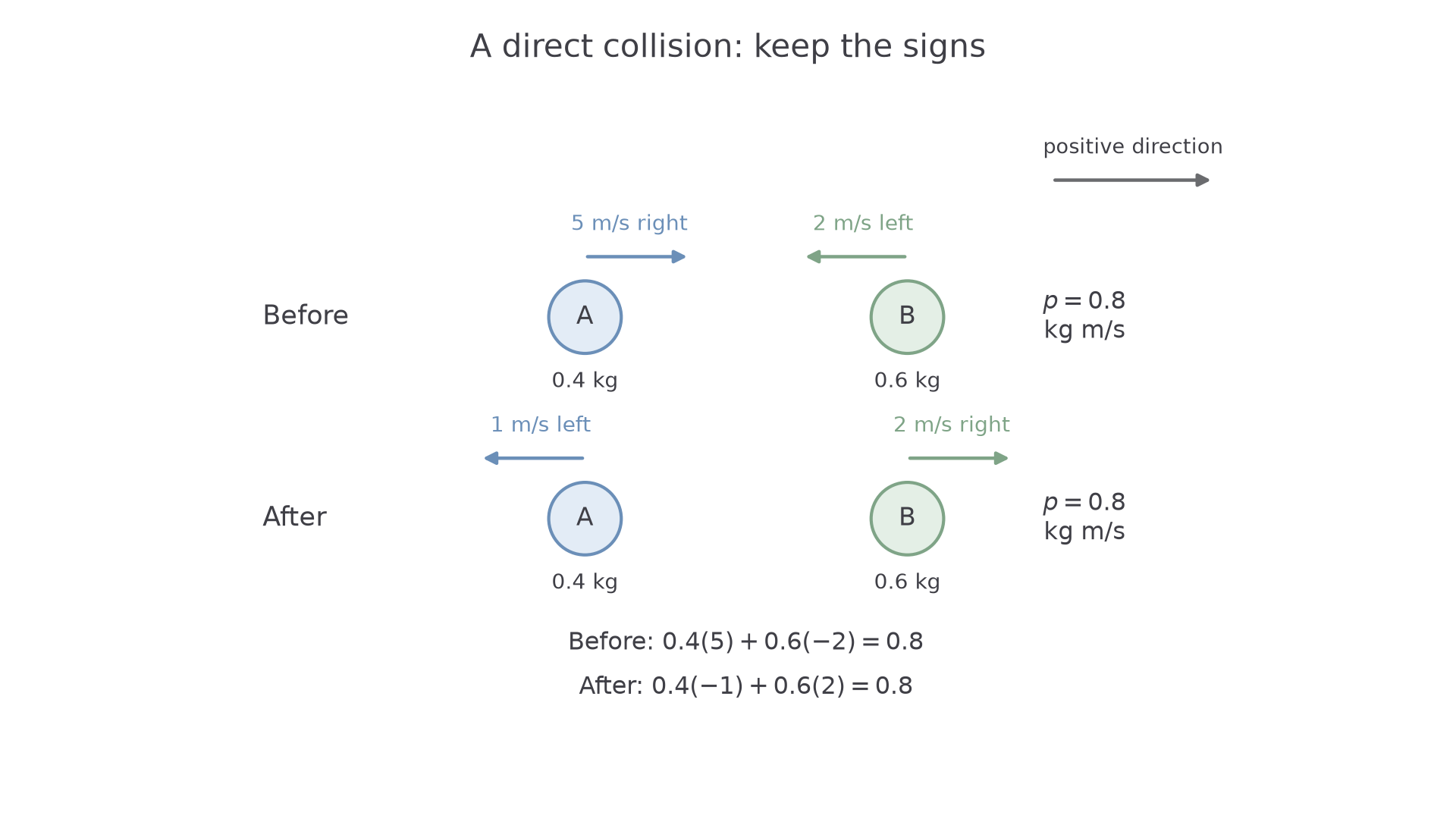
The 's are velocities immediately before impact and the 's immediately after, all measured in one positive direction. The total is conserved; each particle's momentum need not be.
Not in the formula booklet: learn it.
Use a before-and-after sketch to attach each velocity to the correct mass. Conservation gives one equation, so you need one further piece of information, such as one final velocity, to determine two unknown final velocities.
[DIAGRAM: asset_name: Before and after a direct collision; asset_slug: momentum-before-after; caption: Keep one positive direction for both particles, before and after impact; description: A two-row diagram shows 0.4 kilogram A on the left and 0.6 kilogram B on the right. Before impact A moves right at 5 metres per second and B left at 2 metres per second. After impact A moves left at 1 metre per second and B right at 2 metres per second. Right is labelled positive. Beneath are signed total momenta 0.4 times 5 minus 0.6 times 2 equals 0.8 before and minus 0.4 times 1 plus 0.6 times 2 equals 0.8 after, in kilogram metres per second.]
Worked example 3: a stationary target
Question. Smooth particles A and B, of masses and , collide directly on a smooth horizontal track. Before impact A moves right at and B is at rest. A rebounds left at . Find B's velocity immediately after impact.
Plan. Take right as positive and conserve the total signed momentum.
Answer. B moves right at .
Check. Final total momentum is , equal to the initial total. A moves left and B right after impact, so the particles separate.
Change only B's initial velocity: it now approaches A. Its initial momentum must be negative in the same equation.
Continue this lesson.
You’re previewing NovaLearn without an account. Create a free account to read the rest.
Create free account