1.2 - Moving and stretching graphs
A graph can be moved, reflected or stretched without calculating a new table of values. In this part of 1.2, you will track its points to understand changes inside and outside a function, describe transformations precisely, and combine them in the correct order for algebraic and given-feature graphs.
Translations
Suppose . Why does the graph contain , rather than ? The input to must still be , so and . Changing an input inside a function moves a point in the opposite horizontal direction.
Translation
A translation moves every point by the same displacement. The vector means units horizontally and units vertically, with positive directions right and up.
An outside addition changes the output; an inside addition changes the input needed to obtain that output.
Translations of a graph
A point on moves as follows:
These rules hold for positive, zero and negative .
Not in the formula booklet: learn it.
The same coordinate change applies to vertices, intercepts as points, endpoints and asymptotes. An old intercept may move away from an axis, so its image need not still be an intercept.
Worked example 1: adding outside the function
Question. Let for . Describe the transformation to , and find its vertex, domain and the image of .
Plan. Add to every output, leaving each input unchanged.
The original vertex moves to , and moves to .
Answer. Translation by ; vertex ; domain ; point image .
Check. At , the new rule gives . The domain is unchanged because the same inputs enter .
Move the same inside the function. Only its position changes, but the displacement is now horizontal.
Worked example 2: adding inside the function
Question. For the same , , describe the transformation to , and find its vertex, domain and the image of .
Plan. Solve for the new horizontal coordinate of each old point .
The vertex moves from to , and moves to . The input to must lie in its original domain:
Answer. Translation by ; vertex ; domain ; point image .
Check. At the new point's input , . The new vertex makes .
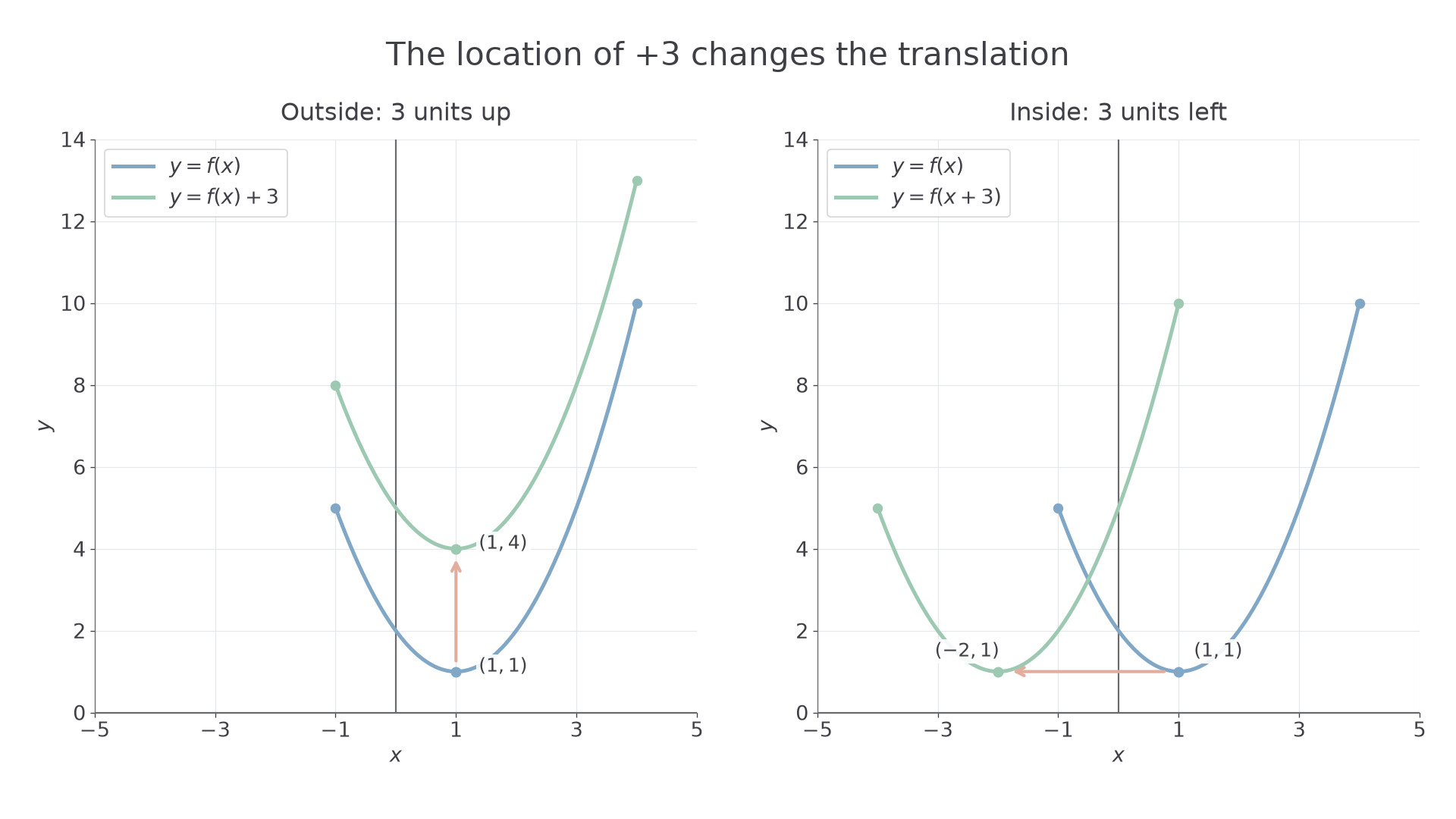
The two panels show the same original function and the two different locations of the .
[DIAGRAM: asset_name: Inside and outside translations; asset_slug: function-translations; caption: Adding 3 outside moves the graph up, while adding 3 inside moves it left; description: Two panels plot the original restricted quadratic y equals the square of x minus 1 plus 1 for minus 1 at most x at most 4 in blue. Left panel adds 3 to outputs, showing the vertex move from 1 comma 1 to 1 comma 4. Right panel adds 3 to the input, showing the vertex move to minus 2 comma 1 and the domain shift from minus 1 through 4 to minus 4 through 1. Endpoints are included.]
Watch out
translates a graph units right, because its new input must satisfy . Do not use the sign inside the bracket as the direction of the movement.
Track a vertex and the domain together.
Reflections and stretches
Multiplying an output changes its distance from the -axis. Multiplying the input changes the horizontal position needed to reproduce the old output. A negative multiplier also reverses the appropriate direction.
Stretch and invariant point
A stretch parallel to an axis multiplies distances from the other axis by a stated positive scale factor. A scale factor between and reduces those distances. An invariant point stays in the same position during the transformation.
For , the old output becomes . For , the input must satisfy , so the old horizontal coordinate becomes .
Reflections and stretches
For ,
If , also reflect in the -axis for , or in the -axis for . In particular, and are single reflections.
Not in the formula booklet: learn it.
In a vertical stretch or reflection, points on the -axis are invariant because their outputs are zero. In a horizontal stretch or reflection, points on the -axis are invariant because their inputs are zero. The identity scale factor , without reflection, leaves every point fixed. The nonzero condition matters: multiplying an input by zero does not give a stretch.
The next examples use a graph made of straight segments joining , and . All its features are supplied, so no formula for is needed.
Worked example 3: a negative output multiplier
Question. The graph of consists of segments joining , and . Describe the transformation to , and find the images of , its domain and range.
Plan. Multiply each vertical coordinate by .
The original outputs range from to ; their images range from to , with the order reversed by the negative multiplier.
Answer. Reflect in the -axis and stretch by factor parallel to the -axis. The images are . Domain ; range .
Check. is invariant because its output is zero. The negative height at becomes positive, as reflection requires.
Move the multiplier inside. Its position changes the affected coordinate and replaces the scale factor by its reciprocal.
Worked example 4: a negative input multiplier
Question. For the same graph, describe the transformation to , and find the images of , its domain and range.
Plan. Divide each old horizontal coordinate by , keeping the output unchanged.
The transformed segment endpoints run from to . Every old output still occurs.
Answer. Reflect in the -axis and stretch by factor parallel to the -axis. The images are . Domain ; range .
Check. At the image of , , so the new graph returns . Point is invariant because its horizontal coordinate is zero.
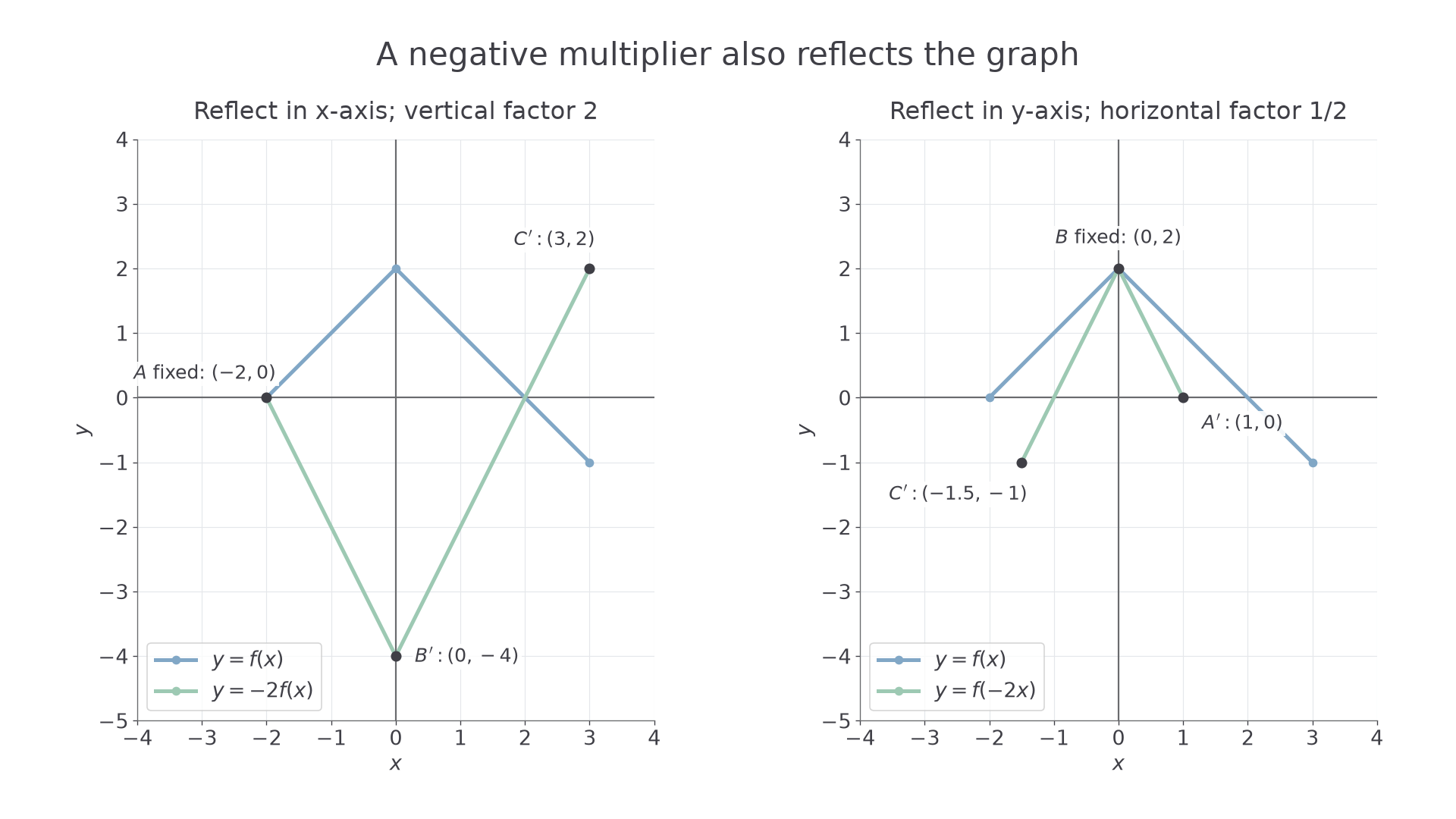
The reflected position and the reciprocal horizontal factor are visible together.
[DIAGRAM: asset_name: Which coordinate is multiplied; asset_slug: function-negative-stretches; caption: The same multiplier outside and inside produces different reflections and different scale factors; description: Two equal-scale coordinate plots show an original three-vertex polyline through minus 2 comma 0, 0 comma 2 and 3 comma minus 1 in blue. Left shows minus 2 f of x in green through minus 2 comma 0, 0 comma minus 4 and 3 comma 2. Right shows f of minus 2x in green through 1 comma 0, 0 comma 2 and minus 1.5 comma minus 1. Labels identify the invariant original point on each panel.]
Watch out
has horizontal scale factor , not . Check one point: an old input now needs , so its new horizontal coordinate is .
Use a different negative input multiplier.
Combined transformations
A translation and a stretch in the same direction can give different graphs when their order is reversed. Track a point, or write the rule after each step, instead of guessing from the final expression.
For a horizontal combination, factor the input first. For example, : this exposes a horizontal scale factor , followed by a translation units left.
A combined point mapping
For nonzero , a point on becomes
Solve to find the new horizontal coordinate; apply to the old output. Negative factors include the reflections already taught.
Not in the formula booklet: learn it.
You can describe this as horizontal scaling/reflection, then horizontal translation, together with vertical scaling/reflection, then vertical translation. Operations affecting separate coordinates commute, but a translation and stretch affecting the same coordinate generally do not.
Worked example 5: stretch, then translate
Question. A graph has domain and contains . Describe a sequence taking it to . State the corresponding point and the new domain.
Plan. Factor the input, then solve for each new input from the old one.
First stretch by factor parallel to the -axis, producing . Then translate units left, replacing by .
For the old input , gives . For the whole domain,
Answer. Horizontal stretch factor , then translation by . Point ; domain .
Check. At , the new graph evaluates . The endpoints send to , respectively.
Reverse those same two operations. The horizontal displacement is now scaled too.
Worked example 6: translate, then stretch
Question. Start again with the graph in Worked example 5. Translate it units left, then stretch by factor parallel to the -axis. Find the resulting rule, the image of and the new domain.
Plan. Write the translated rule first, then replace its input by .
After translation, let . After stretching,
Tracking the point directly gives . The domain changes from to , then to .
Answer. , containing , with domain . This differs from .
Check. At , the new input is , giving the required output .
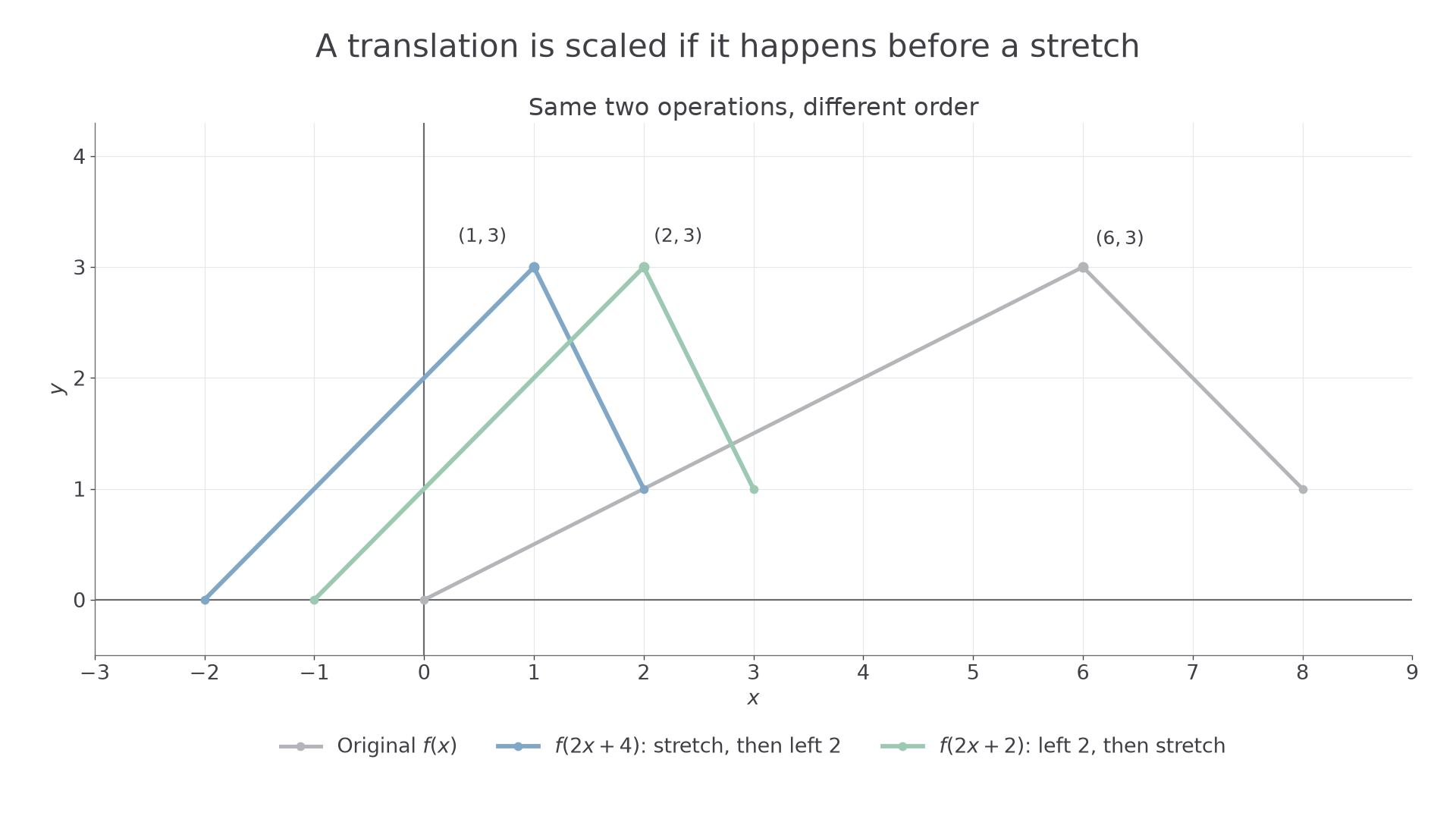
The graphs below use a particular through the supplied point. The two final peaks differ by one horizontal unit.
[DIAGRAM: asset_name: Order changes the result; asset_slug: function-transformation-order; caption: Reversing a horizontal stretch and translation changes the final graph; description: A polyline f with vertices 0 comma 0, 6 comma 3 and 8 comma 1 is grey. Blue f of 2x plus 4 has vertices minus 2 comma 0, 1 comma 3 and 2 comma 1. Green f of 2x plus 2 has vertices minus 1 comma 0, 2 comma 3 and 3 comma 1. The original peak 6 comma 3 and the two final peaks are labelled. A legend states the respective transformation orders.]
These rules apply to trigonometric graphs too. You can transform supplied features without solving a trigonometric equation or knowing how those features were first obtained.
Worked example 7: a trigonometric graph with supplied features
Question. For , the graph has range , a maximum at , a minimum at , and passes through . Describe transformations to . Find the images of those three points and the transformed domain and range.
Plan. Translate the inputs right, then apply the output rule .
The point mapping is . Hence
Answer. Translate right, reflect in the -axis, stretch by factor parallel to the -axis, then translate unit up. The new domain is ; range . The old maximum becomes the new minimum at , and the old minimum becomes the new maximum at .
Check. At , the inner input is , whose supplied output is zero; the new height is . Applying to the old range endpoints gives and , confirming the range.
The same point mapping handles a polynomial, a trigonometric curve or an unfamiliar graph with given features. For an asymptote, transform its coordinate: for example, under , an old vertical asymptote becomes , and an old horizontal asymptote becomes .
Problem-solving
For an inside change, set the new input expression equal to the old input. For an outside change, apply the stated operations to the old output. This checks both the direction and the order.
Use that point mapping once more.
Quick Recap
- Outside additions and multipliers change outputs; inside additions and multipliers change the inputs needed to reproduce an output.
- moves left by ; has horizontal scale factor , with a reflection when .
- Describe a stretch with its scale factor and direction, a reflection with its axis, and a translation with its displacement.
- Factor a combined input or track a point to determine the transformation order and new domain.
In the opening puzzle, requires , so contains .