1.1 - Solving quadratic inequalities
An equation finds the inputs where a quadratic is zero; an inequality asks where it is positive, negative or equal to a boundary. You will use roots to divide the number line into intervals, handle strict and inclusive endpoints and recognise when every real input, or none, satisfies an inequality.
Intervals between roots
If a quadratic is positive at both ends of the number line, must it be positive in the middle? Try : it is positive at and , but negative at .
The roots and divide the number line into three intervals. Within an interval, neither linear factor changes sign, so their product keeps its sign. Choose one test value in each interval, or read the signs of the two factors.
Sign diagram
A sign diagram records whether an expression is positive, zero or negative on the intervals separated by its roots. It identifies whole ranges of inputs, rather than just the roots themselves.
For , both factors are negative when , their signs differ when , and both are positive when . The product therefore has signs positive, negative, positive.
[DIAGRAM: asset_name: Signs between quadratic roots; asset_slug: quadratic-sign-intervals; caption: The roots split the number line into intervals with constant signs, and negating the quadratic reverses those signs; description: Two matching number-line sign diagrams compare x squared minus x minus 6 with minus x squared plus x plus 6. Roots minus 2 and 3 are marked. The first has positive signs outside the roots and negative between; the second has negative outside and positive between. Pale highlighted intervals show the solutions to each expression being greater than zero.]
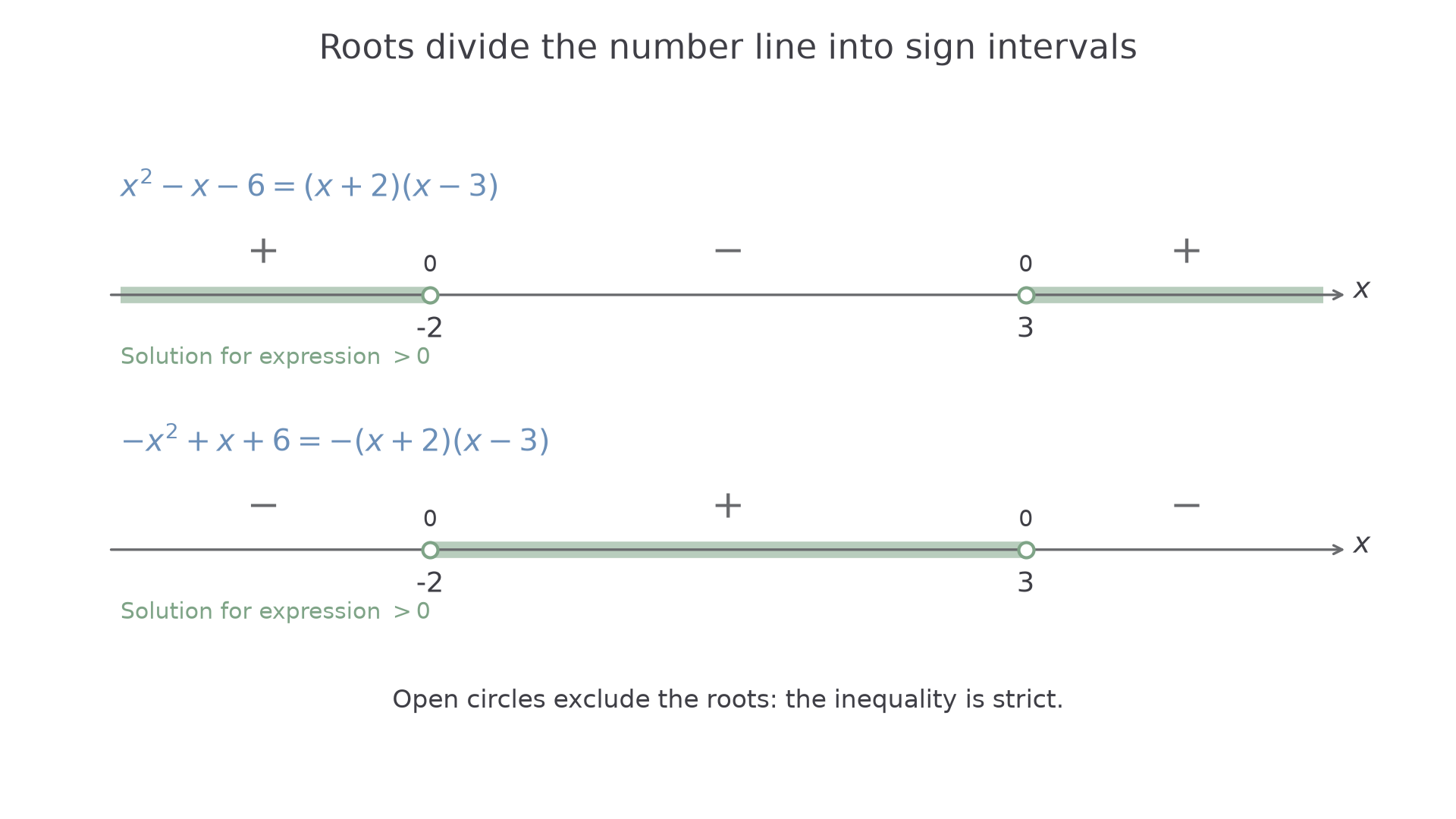
The graph gives the same information: a positive leading coefficient opens upwards; a negative one opens downwards. A sign test also works when the picture is unfamiliar.
Worked example 1: positive outside the roots
Question. Solve .
Plan. Factorise, find the boundary roots and test the intervals.
| Interval | Test input | Value of the expression | Sign |
|---|---|---|---|
| Positive | |||
| Negative | |||
| Positive |
Answer. or . The roots are excluded because zero is not greater than zero.
Check. The factor signs establish the sign throughout each interval, not only at the three test inputs. At the excluded boundaries the expression is zero.
Negate the expression while keeping the same inequality sign. The roots stay fixed, but every interval sign reverses.
Worked example 2: a negative leading coefficient
Question. Solve .
Plan. Use and reverse the signs from the previous diagram.
Answer. .
Check. At , the expression is . Outside the roots, for instance at , it is . Equivalently, multiplying the original inequality by gives .
The last check uses the familiar rule that multiplying or dividing an inequality by a negative number reverses its direction.
Watch out
“Positive outside the roots” is not a universal rule: it depends on the leading coefficient. Find or test the sign of the actual expression. Write disjoint intervals with or, rather than an impossible chain such as .
Find the roots first, then decide which interval to keep.
Including the endpoints
At a root, the quadratic equals zero. Include that input when the inequality allows equality, and exclude it when the inequality is strict.
For example, gives , whereas gives . The interval signs have not changed; only the treatment of its endpoints has changed.
A repeated root needs special care. For , the expression is positive on both sides of and zero at . It does not change sign at that root: both identical factors change sign together.
Worked example 3: a strict inequality at a repeated root
Question. Solve .
Plan. Write the expression as a square and compare its possible values with zero.
Answer. There are no real solutions.
Check. At the smallest point , the value is , which still fails the strict inequality. Every other input gives a positive value.
Change only to . The one boundary input is now allowed.
Worked example 4: including the repeated root
Question. Solve .
Plan. Use the same non-negative square and determine when equality holds.
The first implication follows because the square is also at least zero.
Answer. only.
Check. Substitution gives . If , the square is strictly positive and fails the inequality.
The other two comparisons complete the picture.
| Inequality | Solution |
|---|---|
| or | |
| All real |
An inequality can therefore have an interval, two intervals, one isolated value, every real value or no solution. The graph and its equality points decide which occurs.
Watch out
Do not assume that a quadratic changes sign at every root. At a repeated root, a squared factor touches zero and keeps the same sign on both sides.
Use both non-negativity and equality in this check.
All real values or none
Some quadratic expressions never reach zero. Completing the square then gives a direct inequality for every input, with no need to hunt for boundary roots.
For instance, is at least . Its graph lies wholly above the -axis. A negative leading coefficient can instead keep a graph wholly below the axis, as in .
Worked example 5: every real input works
Question. Solve .
Plan. Complete the square and compare the minimum with zero.
Answer. All real values of .
Check. The minimum occurs at , where the original gives . Even this smallest value satisfies the inequality.
Keep the same expression and change the requested sign. Its possible values stay the same.
Worked example 6: no real input works
Question. Solve .
Plan. Use the same lower bound rather than attempting real factorisation.
No value at least can be less than zero.
Answer. There are no real solutions.
Check. Rewriting the required inequality as would require a negative real square, which is impossible.
These arguments prove the result for every input. Testing several numbers would suggest a pattern but would not prove a universal claim. Likewise, a calculator's failure to find roots does not by itself decide whether the expression is always positive or always negative.
Problem-solving
First compare the expression with zero. Move terms if needed, then use either real roots and interval signs or a completed square with a fixed sign. Choose the form that makes the whole solution set visible.
The opening quadratic is negative between its two roots even though it is positive on either side. We needed the intervals, not just its end behaviour.
Quick Recap
- Roots divide the number line into intervals on which the sign is fixed.
- A negative leading coefficient reverses the signs of the corresponding positive-leading-coefficient quadratic.
- Include roots for or , and exclude them for or .
- Repeated roots and quadratics with a fixed sign need their own boundary checks.
The opening expression is positive for or , and negative for .