4.2 - Constant acceleration
At the highest point of a vertical throw, velocity is zero but gravitational acceleration is still acting. You will use the equations for constant acceleration, keep direction signs consistent, and connect stages or two particles with the correct times. These methods calculate motion without first needing to find the forces that caused it.
Choosing a motion equation
A particle starts at and gains each second. After , its velocity is . The straight velocity–time line has average height , so its area, and therefore displacement, is .
This reasoning depends on constant acceleration: equal changes of velocity in equal times. It does not hold across an interval in which acceleration varies.
Constant-acceleration equations
For motion along a straight line with constant acceleration ,
Here and are initial and final velocities, is elapsed time and is displacement during that interval, not final position unless the initial position is zero. Use one positive direction for .
In the formula booklet.
The first equation comes from the definition of constant acceleration. The second is the trapezium area under its straight velocity graph. Substituting into that area gives ; eliminating instead gives .
Choose an equation that includes what you need and excludes an unnecessary unknown.
| Quantity not needed | Useful equation |
|---|---|
Write known signed values before substituting.
Worked example 1: positive acceleration
Question. A particle has initial velocity and constant acceleration . Find its velocity and displacement after .
Plan. Take the initial motion as positive; use time in the velocity and displacement equations.
Answer. Velocity , displacement .
Check. The velocity graph's area is , independently recovering the displacement.
Reverse only the acceleration. A negative is a signed change of velocity; it is not an instruction to make every other quantity negative.
Worked example 2: negative acceleration
Question. A particle has initial velocity and constant acceleration . Find its velocity and displacement after .
Plan. Keep the initial direction positive and substitute .
Answer. Velocity , displacement .
Check. Average velocity is , giving displacement . Velocity stays positive over the interval, so distance is also .
When using , the square gives the speed magnitude; decide the velocity sign from the stage of motion. For example, “first comes to rest” means , whereas reaching a height on the way down requires a negative velocity if up is positive.
Watch out
These equations require one constant acceleration over the chosen interval. If acceleration changes, divide the motion into stages and give each stage its own initial velocity and elapsed time.
Choose an equation that avoids an unknown time.
Vertical motion
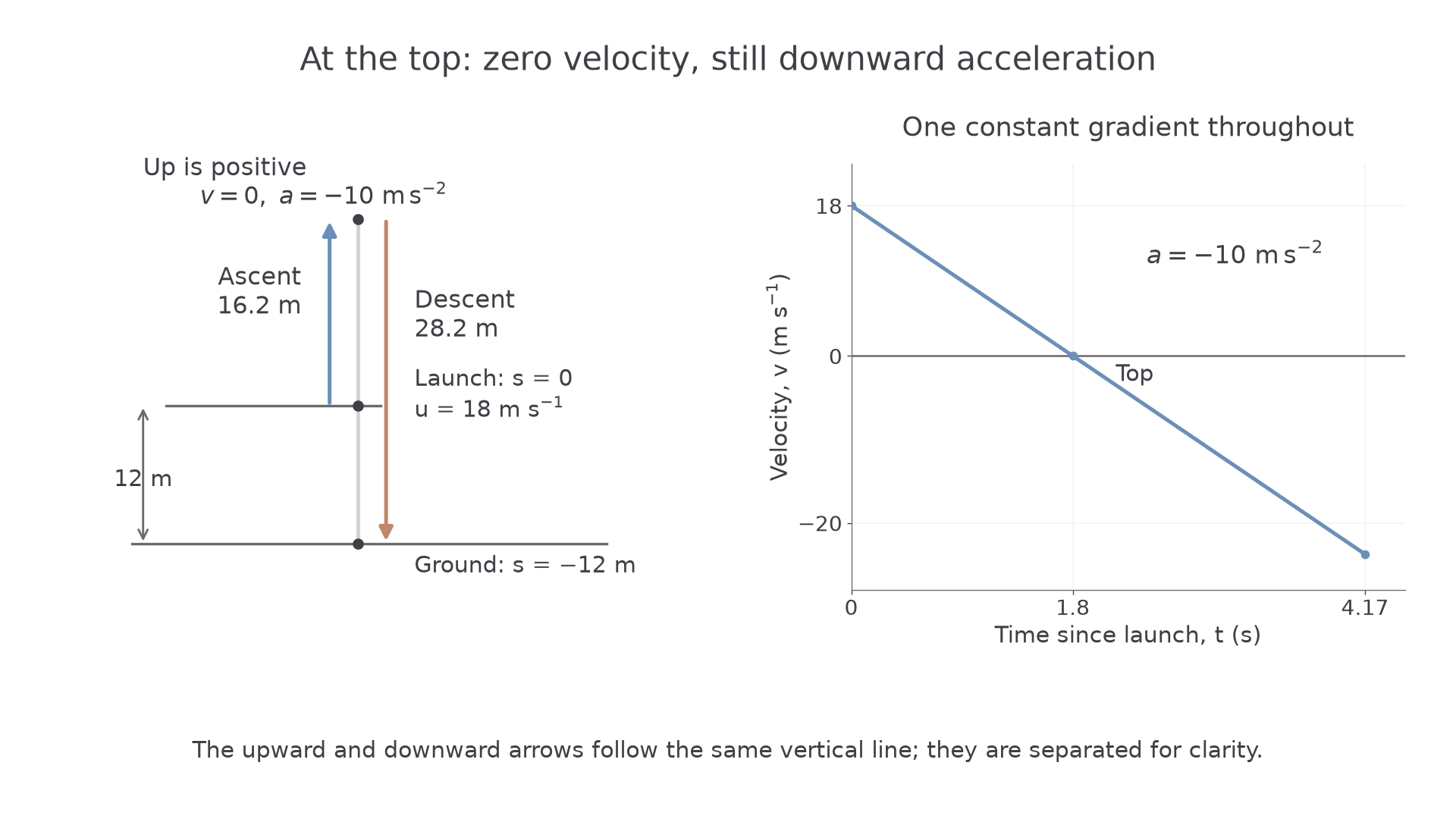
For vertical motion with air resistance neglected, acceleration is constant and downwards. Taking up as positive gives , during both the ascent and descent. At the top, for an instant; has not become zero.
Use displacement relative to the launch point unless you explicitly define a ground-based position. A landing below the launch point has negative displacement when up is positive.
[DIAGRAM: asset_name: One acceleration through the turning point; asset_slug: mechanics-vertical-throw; caption: Velocity reverses at the top while acceleration remains downwards; description: A vertical position schematic shows a particle launched upwards from a 12 metre platform at 18 metres per second, rising 16.2 metres above launch and then falling to the ground. The top is labelled velocity zero and acceleration minus 10 metres per second squared. Up is positive, launch is position zero, and ground position minus 12 metres. Separate ascent and descent arrows identify 16.2 metres and 28.2 metres. A second panel plots velocity 18 minus 10t from launch to landing at 4.17 seconds, with the zero at 1.8 seconds and constant gradient minus 10.]
Worked example 3: returning to the launch level
Question. A particle is projected vertically upwards from the ground at . Neglect air resistance. Find its greatest height, time until it returns to the ground and total distance travelled by then.
Plan. Use at the top, then for the return to launch level.
Answer. Greatest height ; return time ; distance .
Check. Time to the top from is , half the return time. The downward return velocity is .
Raise only the launch point to a platform. The upward part is unchanged, but the descent is longer and the landing time is no longer twice the ascent time.
Worked example 4: landing below the launch point
Question. A particle is projected vertically upwards at from a platform above the ground. Neglect air resistance. Find its landing time and total distance travelled.
Plan. Take launch position as zero and up as positive; landing has displacement .
The other root is negative, so it is outside the motion after projection. The ascent is still . The descent to the ground is .
Answer. Landing time ; total distance .
Check. The landing velocity from is approximately . Its square is , agreeing with .
Continue this lesson.
You’re previewing NovaLearn without an account. Create a free account to read the rest.
Create free account