2.4, 3.4 - Differentiating parametric curves
A curve can be described by giving both coordinates in terms of a third variable. You will follow such a curve, turn its two parameter derivatives into a gradient, and find tangents and normals without first finding an equation of the form .
A curve given by a parameter
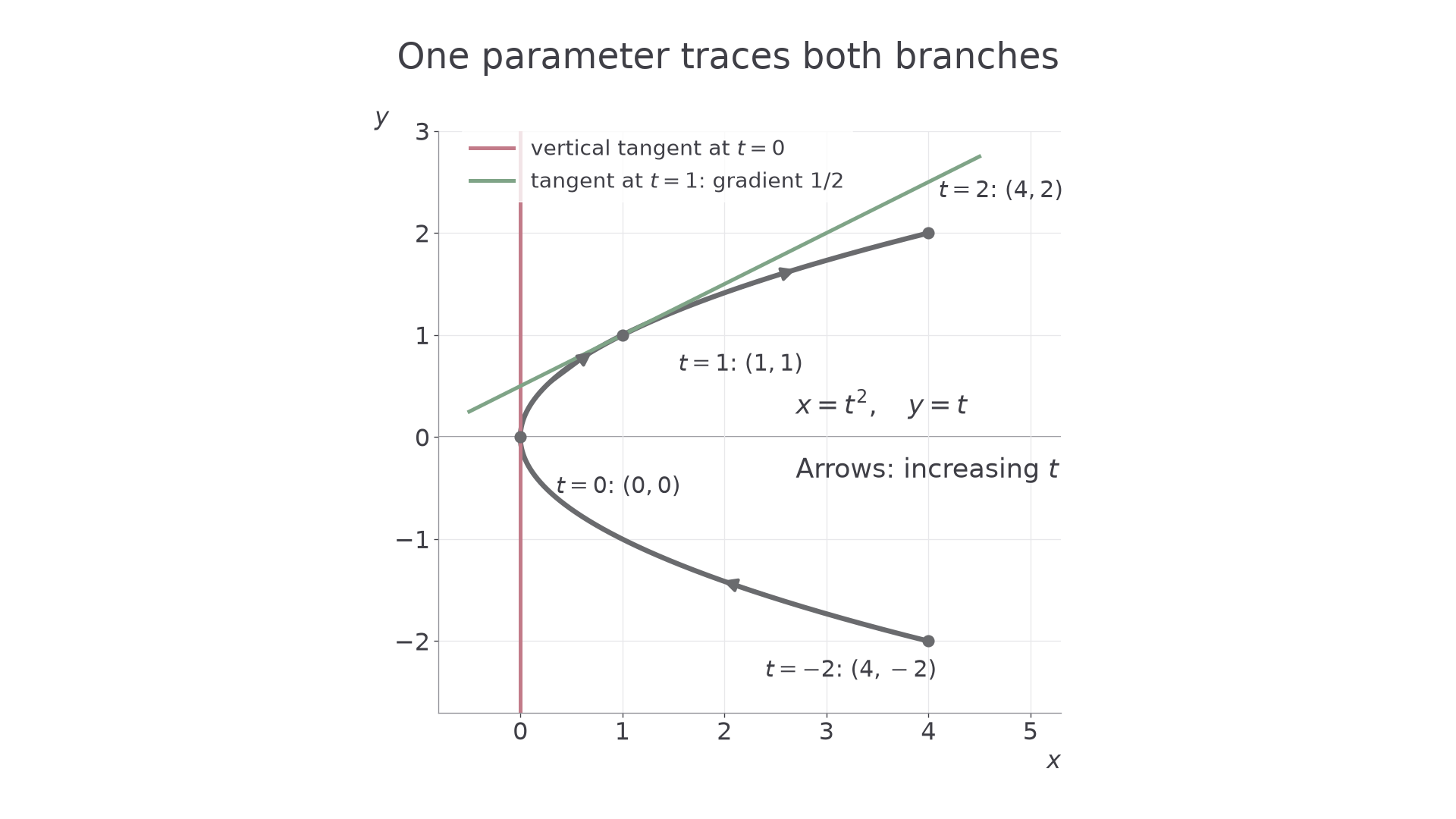
How can one curve contain both and , yet still be easy to describe? Let and . The inputs and give those two points. We have described both branches using one moving parameter.
Parametric equations
Parametric equations give the coordinates of a point using a common parameter, such as , . Each permitted value of supplies one ordered pair . The parameter need not be time.
Use the same parameter value in both equations. Changing traces the curve, and the permitted parameter interval determines which part is traced.
Worked example 1: following a sideways parabola
Question. For , , find the points corresponding to , and find a Cartesian equation.
Plan. Substitute each value into both coordinates, then eliminate using .
Since , the equation becomes .
Answer. The points are , , ; the curve is , with .
Check. Each point satisfies . As increases through these values, the point moves towards the vertex along the lower branch, then away along the upper branch.
Shift only the -equation up by . The parameter substitution is unchanged, but elimination now uses .
Worked example 2: a shifted curve with a restricted parameter
Question. For , , where , find the endpoints and a Cartesian equation with the restriction that selects the traced arc.
Plan. Substitute the parameter endpoints, then express in terms of .
The parameter restriction becomes .
Answer. Endpoints , ; , with .
Check. At , the point is , the shifted vertex. Both endpoints satisfy the Cartesian equation and the stated restriction.
The parameter interval matters: the Cartesian equation alone would include the rest of the parabola too.
[DIAGRAM: asset_name: A parameter follows a curve; asset_slug: parametric-parabola; caption: Increasing t traces both branches, and t equals zero gives a vertical tangent; description: Coordinate plot of x equals t squared and y equals t, from t equals minus two to two. Points are labelled t equals minus two at four comma minus two, t equals zero at the origin, t equals one at one comma one, and t equals two at four comma two. Arrows show increasing t. A vertical tangent at the origin and the tangent of gradient one half at one comma one are drawn.]
Watch out
does not imply for every real . Negative gives the other branch. Use the other coordinate or the parameter interval before choosing a square-root sign.
Follow a new upward shift and interval.
The parametric gradient
A gradient measures vertical change per horizontal change, rather than either change per unit parameter. If a small parameter change gives and , then . Taking limits gives the parametric gradient when the horizontal rate is nonzero.
The parametric gradient
For differentiable , , at a parameter value where ,
In the formula booklet.
Differentiate both coordinates with respect to , then divide in the order “vertical rate over horizontal rate”. The result will usually still contain .
Worked example 3: a gradient without eliminating the parameter
Question. Find for , , and evaluate it at .
Plan. Find the two parameter derivatives, then take their ratio.
Answer. , and the gradient at is .
Check. Near , the curve is , whose derivative at is .
Keep , but replace the linear -coordinate with an exponential. The numerator is now a changing rate too.
Continue this lesson.
You’re previewing NovaLearn without an account. Create a free account to read the rest.
Create free account