1.8 - Areas between curves
An integral adds signed contributions, whereas a geometrical area is non-negative. You will split a region when its boundary crosses an axis, find intersections before subtracting curves, and choose vertical or horizontal strips to calculate an enclosed area.
Signed area and total area
The integral is . Is that the area between the line and the -axis? A sketch reveals a small triangle below the axis as well as a larger one above it. Their contributions subtract in the integral but add in the total area.
A thin vertical strip has width . Above the axis, its height is , so its positive area is approximately . Below the axis, the positive height is , so the area contribution is approximately .
Signed integral and geometrical area
For increasing limits , equals area above the -axis minus area below it. The total area between the curve and the axis adds the magnitudes of all these pieces. Split the interval at every crossing where the sign changes.
If a curve stays below the axis throughout an interval, negate its integral. If it changes sign, do this separately on each piece. Taking the magnitude of one combined integral can lose area through cancellation.
Worked example 1: a region wholly above the axis
Question. Find the area bounded by , the -axis and the lines , .
Plan. Check the sign on the interval, then integrate the positive height.
For , . Therefore
Answer. square units.
Check. The region is a triangle with base and height , so its area is .
Move only the left boundary to . The new piece lies below the axis and must be added with its positive area.
Worked example 2: a region crossing the axis
Question. Find the total area between and the -axis, from to .
Plan. Split at , where the line crosses the axis, and reverse the sign of the negative piece.
Answer. square units. The signed integral is only .
Check. The two triangles have areas and . Their sum is , as required.
The picture keeps the two positive areas visible even though the integrals have opposite signs.
[DIAGRAM: asset_name: Cancellation is not total area; asset_slug: signed-versus-total-area; caption: The two triangles add to 5 over 2 square units, while their signed contributions give 3 over 2; description: Graph of y equals x minus 1 over x equals zero to three. The triangle below the axis from zero to one is shaded clay and labelled area one half and integral minus one half. The triangle above from one to three is shaded blue and labelled area 2 and integral plus 2. The crossing at 1 and vertical boundary at 3 are marked.]
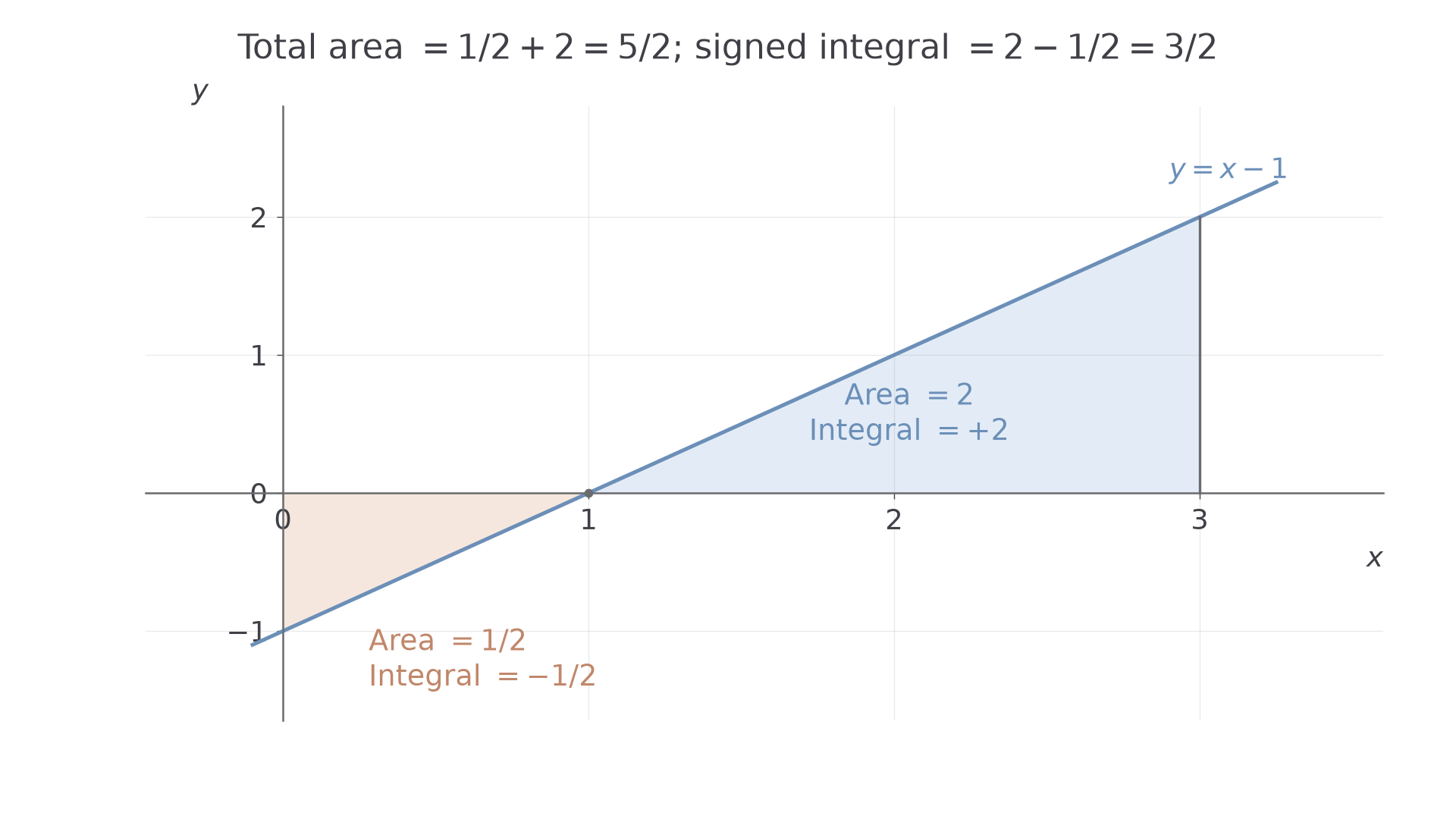
A horizontal boundary works in the same way: between and , use the vertical distance where the curve is above the line, or where it is below. Split if their order changes.
Watch out
In example 2, , which is still wrong for the total area. Split before taking positive magnitudes.
Locate the crossing before calculating this area.
A line and a curve
Between two graphs, a vertical strip stretches from the lower boundary to the upper boundary. Its height is their difference. The intercepts with an axis are usually irrelevant: the limits come from the intersections of the two boundaries.
First solve the two equations simultaneously. Then test an input between successive intersections, or inspect a reliable sketch, to decide which graph is above the other.
Area from vertical strips
If throughout , then the area between them is
Split into intervals if the upper and lower boundaries exchange places.
Not stated in the formula booklet: learn upper minus lower.
Subtract the complete lower expression, with brackets. This gives a positive strip height even when both graphs lie below the axis.
Worked example 3: a line through the origin
Question. Find the area enclosed by and .
Plan. Find their intersections, identify the upper graph, and integrate the difference.
so the limits are and . At , the line has height and the curve height , so the line is above the curve between these intersections.
Answer. square units.
Check. The strip height is non-negative between and and no greater than . The answer is positive and less than the enclosing rectangle's area .
Move only the line upwards by . Both intersection limits now change, including one to the left of the origin.
Worked example 4: a shifted line
Question. Find the area enclosed by and .
Plan. Recalculate the intersections rather than reusing the earlier limits.
The limits are and . At , the line is above the curve. Hence
Answer. square units.
Check. The height is , positive between and , with maximum . An area of about fits inside the width-, height- rectangle of area .
Continue this lesson.
You’re previewing NovaLearn without an account. Create a free account to read the rest.
Create free account