1.7 - Tangents and normals
A derivative supplies the gradient needed for a straight-line equation. You will find tangents and perpendicular normals, handle horizontal and vertical cases, and work backwards from a line condition to an unknown contact point. You will then use ordinary line intersections to finish geometric problems.
The tangent equation
How can one calculation replace trying to draw the tangent accurately? At a chosen input, the function gives the point and its derivative gives the gradient. Those are exactly the two ingredients of a line equation.
You already know
A line of gradient through has equation . A vertical line through that point has equation .
Use the original function for the height and the derivative for the slope. Write these separately before forming the equation.
Tangent at a known input
If is finite, the tangent to at is
Not in the formula booklet: learn it.
This formula uses a finite derivative. A vertical tangent, when present, needs a vertical line equation instead.
Worked example 1: the point and its gradient
Question. Find the equation of the tangent to at .
Plan. Find the curve's height and derivative at , then use point-gradient form.
Answer. .
Check. The line passes through . Also, , so the curve and line agree at the contact point with a repeated intersection there.
Change only the coefficient of inside the square. The chain factor changes the gradient, and the point's height changes too.
Worked example 2: a composite curve
Question. Find the tangent to at .
Plan. Use the chain rule for the gradient and the original expression for the height.
Answer. .
Check. At , the line gives . Subtracting it from the curve gives , confirming the contact input.
The line's gradient answers the opening question exactly; a sketch can then check its direction.
Watch out
Do not use as the point's height. In the second example, the contact point is , not . The derivative supplies , while the original function supplies .
Use both functions in the right place.
The normal equation
The normal at a point is the line through that point perpendicular to the tangent. Its contact point is unchanged; only its direction changes.
Normal
A normal to a curve at a point is the straight line through that point perpendicular to the tangent there.
For two perpendicular lines with finite, nonzero gradients, the product of their gradients is . Therefore a tangent gradient gives normal gradient .
Normal at a known input
If is finite and nonzero, the normal is
If the tangent is horizontal, the normal is vertical: . If a tangent is vertical, its normal is horizontal: .
Not in the formula booklet: learn it.
The negative-reciprocal calculation cannot be used with a zero gradient. Perpendicular horizontal and vertical directions settle that case directly.
Worked example 3: a nonzero tangent gradient
Question. Find the normal to at .
Plan. Find the tangent gradient, take its negative reciprocal, and use the curve's point.
Answer. .
Check. The line contains , and , so its direction is perpendicular to the tangent.
Move only the contact input to . The derivative is now zero, so the normal needs a vertical equation.
Worked example 4: a horizontal tangent
Question. Find the tangent and normal to at .
Plan. Evaluate the derivative and identify the perpendicular directions geometrically.
The tangent is horizontal through the origin. The normal is vertical through the same point.
Answer. Tangent ; normal .
Check. These are the coordinate axes, which meet at right angles at . No division by zero has been used.
[DIAGRAM: asset_name: Normals at sloping and horizontal tangents; asset_slug: tangent-normal-cases; caption: The normal passes through the contact point and is perpendicular to its tangent; description: Two equal-scale plots of y equals x squared. The first marks P at 1 comma 1, tangent y equals 2x minus 1, and normal y equals minus x over 2 plus 3 over 2. The second marks the origin, horizontal tangent y equals 0 and vertical normal x equals 0.]
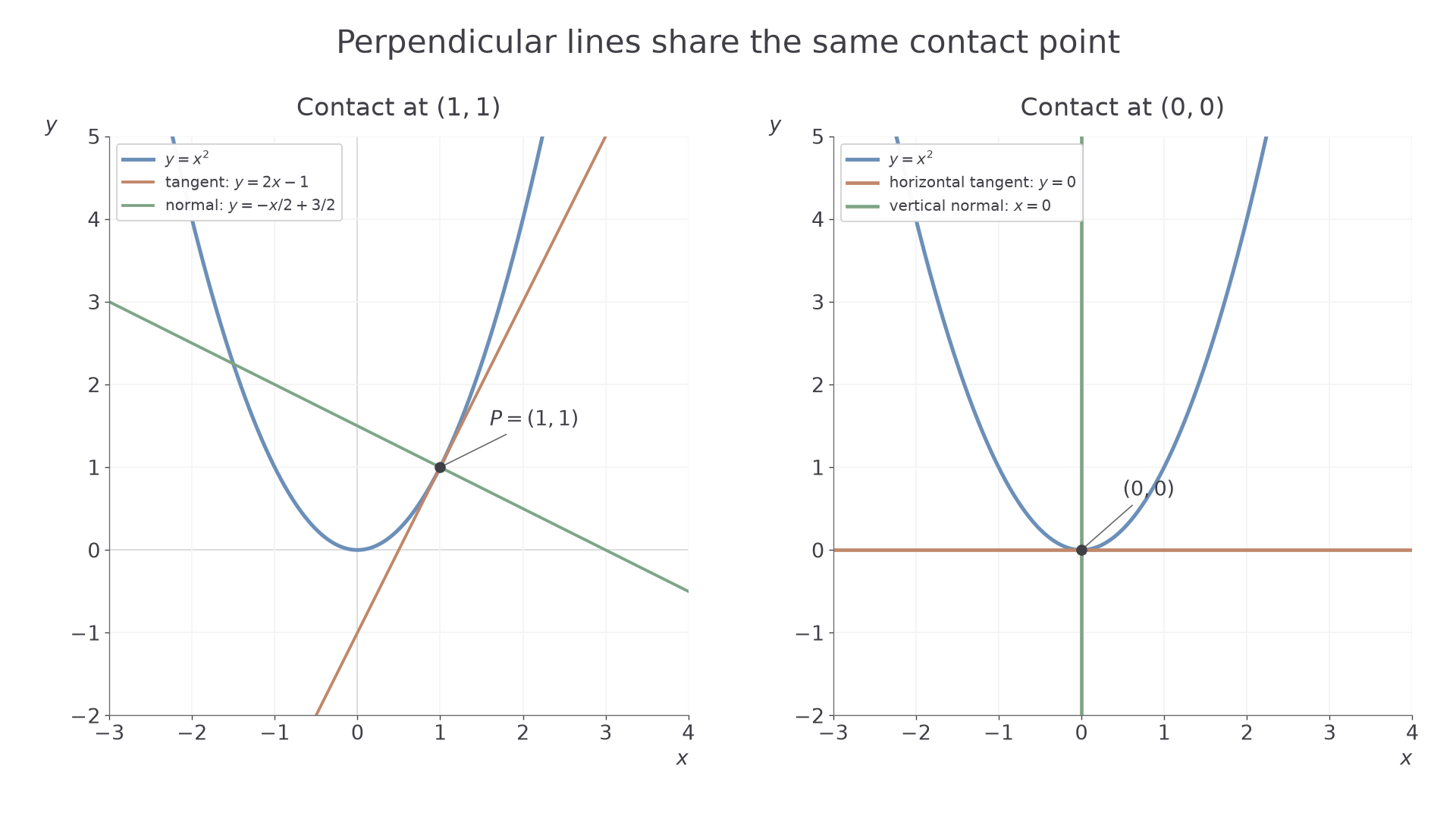
A vertical tangent can also occur. For , the chord gradient from to is , which grows without bound as positive approaches zero. The tangent direction there is vertical, , and the normal is horizontal, . There is no finite derivative at that endpoint.
Watch out
The negative reciprocal of is , not . Change the sign and take the reciprocal. If the tangent gradient is zero, use a vertical normal instead.
Try a negative tangent gradient.
Unknown contact points
Sometimes the point is unknown but a tangent or normal direction is given. Let its input be , turn the direction into an equation for , and solve for every permitted . Recover each height from before constructing lines.
Parallel lines have equal gradients. A stated normal gradient must first be converted into its perpendicular tangent gradient. Once the line equations are known, find their intersections by simultaneous equations, just as for any two straight lines.
Worked example 5: a tangent parallel to a line
Question. A tangent to is parallel to . Find its contact point, its equation and its -intercept.
Plan. Set the derivative equal to , then use the contact point to find the line.
Answer. Contact point , tangent , -intercept .
Check. The tangent has the required gradient ; confirms contact at .
Keep the same curve and direction condition, but apply it to a normal. Its tangent must have the negative reciprocal gradient.
Worked example 6: a normal direction and an intersection
Question. A normal to is parallel to . Find its contact point and equation. Find where this normal meets the tangent from the previous example, or explain why it does not meet it.
Plan. A normal gradient of requires tangent gradient . Solve for the point, then compare the two line equations.
Equating this with would give , which is false.
Answer. Contact point , normal . The normal and the earlier tangent are distinct parallel lines, so they have no intersection.
Check. At the contact point the tangent gradient is ; its product with the normal gradient is . Substituting into the normal gives .
For a non-parallel intersection, equating line equations gives an input. For example, and meet where , namely . Use exact fractions until a final numerical answer is required.
Problem-solving
Translate the condition before solving: tangent parallel means equal gradients; normal parallel means take a negative reciprocal first. Check every resulting input against the curve's domain.
Use the same steps with new data and a genuine intersection.
Quick Recap
- Use for the height and for the tangent gradient.
- A normal is perpendicular to the tangent through the same point.
- Horizontal tangents have vertical normals; vertical tangents have horizontal normals.
- For an unknown contact input, solve the gradient condition first.
- Use simultaneous line equations for intersections, checking for parallel lines.
The derivative and one point determine a tangent exactly; a careful sketch checks its direction.