1.1, 1.3 - Linear and quadratic intersections
A point common to two curves must satisfy both equations at once. You will use substitution to solve a linear and a quadratic equation, including equations with circles or products of coordinates. You will then connect the resulting quadratic to the graph relationship in 1.3: crossing, touching or missing.
Substitution
Where does the line meet the parabola ? A common point has the same -coordinate in both equations, so its -coordinate must satisfy .
Simultaneous solution
A simultaneous solution is a set of values satisfying every equation in the pair. For two coordinate equations, give matched pairs : an -value from one intersection cannot be combined with the -value from another.
Use the linear equation to express one variable in terms of the other. Substituting that expression into the quadratic removes one variable. After solving, use the linear equation again to recover each matching coordinate.
Worked example 1: a line and a parabola
Question. Solve simultaneously and .
Plan. Equate the two expressions for , solve for , then recover .
Using , the corresponding values of are and .
Answer. and .
Check. In the parabola, and . Each pair also satisfies .
Change only the line's coefficient from to . The parabola is unchanged, but the second intersection moves.
Worked example 2: a steeper line
Question. Solve simultaneously and .
Plan. Substitute for , then keep both roots when factorising.
Then gives or , in the same order.
Answer. and .
Check. At , the parabola gives and the line gives . At , both give zero.
The graph displays the matched points rather than two unrelated lists of coordinates.
[DIAGRAM: asset_name: Matched intersection coordinates; asset_slug: line-parabola-pairs; caption: Each intersection satisfies the line and parabola together; description: Coordinate plot shows y equals x squared minus 2x in blue and y equals 2x in clay. Their common points 0 comma 0 and 4 comma 8 are marked and labelled.]
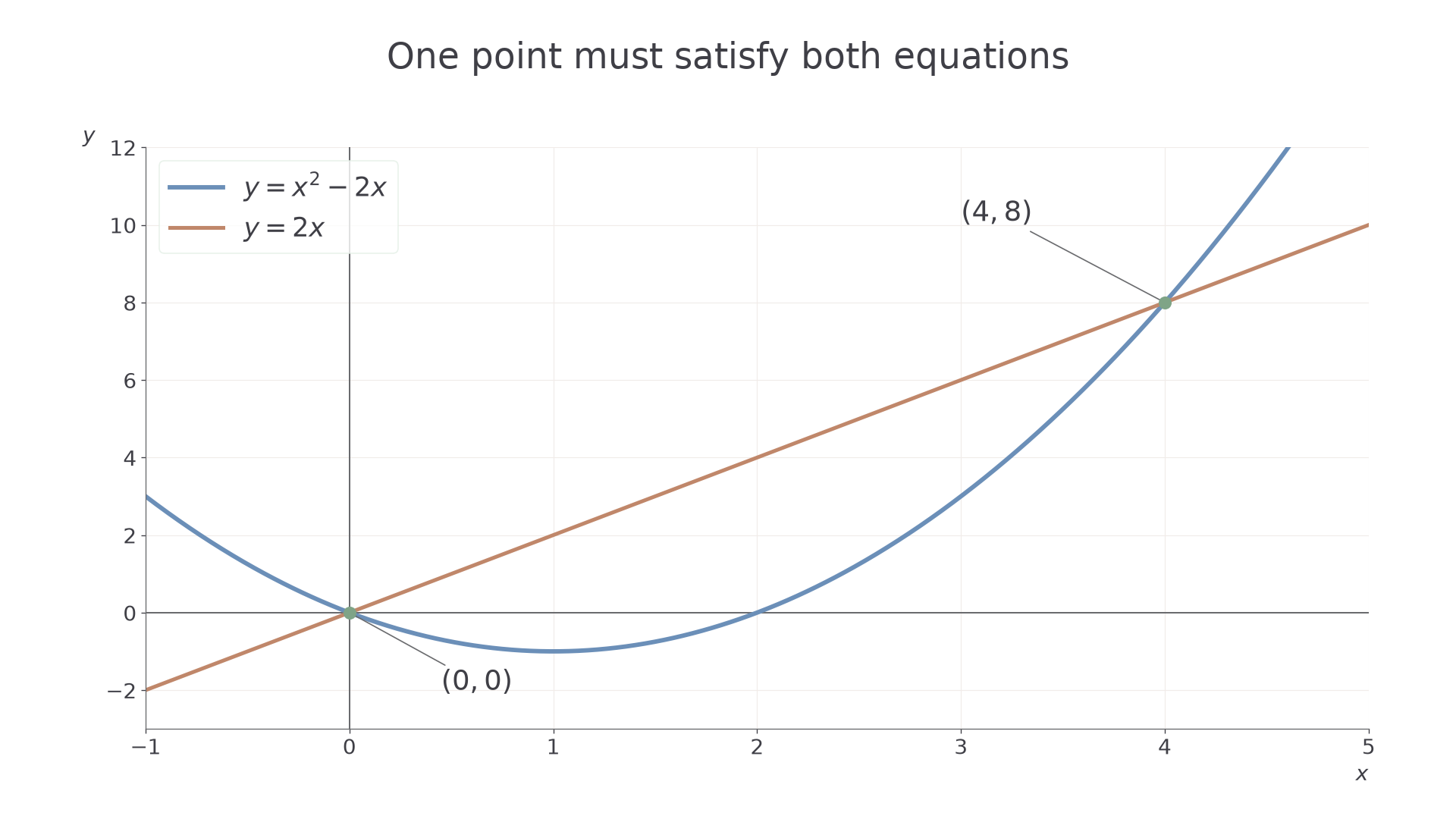
If the line is given as , first write . The same substitution works. Dividing by would discard the origin, so use the zero-product property instead.
Watch out
Finding and is not permission to form four combinations. Pair each with the produced by substituting that particular .
Give coordinates together in this check.
Curves beyond y equals a quadratic
A quadratic equation in and may contain , or . It need not already say a quadratic. A linear equation still lets you substitute and reduce it to one variable.
For example, describes a circle. You do not need any circle theorems here: a common point is simply a pair satisfying this equation and the line's equation. A term means the product of the two coordinates, so substitute into the whole product.
Worked example 3: a circle equation
Question. Solve simultaneously and .
Plan. Replace by , including the bracket when squaring.
Thus gives , and gives .
Answer. and .
Check. and . Also and , so each pair satisfies both equations.
Keep the same line but replace the circle equation by an equation containing . The substitution step is unchanged; the expansion differs.
Worked example 4: a product of coordinates
Question. Solve simultaneously and .
Plan. Replace the product by , then collect the quadratic terms.
Hence gives , and gives .
Answer. and .
Check. At , . At , . Both pairs satisfy .
These examples change the quadratic equation, rather than requiring a new method for every curve shape.
Watch out
If , then , not . Likewise , not . Keep brackets until the substitution is complete.
Use the whole product in your working.
Parameter intersections
When a line contains a parameter, substitution produces a quadratic whose coefficients contain that parameter. Its discriminant tells you whether the graphs cross twice, touch once or do not meet.
This test belongs to the reduced equation after substitution. A repeated root gives the touching point. Once the parameter is known, solve that repeated-root equation and recover the other coordinate.
Worked example 5: a line that moves vertically
Question. Determine the values of for which crosses, touches or does not meet . Find the point of contact in the touching case.
Plan. Equate the heights, classify its discriminant and solve the repeated-root equation at the boundary.
The leading coefficient is , so the equation remains quadratic for every .
Answer. Two crossings when ; one touching point when ; no intersection when . At , the equation is , so the point of contact is .
Check. The line and curve both give at . Their height difference is , which is positive for every other input, confirming one contact.
Change the coefficient of in the line from to . The same test finds a different touching line.
Worked example 6: a different line direction
Question. Find when touches , and find the point of contact.
Plan. Use a zero discriminant in the new reduced quadratic, then substitute back.
The reduced equation becomes , so . Then .
Answer. ; point of contact .
Check. In the curve, . Its height minus the line's height is , zero at exactly one input.
The opening line and parabola meet at and . Substitution found the two coordinates; the discriminant of , namely , would have predicted two intersections before finding them.
Problem-solving
For a touching-line problem, keep the parameter symbolic until the reduced quadratic is formed. Apply there, then return to the original equations for the contact coordinates.
Complete the same chain for another line direction.
Quick Recap
- Substitute from the linear equation to obtain one quadratic in one variable.
- Recover each matching coordinate and check both original equations.
- Brackets matter when substituting into or .
- Apply the discriminant to the reduced quadratic to classify intersections or find a touching line.
The opening graphs meet at two matched points: and .