1.4 - Measuring angles in radians
An angle can be measured by comparing a curved length with a straight one. In this part of 1.4, you will define radians, convert between radians and degrees, and use radians to calculate arc lengths. The new unit makes a circle's geometry especially simple: arc length becomes radius multiplied by angle.
A radian from an arc
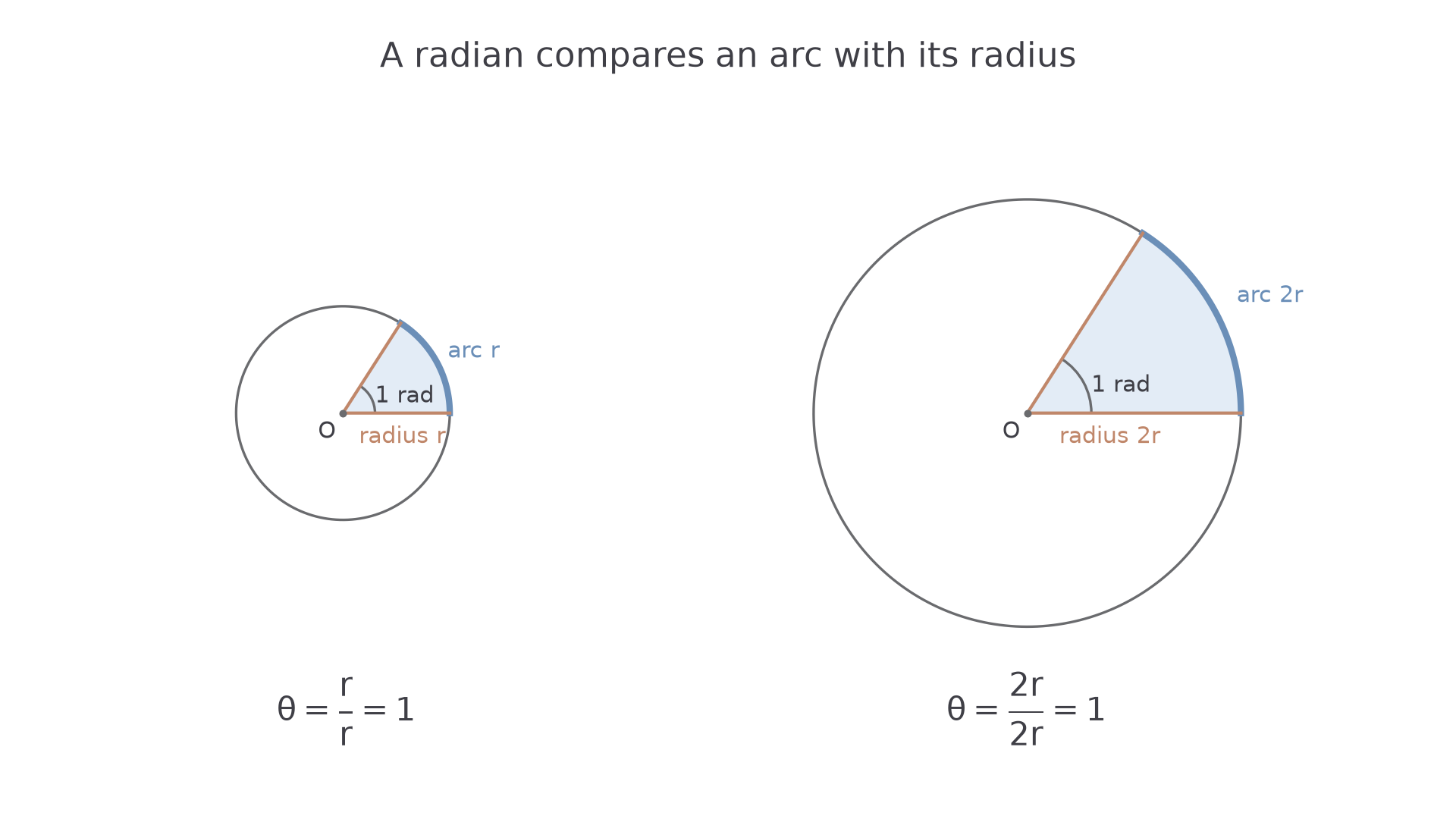
Imagine marking a length equal to a circle's radius along its circumference. Join the two ends of that arc to the centre. The angle between the radii is one radian. It is the same angle on a small circle as on a large one because enlarging a circle multiplies its radius and arc lengths by the same factor.
Radian
One radian is the angle at a circle's centre subtended by an arc whose length equals the radius. More generally, an arc of length on a circle of radius subtends an angle
Measure and in the same length unit before taking their ratio.
A whole circumference has length . Its angle is therefore radians. Half a turn is radians and a quarter-turn is radians. A radian is a unit of angle; it is a ratio of lengths, so its numerical value has no length unit.
[DIAGRAM: asset_name: An arc equal to a radius; asset_slug: radian-arc-radius; caption: Doubling both an arc length and its radius preserves the angle of one radian; description: Two circles show sectors with equal central angles of one radian. In the smaller circle the radius and highlighted arc each have length r. In the larger circle both are doubled to 2r. The ratios r over r and 2r over 2r both equal one.]
Use the definition before memorising conversions.
Worked example 1: an arc equal to the radius
Question. An arc of length lies on a circle of radius . Find the angle it subtends at the centre in radians.
Plan. Divide the arc length by the radius, using matching units.
Answer. radian.
Check. The arc and radius have equal lengths, which is exactly the defining case for one radian.
An arc can span several radius-lengths. The same ratio gives its angle.
Worked example 2: an enlarged circle
Question. An arc has length on a circle of radius . Find its central angle. The circle and arc are then enlarged by scale factor ; find the new angle.
Plan. Compare the original and enlarged ratios.
After enlargement, the arc length is and the radius is , so
Answer. Both angles are radians.
Check. The arc occupies the same fraction of each circumference, so the central angle must be unchanged.
For an ordinary arc traversed no more than once, use . An angle greater than is a reflex angle and corresponds to the longer arc between its endpoints. Specify which arc is intended: the same two endpoints usually determine two arcs.
Converting angle units
Degrees and radians describe the same angle on different numerical scales. A half-turn gives the bridge between them: radians. A conversion changes the number and unit together, while keeping the angle itself fixed.
Degrees and radians
The conversion relationship is not listed in MF19. Keep exact when an exact answer is required.
For example, , and . Reconstruct these from a half-turn rather than memorising an unrelated list.
Worked example 3: degrees to exact radians
Question. Express in radians, giving an exact answer.
Plan. Multiply by the number of radians in one degree and simplify the fraction.
Answer. radians.
Check. is of a half-turn, so its angle must be of radians.
Now reverse the direction of conversion. A reflex angle remains reflex in either unit.
Worked example 4: radians to degrees
Question. Express radians in degrees.
Plan. Multiply by , cancelling before calculating.
Answer. .
Check. , which is a half-turn plus , giving .
A radian answer does not need to contain : radians is a perfectly valid angle. Use the same conversion for decimal inputs. Write the degree symbol only on degree values; radians and are very different angles.
Watch out
Set the calculator's angle mode to match the input when using , , or their inverses. Merely typing does not switch a calculator to radian mode. A multiplication such as itself is ordinary arithmetic.
Practise one exact conversion and one decimal conversion.
Arc lengths
The radian definition rearranges immediately to . You can also derive it by taking the fraction of a whole circumference: . Both arguments depend on measuring the angle in radians.
Arc length
This formula is supplied in MF19. Rearrangements are and, for , .
A sector is the region bounded by two radii and their connecting arc. For , its perimeter includes both radii as well as the arc: . A full disc has no radial edges in its outside boundary, so its perimeter is just .
Worked example 5: arc and sector perimeter
Question. A sector has radius and angle radians. Find its arc length and perimeter exactly.
Plan. Multiply radius by radian angle for the arc, then add the two straight radii.
Answer. Arc length ; perimeter .
Check. The angle is of a full turn, and , agreeing with the arc length.
The formula also works backwards when a radius is unknown.
Worked example 6: recovering the radius
Question. A sector's arc length is and its central angle is radians. Find its radius and perimeter.
Plan. Divide the arc length by the angle, then include both straight edges.
Answer. Radius ; perimeter .
Check. With the recovered radius, the fraction of the circumference used is . Multiplying that fraction by gives the stated angle radians.
Before calculating a mixed perimeter, trace its outside edge. An arc length alone is not the perimeter of a sector, and a line drawn inside a shape does not automatically belong to its perimeter.
Quick Recap
- A radian measures arc length as a multiple of the radius: .
- radians is a full turn; radians is .
- Use with a radian angle, and keep length units consistent.
- Trace the actual boundary when combining arcs with straight lengths.