4.4 - Connected particles
A string or tow-bar links the motions of different bodies, but each body still has its own forces. You will use the modelling assumptions behind strings and pulleys, choose between whole-system and individual equations, and distinguish a connector pulling in tension from a rigid connector pushing in thrust. A change of constraint starts a new stage.
Strings and pulleys
Two unequal hanging masses are joined over a pulley. Why is the tension not simply the weight of either mass? Both masses accelerate, so neither has balanced forces.
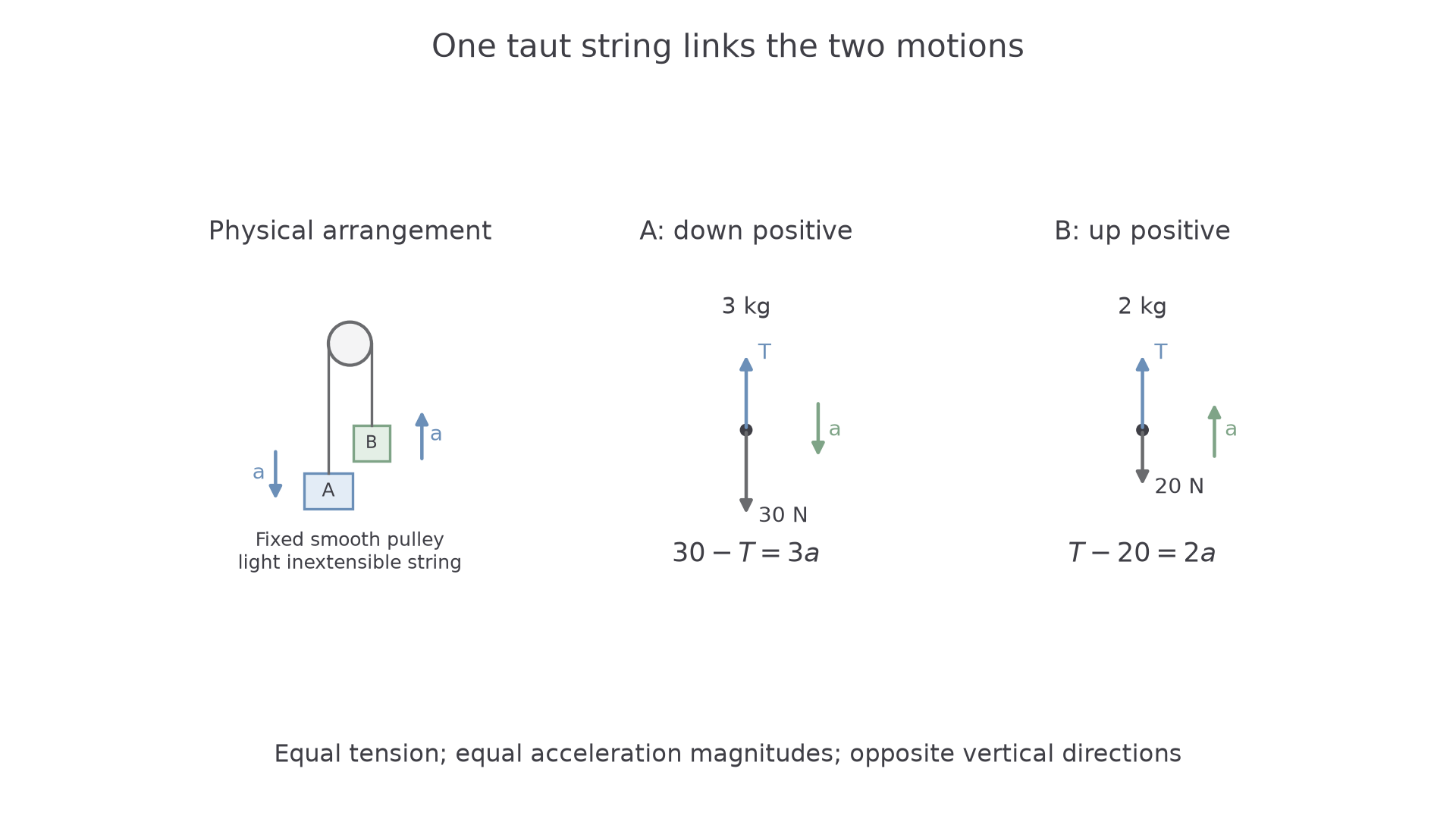
Consider masses and hanging from a taut string over one fixed pulley. If the first descends , the other must rise : the string's total length does not change. Their speeds and acceleration magnitudes therefore match, with opposite vertical directions.
Light inextensible string
A light string has negligible mass. An inextensible string does not stretch. When it remains taut over a fixed smooth pulley, the simple two-particle arrangement has equal tension in its two sections and equal acceleration magnitudes along those sections. A smooth pulley offers no frictional resistance to the string.
These conclusions rely on the stated arrangement. Inextensibility does not mean zero acceleration; smoothness does not mean zero tension. A string pulls away from each particle and cannot push. The equations apply while the string is taut and neither body has reached an obstruction or the pulley.
[DIAGRAM: asset_name: One string, two body equations; asset_slug: connected-fixed-pulley; caption: The masses have equal acceleration magnitudes, but the force balances differ; description: A light inextensible string passes over a fixed smooth pulley. Mass A is 3 kilograms on the left and B is 2 kilograms on the right. On A, tension T acts up and weight 30 newtons down. On B, tension T acts up and weight 20 newtons down. Separate acceleration arrows show A down and B up, both magnitude a. Under the two force diagrams are 30 minus T equals 3a and T minus 20 equals 2a.]
Worked example 1: unequal hanging masses
Question. Particles A and B, of masses and , are joined by a light inextensible string over a fixed smooth pulley. Both hang freely and are released from rest with the string taut. Find their acceleration and the tension.
Plan. Take A down and B up as their positive directions, and use the common acceleration magnitude .
Answer. A accelerates down and B up at ; tension .
Check. On A, . On B, . The positive tension is less than A's weight but greater than B's, as their accelerations require.
Reduce only B's mass. The weight difference increases while the total mass decreases, so expect a larger acceleration.
Worked example 2: a lighter partner
Question. Replace B by a particle, leaving A at and the same ideal string and pulley. Find the acceleration and tension after release from rest.
Plan. Keep A down and B up positive, but use B's new mass in both its weight and its term.
Answer. A down and B up at ; tension .
Check. A has downward resultant ; B has upward resultant . The acceleration remains below free fall because the string pulls upwards on A.
If equal masses are released from rest in this model, the equations give , and the tension equals either weight. Equal mass does not invalidate Newton's law; it gives its equilibrium case.
Watch out
The tension is the same on the two bodies, but its direction is along the string away from each body. Here both tension arrows point up; it is the chosen positive directions for the two motions that differ.
Link two body equations for a new pair of hanging masses.
A system or separate bodies
Adding suitable individual equations can remove an internal tension and reveal the acceleration directly. To recover that tension, you must return to one body: the tension has disappeared from the whole-system equation.
For a particle on a table joined over an edge pulley to a hanging particle, choose positive along each particle's possible motion. Do not add their weights as if both acted along the string. The table supports one weight; the hanging weight supplies the driving component.
Worked example 3: a smooth table
Question. A particle A rests on a smooth horizontal table. It is connected to a freely hanging particle B by a light inextensible string over a fixed smooth edge pulley. The table section of string is horizontal. They are released from rest with the string taut. Find the acceleration and tension.
Plan. Take A towards the pulley and B down positive. Add the body equations for acceleration, then isolate A for tension.
Answer. Acceleration magnitude ; tension .
Check. B's downward resultant is . A's weight is balanced by the table's normal force and does not enter its horizontal equation.
Change only the table to a rough one. Friction on A now subtracts from the combined driving force.
Worked example 4: friction and a later slack string
Question. In Example 3 the table is instead rough with , and B initially hangs above the floor. Find acceleration and tension while the string is taut, and the speed just before B hits the floor. After B hits the floor it stays there, the string goes slack, and A continues on the table without reaching the pulley. Find how much farther A travels before stopping.
Plan. Include friction in A's equation, calculate the common speed at impact, then begin a new stage for A with zero tension.
A has , so sliding friction is , away from the pulley. At release, the hanging weight exceeds the friction limit, justifying this motion.
Once the string is slack, A has horizontal equation , giving . Until A stops,
Answer. While taut: , . Speed before impact ; A then travels a further .
Check. The taut stage lasts , giving A displacement . Its second stage lasts , with mean speed , confirming .
Continue this lesson.
You’re previewing NovaLearn without an account. Create a free account to read the rest.
Create free account