1.3 - Lines meeting circles
How can algebra distinguish a line that cuts a circle twice from one that just touches it? In this part of 1.3, you will find intersection coordinates, construct a tangent using its radius, and use a repeated root to determine an unknown tangent. The same equations explain all three possibilities: two meetings, one meeting or no meeting.
Line–circle intersections
An intersection belongs to both the line and the circle, so its coordinates must satisfy both equations. Substitute the line's expression for one coordinate into the circle equation. The resulting quadratic finds the other coordinate; substitute each root back into the line to recover its partner.
Chord and tangent
A chord is a line segment whose endpoints lie on a circle. A line through two distinct points on a circle cuts a chord. A tangent meets a circle at exactly one point, its point of contact.
A quadratic root is an input coordinate, not a whole point. Keep each calculated output with the input that produced it.
Worked example 1: an oblique chord
Question. Find the intersections of and .
Plan. Substitute , solve for , then use the line for each .
Thus gives , while gives .
Answer. and .
Check. The squared distances from the centre are and . Both points also satisfy .
A vertical line has no finite gradient, but substitution still works. This time its equation already supplies .
Worked example 2: a vertical chord
Question. Find the intersections of the same circle with .
Plan. Substitute the fixed -coordinate and solve the remaining square equation.
Therefore or .
Answer. and .
Check. Their midpoint is , level with the centre. Each endpoint is units above or below that midpoint, matching the circle's symmetry.
After a genuine line substitution, the quadratic has positive leading coefficient. Its discriminant tells us how many real coordinate pairs exist: positive gives two distinct intersections; zero gives one; negative gives none. A repeated root counts as just one point.
A tangent and its radius
The radius to a point of contact is perpendicular to the tangent. You can therefore construct a tangent from the centre and a point on the circle, using the perpendicular-line method you already know.
Why does the right angle matter? If is perpendicular to a line through , every other point on that line has . Those points lie outside the circle, leaving as its only meeting point. Conversely, a line through that is not perpendicular to has its nearest point to at a distance less than , so it cuts through the circle.
Tangent from a radius
For a point on a circle with centre , its tangent passes through and is perpendicular to . When both gradients are finite,
A horizontal radius gives a vertical tangent; a vertical radius gives a horizontal tangent. This circle property is not listed in MF19.
Check that the specified point is on the circle before treating it as a point of contact. The radius from the centre to an outside point does not directly give a tangent through that point.
Worked example 3: a sloping radius
Question. Find the tangent to at .
Plan. Find the radius gradient, take its negative reciprocal and use the point .
Since , is on the circle. The centre is , so
Hence
Answer. .
Check. Substituting into the circle and clearing fractions gives . There is just one intersection, at , .
The chord in the first example passes through , but it crosses the circle. The perpendicular radius picks out the unique line that only touches there.
[DIAGRAM: asset_name: A chord and a tangent; asset_slug: circle-chord-and-tangent; caption: The chord crosses at two points, while the tangent is perpendicular to the radius at P; description: Equal-scale coordinate axes show the circle with centre C at 1 comma minus 2 and radius 5. The line y equals x minus 2 cuts it at P 4 comma 2 and Q minus 3 comma minus 5. The tangent 3x plus 4y minus 20 equals zero passes through P, with CP drawn and a right angle marked between radius and tangent.]
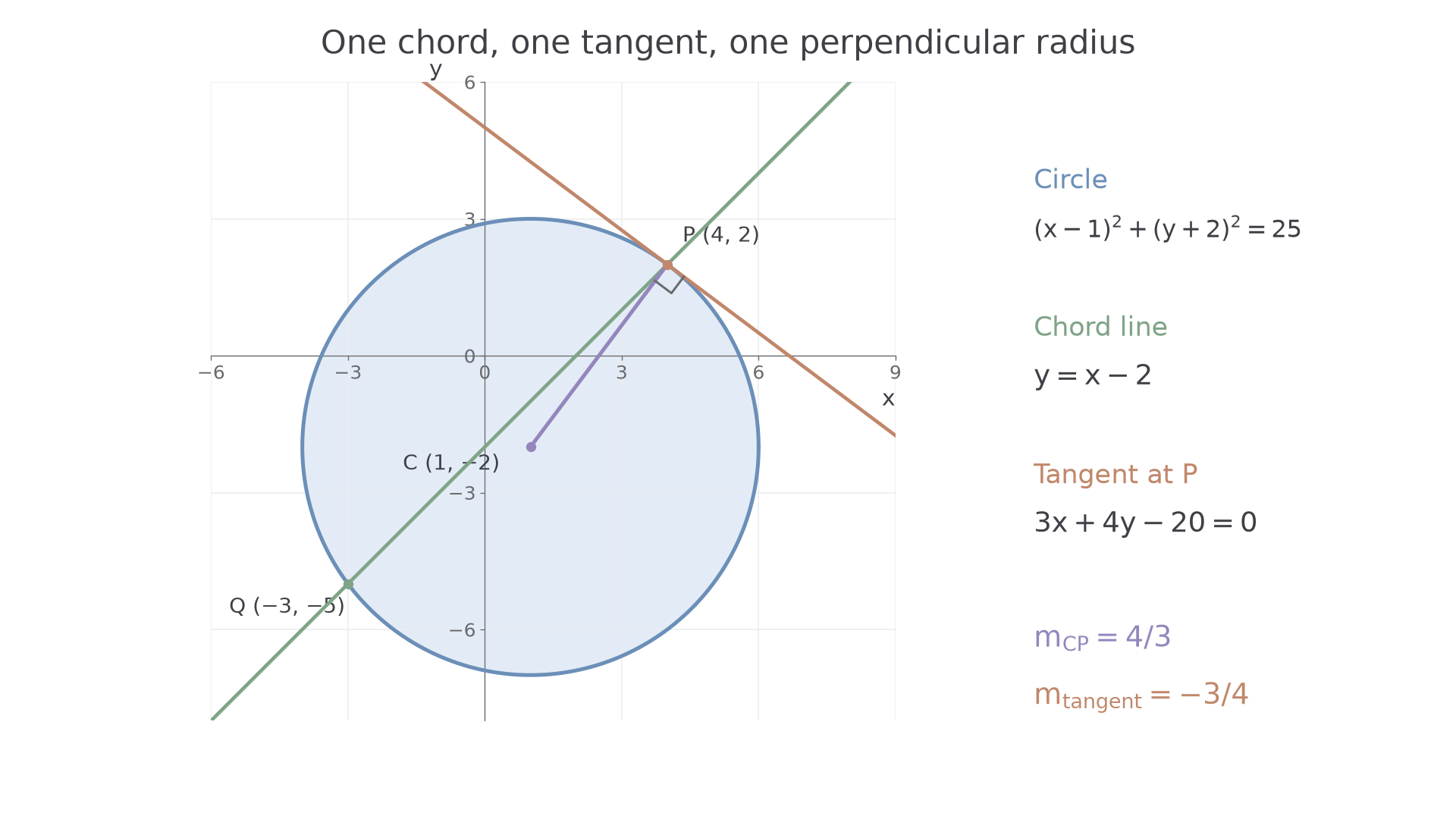
A zero radius gradient needs a geometric decision rather than a reciprocal calculation.
Worked example 4: a horizontal radius
Question. Find the tangent to the same circle at .
Plan. Compare with the centre to identify the radius direction.
The radius lies on , a horizontal line. Its perpendicular through is vertical.
Answer. .
Check. Substituting gives , so only. This confirms one point of contact.
Similarly, the top point has a vertical radius and horizontal tangent . No gradient division is needed in either axis-aligned case.
Tangency with a parameter
When the contact point is unknown, start with the line and circle equations. A tangent produces a quadratic with one repeated real root, so set its discriminant equal to zero. First form the quadratic in the coordinate; only then use its coefficients to find the parameter.
Key idea
A line is tangent to a circle precisely when substitution produces one repeated coordinate root. For the resulting quadratic , set . Recover the contact coordinate from that repeated root, , then find its partner from the line.
The quadratic formula is supplied in MF19; its repeated-root and discriminant interpretations need to be understood. This method uses algebra and circle geometry throughout.
Worked example 5: an unknown intercept
Question. Find the values of for which is tangent to , and find both points of contact.
Plan. Substitute the line, impose a repeated root and use that root separately for each .
For tangency,
Thus . The repeated root is , and .
Answer. For , contact is ; for , contact is .
Check. Each contact has . Each radius has gradient , perpendicular to the tangent gradient .
The same discriminant also gives a complete position test: when , so those lines cross twice. At the boundary values they touch; for or , they miss the circle.
Now let the gradient vary while the line passes through a fixed outside point.
Worked example 6: two tangents from an outside point
Question. A line is tangent to . Find and the contact coordinates.
Plan. Keep symbolic in the substituted quadratic. After finding its values, use .
The discriminant condition gives
For either gradient, . Thus
Answer. touches at ; touches at .
Check. At either contact, . The radius gradients are respectively and , each with product with its tangent gradient. Both tangents pass through .
The line through an outside point need not have two intersection points: each of these two special directions makes its pair of roots merge. Keep the signs paired when stating which tangent touches at which point.
Quick Recap
- Substitute a line into a circle and recover both coordinates for every real root.
- A tangent is perpendicular to the radius at its contact point.
- With unknown contact, tangency makes the substituted quadratic's discriminant zero.
- Positive, zero and negative discriminants describe two, one and no intersections respectively.