1.8 - Volumes of revolution
Rotating a flat region about an axis creates a solid. You will build its volume from circular cross-sections, choose the correct radius and limits for either coordinate axis, and subtract an inner volume when the solid has a hole.
Discs about the x-axis
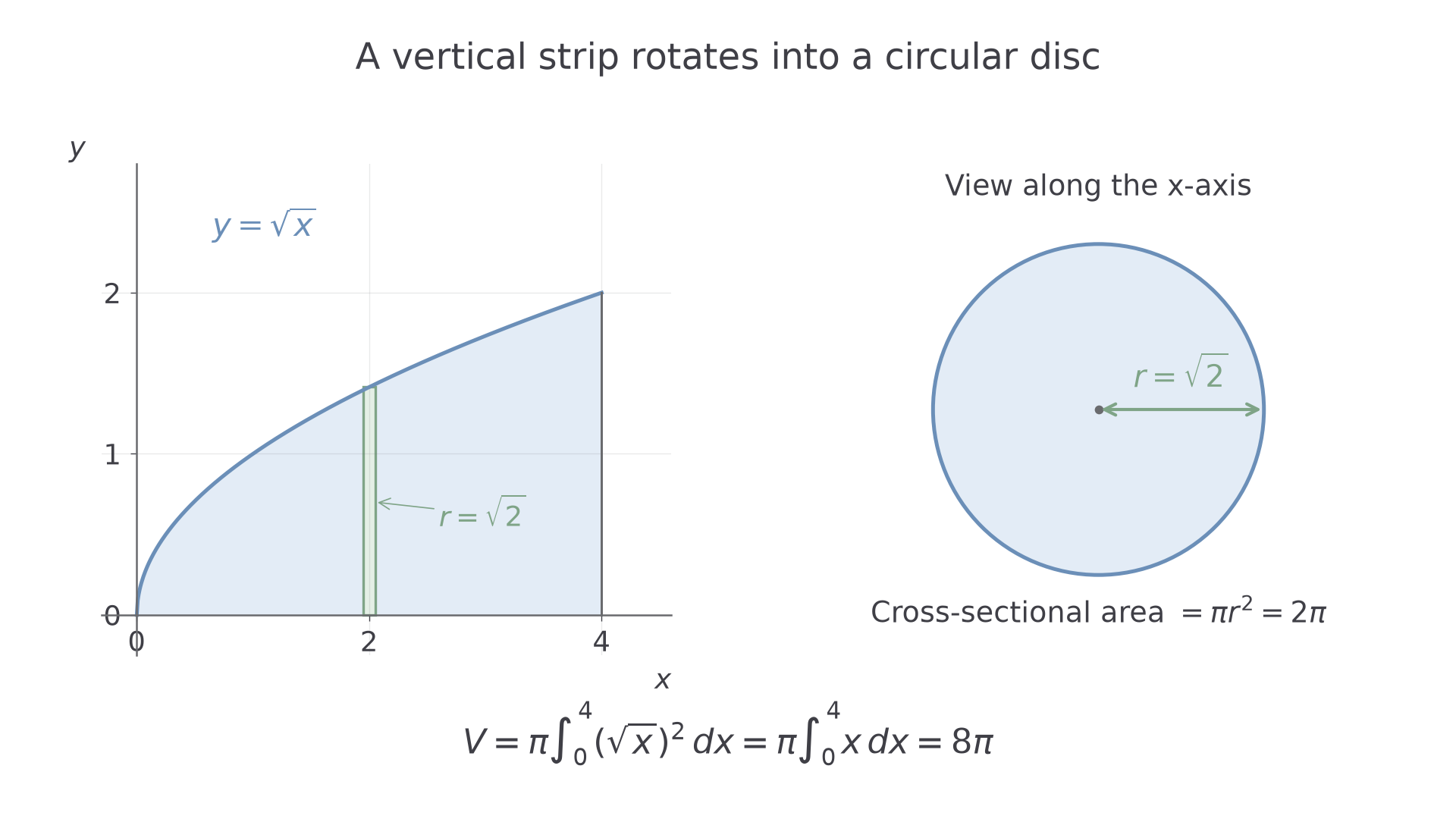
When the region under , from to , makes one complete turn about the -axis, why does its volume involve , rather than ? A thin vertical strip rotates into a thin circular disc. Its radius is , so its cross-sectional area is .
A disc of small thickness has volume approximately . Adding these and letting the thickness approach zero gives an integral. The squared radius comes from the area of a circle; integrating instead would calculate a flat area.
Solid of revolution
A solid of revolution is generated by rotating a plane region through one complete turn about a line. In a disc calculation, the radius is the perpendicular distance from the axis to the region's outer boundary.
Distance is non-negative. For a curve below the -axis the radius is , and its square is still .
Discs about the x-axis
For the region between and the -axis over , with ,
Each cross-section perpendicular to the axis is a disc. Use -limits because the thickness is .
Not in the formula booklet: learn it.
Square the complete expression for the radius before integrating. If , the integrand is , which can be expanded or integrated as a linear bracket.
Worked example 1: discs above the axis
Question. The region between , the -axis and is rotated through about the -axis. Find the exact volume.
Plan. Square the radius and integrate from to .
Answer. cubic units.
Check. The cross-sectional area increases linearly from to ; its average is . Multiplying by the length gives .
Reflect only the region in the -axis. Its distances from the axis, and therefore its rotating discs, stay the same.
Worked example 2: discs below the axis
Question. The region between , the -axis and is rotated through about the -axis. Find the exact volume.
Plan. Use radius , or square the negative boundary value directly.
Answer. cubic units.
Check. The reflection produces exactly the same solid as example 1 after a complete turn. A negative curve height cannot make a volume negative.
The disc picture connects the generating strip with its circular cross-section.
[DIAGRAM: asset_name: A strip becomes a disc; asset_slug: discs-x-axis; caption: The radius is square root of x, so the circular cross-section has area pi times x; description: A left panel shows the region under y equals square root of x from zero to four, with a vertical generating strip at x equals two and radius square root of two. A right panel shows its circular cross-section perpendicular to the x-axis, labelled radius square root of two and area two pi. The formula V equals pi integral zero to four of x dx equals eight pi is shown below.]
Watch out
, not , for these discs about the -axis. Write the radius and its square before integrating.
Use a linear boundary whose whole expression needs squaring.
Rotation about the y-axis
For rotation about the -axis, take horizontal strips. Each disc's radius is a horizontal distance , and its thickness is . Rewrite the curve so that is expressed in terms of , then use lower and upper -coordinates as the limits.
This often avoids solving explicitly for . For , the needed square is already . The relation applies to either branch, but specify the actual region before calculating its rotation.
Discs about the y-axis
If bounds a region with the -axis for , where , then
Use the square of the horizontal radius and -limits.
Not in the formula booklet: learn it.
The integral variable is chosen by the disc thickness, not by which letter appears first in the original equation.
Worked example 3: expressing the squared radius directly
Question. The region in bounded by , the -axis and is rotated through about the -axis. Find the exact volume.
Plan. Use horizontal discs from to , with .
Answer. cubic units.
Check. At height , the cross-sectional area is . Its average over is , so the volume over height is .
Change only the curve's coefficient to , keeping the top height . Every horizontal radius is reduced by a factor .
Worked example 4: changing the radius scale
Question. The region in bounded by , the -axis and is rotated through about the -axis. Find the exact volume.
Plan. Express the squared radius as before integrating.
Answer. cubic units.
Check. Compared with example 3, each squared radius and hence each disc area is halved, while the height range is unchanged. The volume should be halved, agreeing with .
The horizontal generating strip makes the use of visible.
Continue this lesson.
You’re previewing NovaLearn without an account. Create a free account to read the rest.
Create free account