2.4, 3.4 - Differentiating exponentials and logarithms
The height of an exponential curve also tells you its gradient. You will use that special property of , differentiate natural logarithms and apply the chain rule to find rates of change and tangent equations.
The derivatives of exp and ln
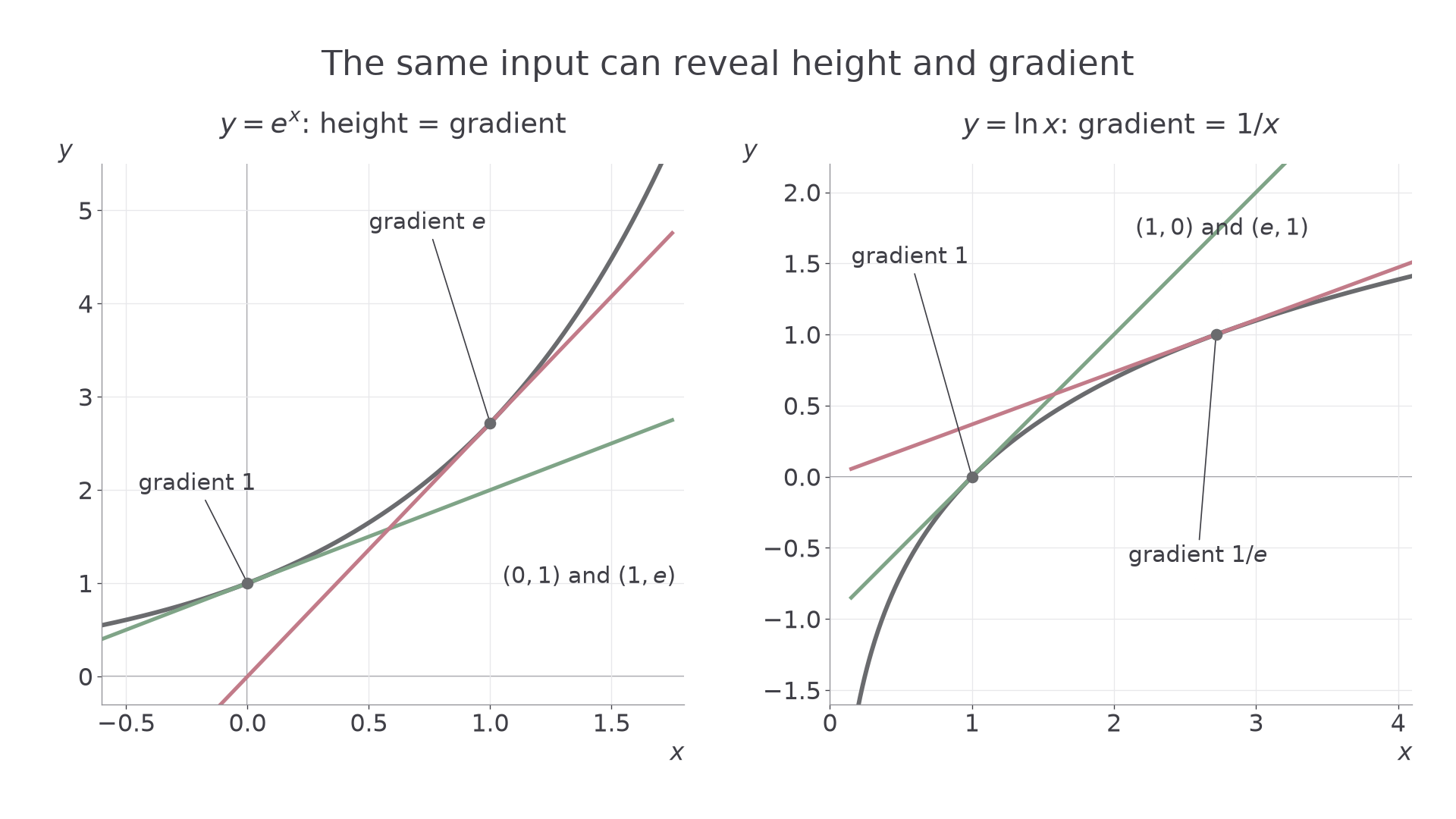
Which curve has gradient equal to its height at every point? For , the gradient is at height , at height , and so on. This is the special calculus property of the base .
A small horizontal change near gives . The limiting gradient is . More generally, the difference quotient for contains the factor , giving the same limiting factor at every .
Exponential and logarithmic derivatives
These derivatives are in the formula booklet.
Why does the logarithm have derivative ? If , then . A small change gives , so the reciprocal gradient is . Here : that is the domain of , even though the expression also exists for negative .
[DIAGRAM: asset_name: Height and gradient; asset_slug: exponential-logarithm-tangents; caption: The exponential gets steeper as it rises, while the logarithm gets less steep; description: Two coordinate panels show y equals e to the x with tangents at zero comma one and one comma e, and y equals natural log x with tangents at one comma zero and e comma one. The tangent gradients are labelled one and e in the exponential panel, and one and one over e in the logarithm panel.]
Worked example 1: an exponential in a sum
Question. Differentiate .
Plan. Differentiate each term and keep its constant multiplier.
The exponential stays unchanged; the power rule applies to the quadratic.
Answer. , for every real .
Check. At , the exponential contributes gradient and the quadratic contributes , giving .
Replace the exponential with a logarithm. The linearity of differentiation stays the same; its domain changes.
Worked example 2: a logarithm in a sum
Question. Differentiate , stating the domain.
Plan. Differentiate term by term, retaining from the logarithm.
Answer. , for .
Check. Near , the central difference , agreeing with .
The derivative formula does not extend the original function's domain.
Watch out
. Its derivative is . For , is not real; the different function has derivative on each interval avoiding , because there and the chain rule gives .
Apply the two basic derivatives in one expression.
Chain-rule derivatives
An exponential or logarithm can contain a whole function of . For , increasing by a small amount changes the exponent three times as quickly. The derivative therefore needs the factor .
You already know
The chain rule differentiates the outside function, keeping the inside intact, then multiplies by the derivative of the inside. If and , then .
Apply that reasoning to the two new outside functions.
Composite exponentials and logarithms
For differentiable ,
The basic derivatives are in the formula booklet; these composite forms follow by the chain rule.
The denominator in the logarithmic derivative is the whole inside function.
Worked example 3: a quadratic exponent
Question. Differentiate .
Plan. Keep the exponential, then multiply by the derivative of .
Answer. , for every real .
Check. At , the exponent has its minimum. The exponential increases with its input, so the composite also has a horizontal tangent there; the derivative is indeed .
Keep a quadratic inside, but change the outside function to a logarithm. Now checking its domain is essential.
Continue this lesson.
You’re previewing NovaLearn without an account. Create a free account to read the rest.
Create free account