3.9 - Loci in an Argand diagram
An equation in a complex number can describe an entire set of points. You will read modulus conditions as distances, equal moduli as equal distances, and an argument condition as a direction from a fixed point. Combining those ideas will let you describe regions and keep their boundaries precise.
Distances from fixed points
Which points satisfy ? If , then . Its modulus is the distance from to , so the equation fixes that distance at .
Locus
A locus is the set of points satisfying a given condition. In an Argand diagram, is the distance from the point representing the fixed complex number to the point representing .
This is the same endpoint-minus-start displacement used in complex subtraction. It gives a direct translation between distance language and equations.
Circle and disc
For a fixed complex number and real :
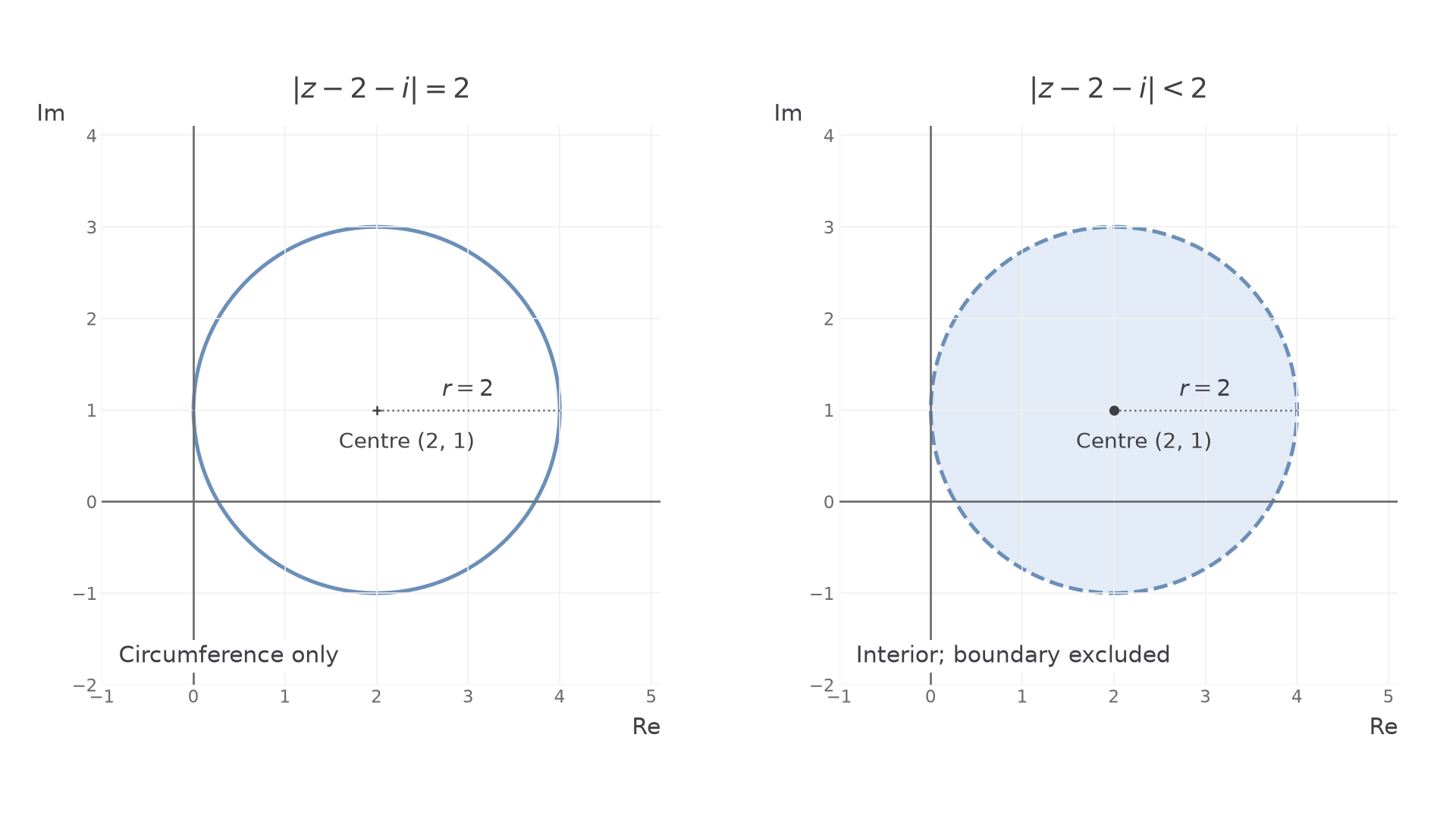
- is the circle with centre and radius .
- is its interior, with the circumference excluded.
- is the closed disc, including the circumference.
- or describes the exterior, excluding or including the circumference respectively.
These locus rules are not listed in MF19.
Draw an included boundary as a solid line and an excluded boundary as a dashed line. Shading identifies the selected region, rather than changing the meaning of the boundary.
Worked example 1: a fixed distance
Question. Describe the locus , and give its Cartesian equation.
Plan. Rewrite the expression as a displacement from one fixed point.
Answer. The circumference of a circle, centre , radius .
Check. and each give modulus . The centre itself gives zero, so it is not on this locus.
Change only equality to a strict inequality. The same circle becomes a boundary rather than the entire set.
Worked example 2: less than the fixed distance
Question. Describe the locus , including its boundary convention.
Plan. Use the same centre and radius, selecting points whose distance is smaller.
Squaring preserves the inequality because both sides are non-negative.
Answer. The interior of the circle with centre , radius , excluding the circumference.
Check. The centre has distance , so it is included. The point has distance exactly , so it is excluded.
The panels distinguish a circle from its interior.
[DIAGRAM: asset_name: A fixed distance and a distance bound; asset_slug: complex-circle-disc; caption: Equality selects the circumference, while a strict upper bound selects the interior and excludes that circumference; description: Two equal-scale Argand panels have centre 2 comma 1 and radius 2. Left shows a solid circle for modulus z minus 2 minus i equals 2. Right shades the interior pale blue and draws a dashed circumference for modulus z minus 2 minus i less than 2. The centre is marked and included only in the right locus.]
Check the signs inside the bracket: has centre . Also check the radius condition before describing a circle. If , equality gives just ; a negative cannot equal a modulus. The strict condition has no points.
Watch out
describes a whole region, not just a dashed circle. The dashed circle is the excluded boundary; the interior must also be identified.
Now describe an exterior rather than an interior.
Equal distances
If , the point is equally far from two fixed points. For distinct , the set is the perpendicular bisector of the segment joining them.
Why a straight line? At the segment's midpoint the distances agree. Every point on the perpendicular through that midpoint forms two right triangles with equal perpendicular height and equal half-base, so Pythagoras gives equal distances. Conversely, equating the squared distances cancels the and terms, leaving exactly that line.
Equal-distance locus
For ,
is the complete perpendicular bisector of the segment joining and . If , both distances are identical for every , so the locus is the whole plane. This result is not listed in MF19.
Worked example 3: fixed points at the same height
Question. Describe , and find its Cartesian equation.
Plan. Identify the two fixed points and use the midpoint of their horizontal joining segment.
The points are and . Their midpoint is ; the joining segment is horizontal.
Answer. The complete vertical line , the perpendicular bisector of .
Check. At a general point , the squared distances are both . There is no restriction on .
Move only the second point upwards. The bisector is now oblique, so equating squared distances is convenient.
Worked example 4: an oblique joining segment
Question. Find the locus as a Cartesian line equation.
Plan. Put , square the two non-negative distances, and simplify.
Answer. The complete line .
Check. The fixed points are and , with midpoint , which lies on the answer. Their joining gradient is ; the answer has gradient , so it is perpendicular.
The perpendicular bisector extends in both directions; its points need not lie between the fixed points.
Continue this lesson.
You’re previewing NovaLearn without an account. Create a free account to read the rest.
Create free account