1.7 - From chords to a tangent
A curve does not have one gradient for its whole length. You will find its gradient at a particular point by bringing a second point closer, then connect this idea to first and second derivatives. This gives a precise meaning to the slope you see in a sketch.
A chord approaches a tangent
What is the gradient of exactly at ? A single point gives no rise and run. Start with a second point on the curve, calculate the gradient of the line joining them, then move that second point closer.
You already know
The gradient of a non-vertical straight line through two points is change in divided by change in . Use the same subtraction order in the numerator and denominator.
The line segment joining two points on a curve is a chord. Keep fixed and let , where . Its gradient is
Here is a horizontal change, not a point's coordinate. Positive puts to the right; negative puts it to the left.
[DIAGRAM: asset_name: Chords approaching a tangent; asset_slug: chords-to-tangent; caption: Moving Q towards P brings the chord gradient towards 2 from either side; description: Two plots of y equals x squared near P at 1 comma 1. The left shows chords from P to points with x coordinates 2 and 1.5, with gradients 3 and 2.5. The right shows points with x coordinates 0.5 and 0.9, with gradients 1.5 and 1.9. Both show the limiting tangent y equals 2x minus 1 with gradient 2.]
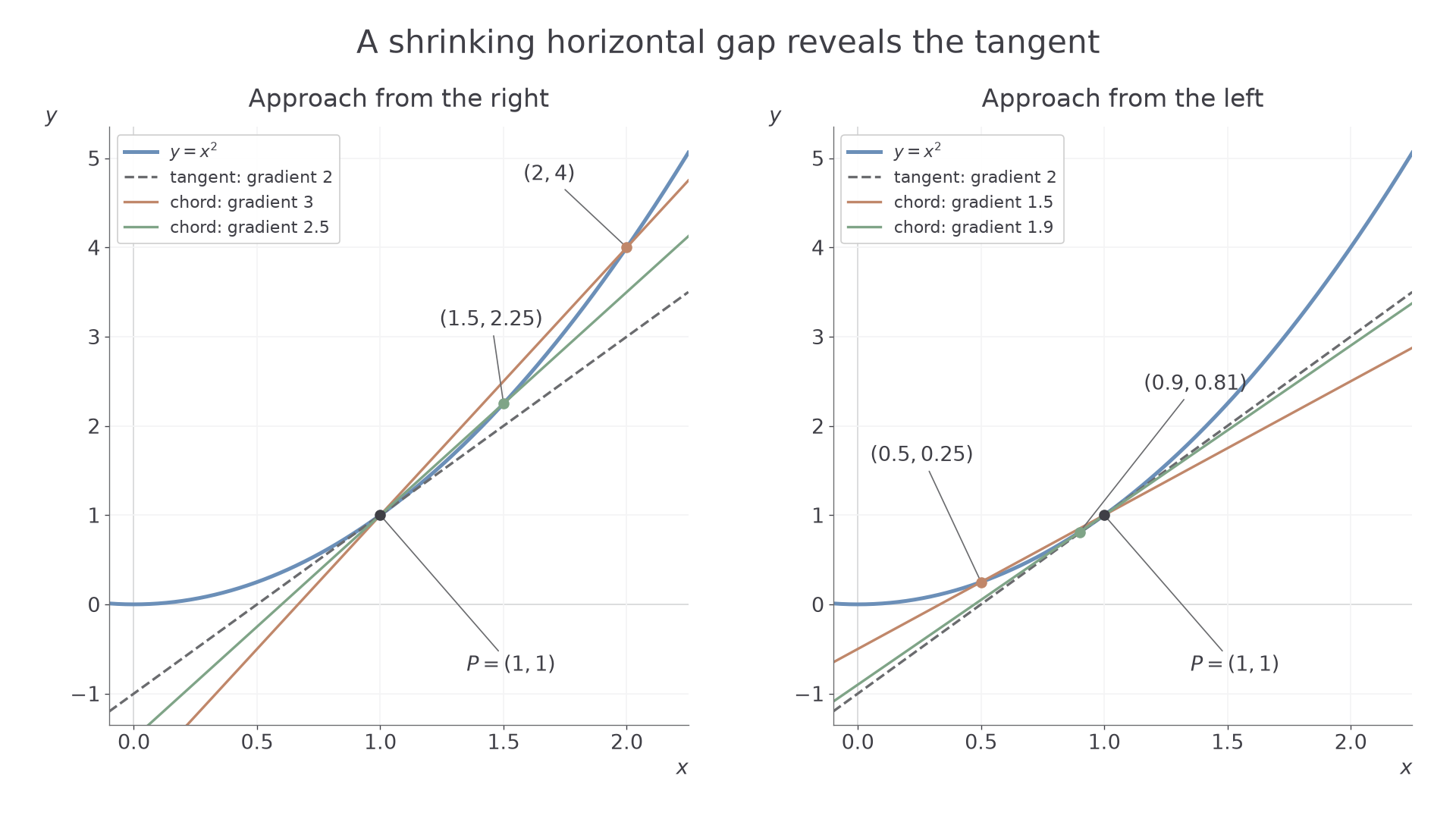
Worked example 1: approaching from the right
Question. For , find the gradients of chords from to points with , and .
Plan. Calculate each rise over its horizontal change from .
Answer. The gradients are , and , approaching .
Check. The horizontal changes are , and . Adding each to gives the same gradients.
Now change only the side from which approaches. Both rise and run will be negative.
Worked example 2: approaching from the left
Question. For the same curve and fixed point, find chord gradients when has , and .
Plan. Keep the order in both differences.
Answer. The gradients approach from below.
Check. With , the expression agrees with all three results. Two negative differences have given a positive gradient.
The same limiting value appears from both sides. This is stronger evidence than one isolated chord.
Watch out
At , the chord calculation becomes , which is undefined. Bring distinct points closer; do not call the gradient.
Try a different fixed point on the same curve.
The derivative at a point
The value approached by the chord gradients is called a limit. You only need the informal idea here: as the horizontal gap becomes arbitrarily small, the gradients settle towards one value. The resulting line through the fixed point is the tangent.
Derivative at a point
The derivative is the gradient of the tangent to at , when that finite limiting gradient exists. It is approached by as nonzero approaches zero.
A tangent describes the curve's local direction. It need not meet the whole curve only once, and it may cross a curve. Its defining feature is its limiting direction at the chosen point.
For at , expand the specific chord calculation:
As approaches zero, the last two terms approach zero. The chord gradient approaches . We have justified this particular limiting value without needing a general first-principles differentiation procedure.
Worked example 3: a cubic from the right
Question. Use and to investigate the tangent gradient of at .
Plan. Substitute the two gaps into the simplified chord gradient.
Answer. These gradients approach , so they support .
Check. Directly, .
Change only the sign of the gaps to check the other side.
Worked example 4: a cubic from the left
Question. Repeat the investigation with and .
Plan. Substitute the negative gaps before evaluating their squares.
Answer. The same limit is approached from below.
Check. Directly, . The sign is positive, as the curve rises near .
The limiting expression explains the value; rounding one nearby chord does not establish an exact derivative. At a sharp corner, for example, the two sides can give different limits, so a derivative need not exist at every point of every curve.
Key idea
is a height; is a gradient. They answer different questions about the same point.
Use the difference between a nearby chord and its limiting value.
First and second derivatives
Repeat the tangent calculation at different inputs and you obtain a new function: the gradient function. For , the tangent gradients at are . The general gradient function is , which you will learn to calculate directly next.
First and second derivatives
For , the first derivative is written or . Differentiating the gradient function gives the second derivative, written or . It measures how the gradient changes as changes.
The superscript in records differentiating twice. It does not mean squaring . In the quadratic example, is a straight line of gradient , so .
[DIAGRAM: asset_name: A curve and its gradient function; asset_slug: first-second-derivatives; caption: Tangent slopes on the parabola become heights on its gradient graph; description: Left plot shows y equals x squared, tangents at minus 1 comma 1 and 1 comma 1, and labelled points minus 2 comma 3 and 0 comma minus 1 on the first tangent and 0 comma minus 1 and 2 comma 3 on the second. Right plot shows f prime of x equals 2x through minus 1 comma minus 2, 0 comma 0 and 1 comma 2, with a rise of 4 over a run of 2.]
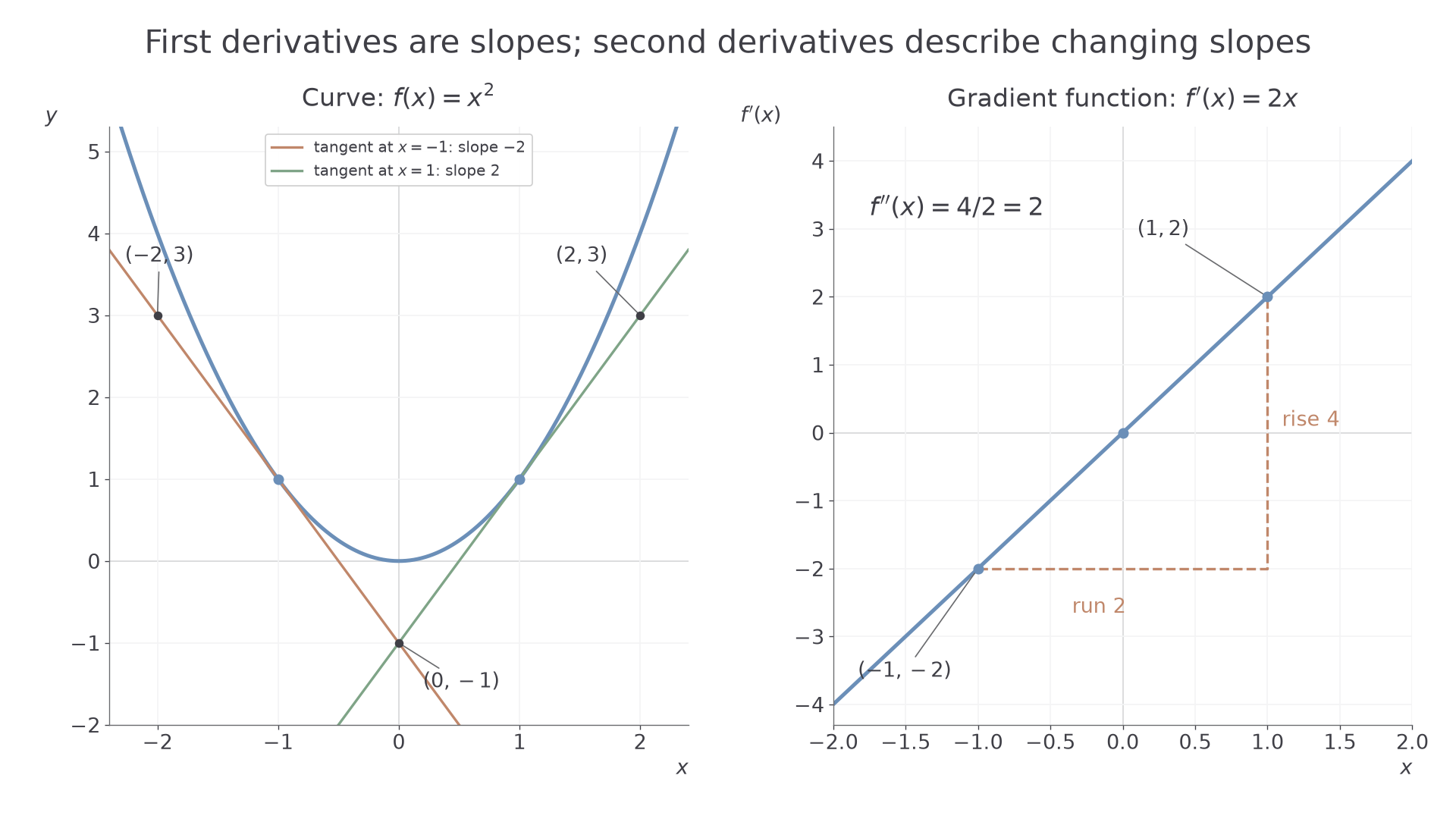
When estimating a gradient from a drawn curve, draw its tangent at the required point, then choose two well-separated readable points on that tangent. They need not lie on the curve.
Worked example 5: estimating a positive derivative
Question. A tangent to at passes through and . Estimate .
Plan. Find the gradient of the tangent using its two stated points.
Answer. .
Check. The tangent rises units over units horizontally, so a positive gradient of fits the drawing.
Change only the contact point to the left side of the parabola. The tangent now falls as you move right.
Worked example 6: estimating a negative derivative
Question. A tangent at passes through and . Estimate , then use and to find the gradient of the straight graph .
Plan. Find the tangent slope first, then the slope between the two points on the gradient graph.
Answer. ; the second derivative is for this straight gradient graph.
Check. Moving units along the gradient graph increases its height by , agreeing with .
The opening question now has an answer: the gradient at on is , although the curve's gradient changes elsewhere.
Watch out
Use points on the tangent to estimate . Joining two distant points on the curve gives a chord gradient instead. A graph estimate should be reported with suitable precision, not as an unjustified exact value.
Check both the notation and the slope calculation.
Quick Recap
- Chord gradients use two distinct points on the curve.
- The tangent gradient is their limiting value as the second point approaches the first.
- and describe a first derivative; and describe a second derivative.
- Estimate a curve's gradient using two readable points on its tangent.
At on , the chord gradients approach .