1.2 - Functions, domains and ranges
A function is more than a formula: its permitted inputs decide which outputs are possible and whether the rule can be reversed. In this part of 1.2, you will use mappings and familiar graphs to find domains and ranges, distinguish one–one functions from many–one functions, and choose useful domain restrictions.
One output for each input
Can two different inputs give the same output and still define a function? Squaring gives and . That is allowed. The crucial question is whether each individual input has exactly one output.
Function, domain and range
A function assigns exactly one output to each input in its domain. The domain is the set of permitted inputs. The range is the set of outputs actually obtained from those inputs.
The notation says that maps to ; gives one input–output pair. The symbol means the set of real numbers.
For the domain , the square function has arrows , , . Its range is : do not list twice. This is a many–one function because distinct inputs share an output. A mapping with two arrows leaving the same input for different outputs is not a function.
A graph represents a function of when every vertical line through its domain meets the graph exactly once. For example, passes this test. The circle does not: at , both and occur. Similarly, “” does not define a function on positive inputs. The usual symbol alone means the non-negative square root and does give one output.
Worked example 1: a finite domain
Question. The function is defined by for . State its range.
Plan. Apply the rule to every permitted input and collect the distinct outputs.
Each input has one output, although two inputs share .
Answer. The range is .
Check. Both listed values are attained, and all three permitted inputs have been used.
Now change only the domain. The same formula can define a different function because its allowed inputs have changed.
Worked example 2: changing the permitted inputs
Question. The function is defined by for . State its range and find . Is defined?
Plan. Evaluate the rule only at inputs in the stated domain.
The expression can be calculated, but is not a permitted input to .
Answer. Range , , and is undefined.
Check. The three distinct outputs come from the three stated inputs; the algebraic rule has not enlarged the domain.
When no restriction is stated and you are asked for the largest real domain, exclude inputs that make the rule undefined. For , exclude . For , require . If a smaller domain is explicitly supplied, respect it.
Watch out
The domain is not automatically . Writing down a formula does not permit division by zero or a real square root of a negative number.
Check the distinction between the number of inputs and the number of outputs.
Finding the range
To find a range, ask how low and how high the output can go, then check whether any boundary value is actually reached. A range is a set of output values, so use an inequality in , or introduce .
For a linear rule, the direction is easy to follow. If for , multiplying by positive and adding gives . The lower endpoint is excluded because is excluded. Every output between the endpoints occurs because the straight line has no gaps.
For a reciprocal, consider both sign and size. If for , then . Increasing positive makes its reciprocal smaller but never zero. Therefore the range is . The value is approached as grows, but no finite input produces it. This is why the boundary at zero is strict.
You already know
A completed square reveals a quadratic's vertex: has turning point . Use the domain to decide whether that vertex is available and which part of the curve remains.
A quadratic can turn inside an interval, so merely substituting the two endpoints can miss its minimum or maximum.
Worked example 3: a domain containing the vertex
Question. Find the range of for .
Plan. Check the vertex and both ends of the permitted interval.
The square is zero at , which is in the domain, so the minimum is . At the endpoints,
Throughout this interval, the largest distance from is , attained at . Thus the largest square is .
Answer. .
Check. The boundary outputs occur at and . For any , the input lies between and , so every claimed output is attained.
Keep the formula and upper endpoint, but place the domain strictly to the right of the vertex. Now the smallest output is approached rather than reached.
Worked example 4: an excluded boundary
Question. Find the range of for .
Plan. Follow the positive quantity across the stated interval.
Squaring preserves this order because all the quantities being squared are non-negative.
Answer. .
Check. . The equation would require , which is excluded. The continuous right-hand branch fills every value between.
The same endpoint reasoning applies to familiar power graphs. For example, increases through every real value, whereas has range . The graphs and require and , respectively; on these largest real domains their ranges are and . For a positive integer , , so must be excluded. The sign and whether the power is even or odd help you recognise the branches.
Watch out
An open domain endpoint need not give an open range endpoint. For , , the output is still attained at . Check whether another permitted input reaches the same height.
Apply the right-branch argument with a new vertex and endpoints.
One–one functions
A function can be valid without allowing its input to be recovered from its output. If you are told that a square is , the original number could have been or . A suitable domain restriction removes that ambiguity.
One–one function
A function is one–one when different inputs in its domain always give different outputs. Equivalently, implies for permitted inputs .
On its graph, every horizontal line meets at most one point. A single pair of distinct inputs with equal outputs proves that a function is not one–one.
The horizontal-line test differs from the vertical-line test: vertical lines test whether a rule is a function; horizontal lines test whether that function is one–one.
[DIAGRAM: asset_name: Keeping one branch; asset_slug: function-one-one-restriction; caption: The whole quadratic repeats heights, while its right-hand branch gives each output once; description: Two equal-scale coordinate plots of y equals the square of x minus 2 plus 1. The left plot allows all real x and a horizontal line y equals 5 meets at 0 comma 5 and 4 comma 5. The right plot restricts x to at least 2 and the same horizontal line meets only at 4 comma 5. The vertex 2 comma 1 is included in both.]
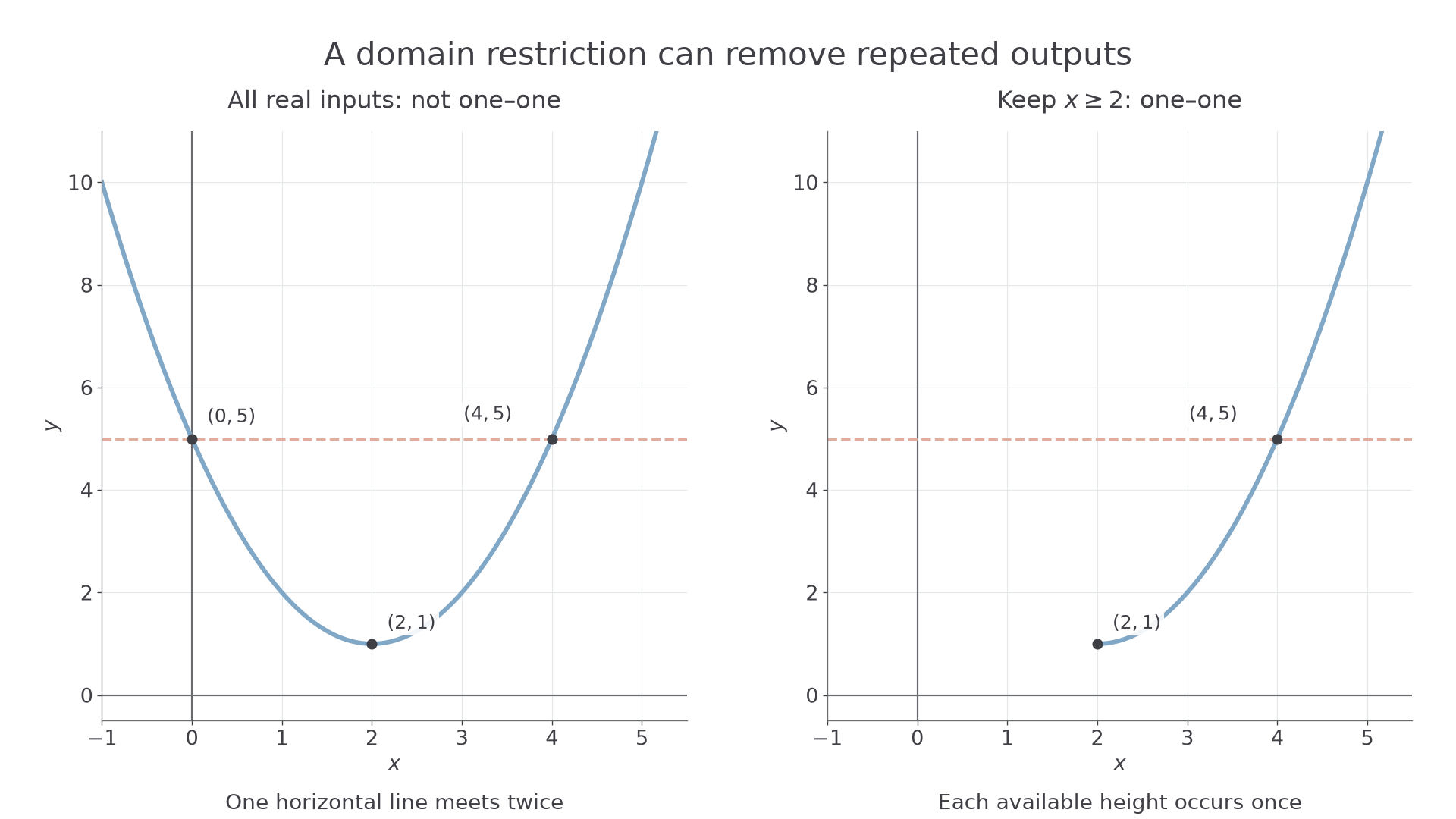
Worked example 5: repeated outputs
Question. Determine whether , for , is one–one.
Plan. Look for two inputs equally far from the vertex's horizontal coordinate.
The inputs and are different and both belong to the domain.
Answer. is not one–one.
Check. The horizontal line meets the graph twice, matching the algebraic counterexample.
Change only the domain to keep the right-hand branch. Checking a few values would not prove one–one behaviour for infinitely many inputs; the argument must cover them all.
Worked example 6: a one–one restriction
Question. Determine whether , for , is one–one. State another half-line restriction that would also work.
Plan. Show that two permitted inputs with the same output must coincide.
If , then . Since and , taking the non-negative square root gives , so .
Answer. is one–one on . The restriction also gives a one–one function, using the left-hand branch.
Check. On either single branch, each available height occurs once. A domain containing inputs equally far on both sides of would repeat a height.
Linear functions with nonzero gradient are one–one on . A reciprocal is also one–one on : if for nonzero , multiplying by gives . A constant function on a domain with more than one input is not one–one.
Key idea
One–one behaviour belongs to the rule together with its domain. A restriction can turn a many–one function into a one–one function, preparing it to have an inverse.
Return to the opening puzzle with a new quadratic.
Quick Recap
- A function gives exactly one output for every permitted input; its range contains only outputs actually reached.
- Find range boundaries using the graph, vertex and domain, and check whether each boundary is attained.
- Different inputs may share an output in a function. A one–one function forbids this.
- Keeping one side of a quadratic's vertex makes it one–one.
Two inputs can give the same output and still define a function. They cannot do so in a one–one function.