1.1 - Completing the square
Two expressions can describe the same quadratic and reveal different things about it. In this first part of 1.1, you will rewrite a quadratic as a square plus a constant, then use that form to find its turning point and sketch its graph. The method also explains why some quadratics can never be negative.
Making a perfect square
Can ever be less than ? Substituting a few values might suggest an answer. Rewriting the expression will prove it for every real .
Start with a square you can recognise:
The first two terms match our expression. The constant is too large, so subtract :
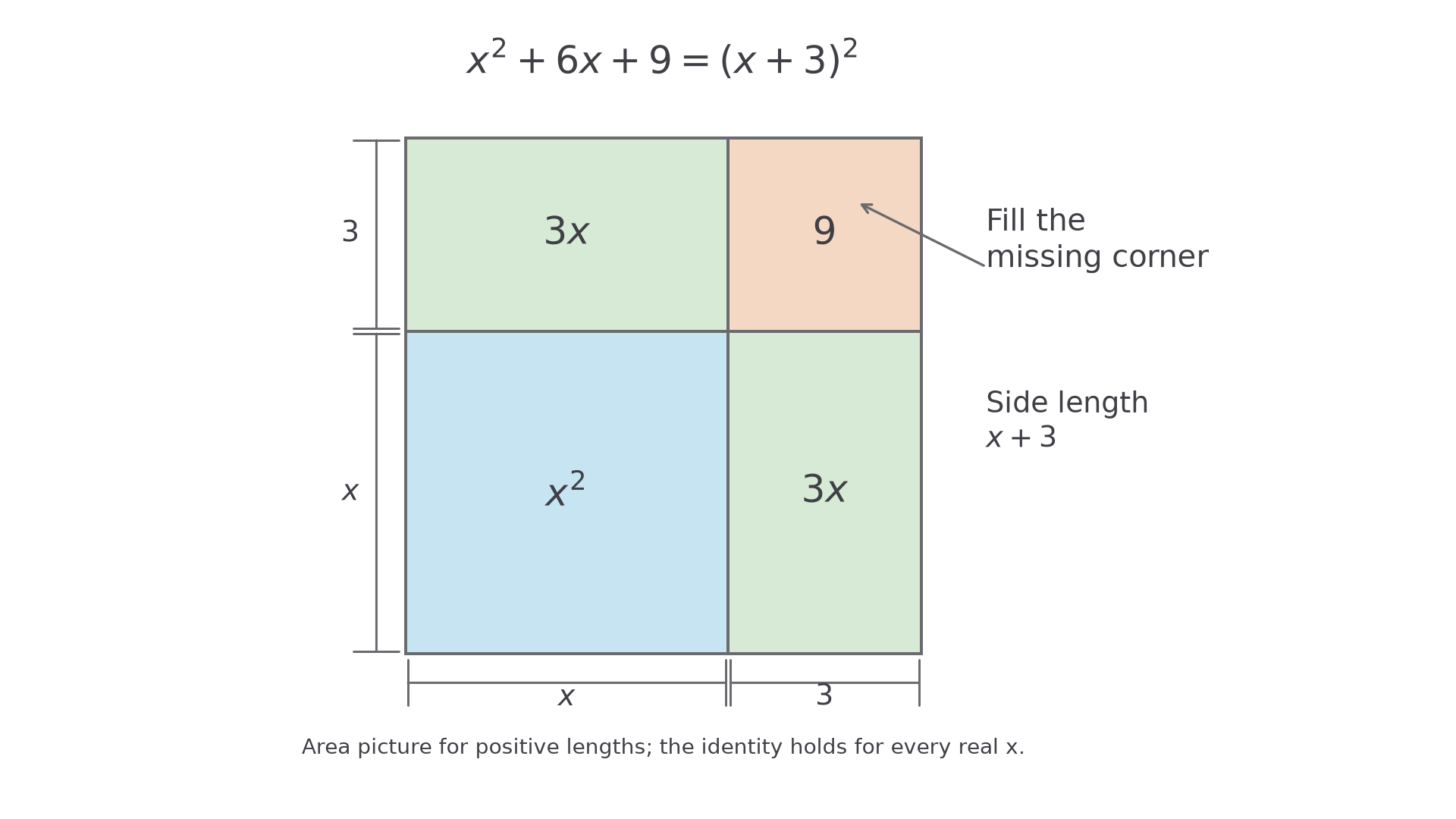
The picture shows where the comes from. For a positive length , an -by- square and two -by- rectangles leave a -by- corner to fill. The algebraic identity remains true for negative too: expand the bracket to check it.
[DIAGRAM: asset_name: The missing corner; asset_slug: completing-square-area; caption: The missing corner has area 9, so x squared plus 6x is nine less than the whole square; description: A square of side x plus 3 is divided into an x by x square, two x by 3 rectangles and a 3 by 3 corner. The four areas are labelled x squared, 3x, 3x and 9, with side lengths x and 3 marked outside. The identity beneath is x squared plus 6x plus 9 equals the square of x plus 3.]
Completing the square
Completing the square means rewriting a quadratic as a multiple of a squared linear expression plus a constant. The new expression has the same value as the original for every permitted input.
Why halve the coefficient of ? Because . To match , choose , then correct the constant.
Completing a monic quadratic
Completing a monic quadratic.
For real and ,
Not in the formula booklet: learn it.
Use the reasoning behind the formula: match the linear term, then check the constant.
Worked example 1: a positive linear term
Question. Express as a square plus a constant.
Plan. Half of is ; expand and adjust its constant.
Answer. .
Check. Expanding gives .
Now change just the sign of the linear term. The sign inside the bracket changes, but the correction still uses a positive square.
Worked example 2: a negative linear term
Question. Express as a square plus a constant.
Plan. Half of is , so start with .
Answer. .
Check. At , the original gives , and the new form gives . Expanding confirms equality for every .
The same method works with odd coefficients: for , the bracket starts . Keep the fraction exact.
Watch out
is , not . A squared bracket has a middle term. Expanding is a quick way to catch a wrong sign or constant.
Try the same method with a different linear coefficient.
A coefficient before the square
When the coefficient of is not , factor it out of the first two terms before completing the square. Anything you add or subtract inside that bracket is multiplied by the outside coefficient.
For example, becomes . The correction outside the square is , not .
The general completed-square form
The general completed-square form.
For ,
Not in the formula booklet: learn it.
You can reconstruct this result by factoring and expanding; there is no need to force every calculation through a memorised substitution.
Worked example 3: a positive multiplier
Question. Express in the form .
Plan. Factor from the first two terms, complete the square inside, then multiply out the correction.
Answer. , so and .
Check. Expanding gives , which is the original expression.
Keep and the constant , but change the multiplier from to . This changes the sign of the correction outside the bracket.
Worked example 4: a negative multiplier
Question. Express in the form .
Plan. Factor , then complete the same square as before.
Answer. , so and .
Check. At , the new form gives , matching the original constant. Expansion also recovers .
The outside coefficient acts on the whole bracket, including the correction.
Watch out
. The correct expression is . Leave the square bracket in place until you have multiplied both terms.
Here is another negative multiplier to handle.
The turning point
A real square is non-negative, and it equals zero exactly when its base is zero. That simple fact reveals the highest or lowest point of a quadratic graph.
In , the squared term is smallest at . Its value there is zero, so the smallest possible is . Inputs equally far from , such as and , give the same squared term and the same height.
Vertex and axis of symmetry
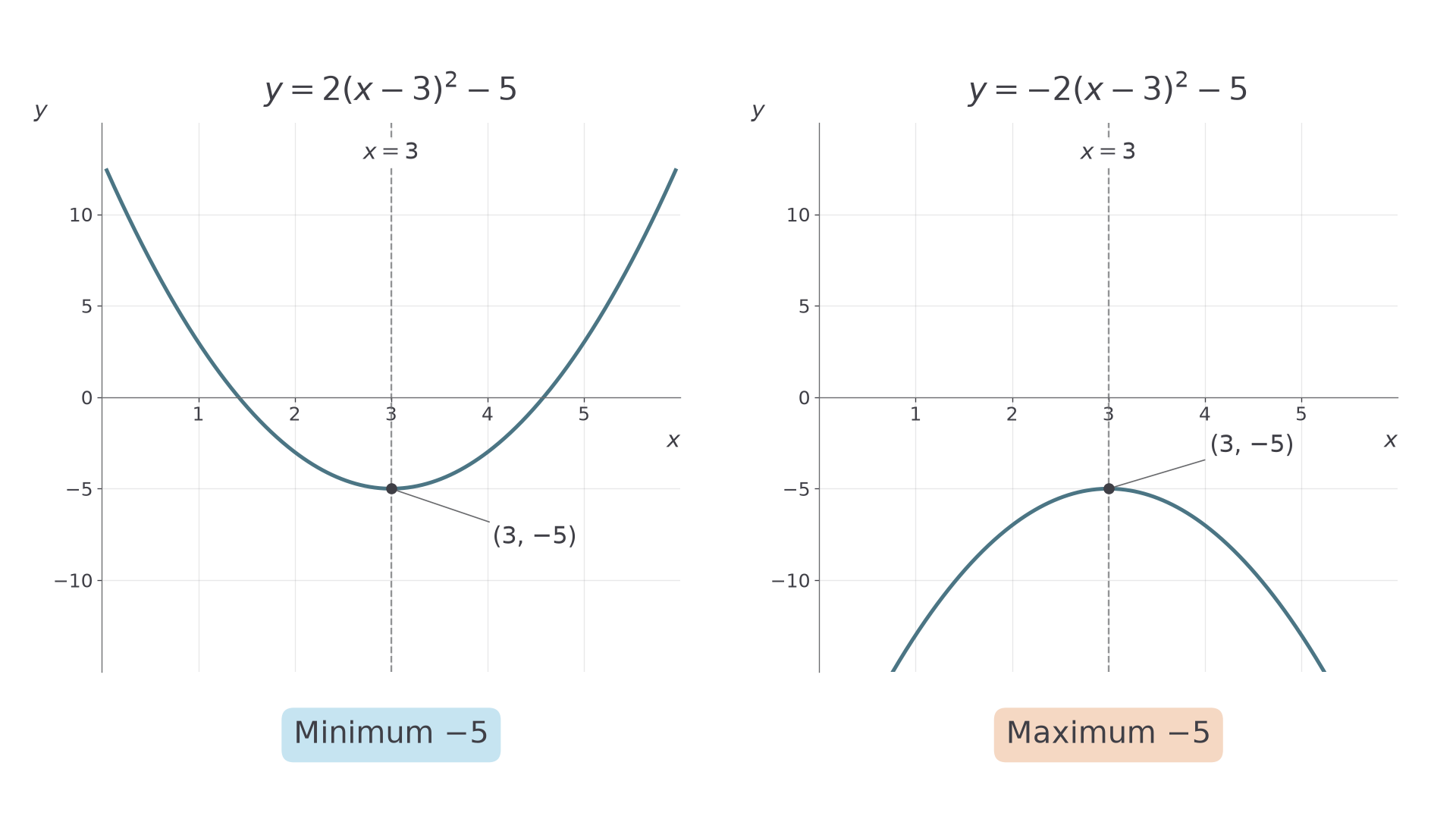
The vertex of a quadratic graph is its turning point. For , where , the vertex is and the axis of symmetry is the vertical line .
If , the graph opens upwards and is its minimum value. If , multiplying a square by makes it non-positive: the graph opens downwards and is its maximum value. These statements allow every real input .
[DIAGRAM: asset_name: One vertex, two directions; asset_slug: quadratic-vertex-sign; caption: The sign before the square decides whether the vertex is a minimum or a maximum; description: Two coordinate plots with matching scales show y equals 2 times the square of x minus 3 minus 5 and y equals minus 2 times the square of x minus 3 minus 5. Both have vertex 3 comma minus 5 and symmetry line x equals 3. The first opens upwards and labels minimum minus 5; the second opens downwards and labels maximum minus 5.]
Worked example 5: the minimum value
Question. State the minimum value of and the value of at which it occurs.
Plan. Use the fact that the square is at least zero and identify when it vanishes.
Equality holds when .
Answer. Minimum value , at . The vertex is .
Check. At the neighbouring inputs and , the value is , higher than .
Now change only the sign of the coefficient before the square. The vertex stays where it was, but its role changes.
Worked example 6: the maximum value
Question. State the maximum value of and the value of at which it occurs.
Plan. A negative multiple of a square cannot exceed zero.
Equality again holds when .
Answer. Maximum value , at . The vertex is .
Check. At and , the value is , below the maximum.
Read the horizontal coordinate by asking which input makes the bracket zero.
Watch out
For , the vertex is , not . The bracket vanishes at .
Use both the bracket and its multiplier in this check.
Sketching from the square
A completed square gives you the shape and turning point immediately. Add the -intercept by substituting , then use symmetry to place a second point. This gives a useful sketch without a long table of values.
Worked example 7: a graph above the axis
Question. Find the vertex and -intercept of , and describe its position relative to the -axis.
Plan. Complete the square, then use its minimum and substitute .
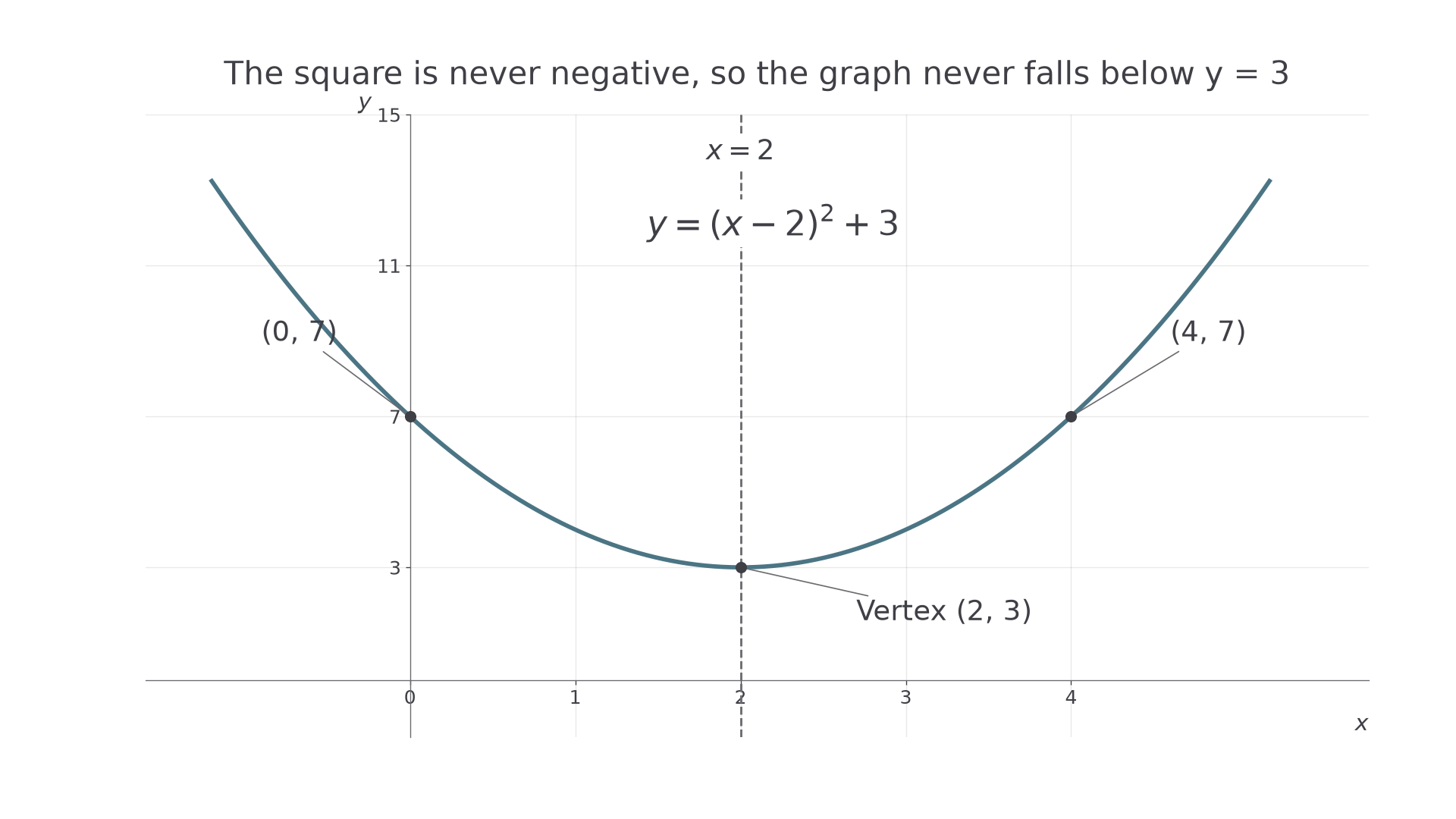
The graph opens upwards. Its minimum is , attained at , and its symmetry line is . At , ; symmetry gives another point .
Answer. Vertex , -intercept . The whole graph lies above the -axis because .
Check. Direct substitution gives and .
The three labelled points and the symmetry line locate the curve clearly.
[DIAGRAM: asset_name: A sketch from three features; asset_slug: quadratic-sketch; caption: A completed square locates the vertex and explains why this graph stays above the x-axis; description: Coordinate plot of y equals x squared minus 4x plus 7, with vertex 2 comma 3, y-intercept 0 comma 7, reflected point 4 comma 7 and dashed symmetry line x equals 2. The curve opens upwards and its minimum height is 3.]
Next, keep the first two terms but make the constant unknown. An extreme value can tell us what that constant must be.
Worked example 8: an unknown constant
Question. The minimum value of , for real , is . Find and state the vertex of its graph.
Plan. Complete the square in terms of , then equate the minimum to .
The square is zero at , so the minimum is . Therefore
Answer. , with vertex .
Check. Substituting into gives . Every other real input adds a positive square to .
Return to our opening question: , so it cannot be less than . It reaches exactly at . One rearrangement has settled infinitely many possible inputs.
Exam tip
When asked for a particular completed-square form, give that form explicitly. Expand it once to check the constant correction: this is the check highlighted in Cambridge's guidance on this question type.
Use the minimum to recover a missing constant in a new quadratic.
Quick Recap
- Match a square by halving the linear coefficient, then correct the constant.
- Factor the coefficient of first when it is not .
- In , the vertex is . It is a minimum for and a maximum for .
- Use the vertex, symmetry and -intercept to sketch a quadratic, and expand your completed square to check it.
The opening quadratic cannot fall below : .