1.7 - Rates of change
A derivative measures how one quantity changes as another changes. You will interpret its sign and units, connect two changing quantities through the chain rule, and find intervals where a function increases or decreases. These ideas turn gradients into useful information about a model.
A rate with units
If water volume is increasing, does its current rate equal the average rate since filling began? The two rates can differ. A derivative measures the rate at a particular instant; a chord measures an average over a time interval.
Suppose is measured in litres and in minutes. Then has units litres per minute. The variable below the derivative tells you what the change is measured against: is a time rate, while would be a rate per unit radius.
Instantaneous rate of change
The instantaneous rate of change of with respect to is . A positive value means is increasing locally; a negative value means it is decreasing locally. Its units are the units of divided by the units of .
Keep the sign in a rate of change. A rate of decrease is usually reported as a positive magnitude together with the word “decreasing”.
Worked example 1: current rate and average rate
Question. A tank's volume is modelled by litres, where is in minutes. Find the instantaneous rate at , and the average rate over the first minutes.
Plan. Differentiate for the instantaneous rate; use total change divided by elapsed time for the average.
Answer. Instantaneous rate ; average rate .
Check. The time rate increases from to over this interval, so an average of is reasonable and is lower than the final rate.
Change only the sign of the linear term. On the stated time interval, the volume now falls.
Worked example 2: a negative time rate
Question. A different tank is modelled by litres for , with in minutes. Find and interpret at .
Plan. Differentiate and evaluate, retaining the negative sign until it is interpreted.
Answer. The rate of change is . The volume is decreasing at .
Check. litres, whereas litres. The short-interval rate is , close to .
Always respect the interval over which a model is given. The formula's algebra may allow later values even when the physical model is no longer intended to apply.
Watch out
In the second example, is a rate, not the volume in the tank. The volume is litres. Units help distinguish these quantities: litres versus litres per minute.
Interpret the sign as well as calculating it.
Connected rates
When a circle's radius changes, its area changes too. The radius need not be given explicitly as a function of time. Use the relation to connect their rates at the same instant.
Differentiating with respect to gives . This has units of area per unit radius, not area per unit time. Multiply by the rate at which the radius changes to obtain a time rate.
Connected time rates
If is a differentiable function of , and changes with time,
Use values of and the rates at the same instant. Rearranging to divide by requires that derivative to be nonzero.
Not stated separately in the formula booklet: learn it.
The units show why multiplication is right: times gives .
Worked example 3: from radius rate to area rate
Question. A circle's radius increases at . Find the rate of increase of its area when .
Plan. Differentiate with respect to , then multiply by .
Answer. The area increases at .
Check. If that radius rate remains constant for the next seconds, the radius becomes . The area change divided by is , close to .
Now reverse which rate is known and make the area decrease. The same relation still applies.
Worked example 4: from area rate to radius rate
Question. A circle's area decreases at . Find the rate of change of its radius when .
Plan. Set and solve the connected-rate equation for .
Answer. : the radius decreases at .
Check. Substitution into gives , the stated area rate. The radius and area both decrease.
Other geometric relations work in the same way. For a cube, gives . The relation determines the conversion factor; it is not generally .
Watch out
and are different rates. Writing misses and has the wrong units for an area time rate.
Use a negative radius rate in a fresh circle.
Increasing and decreasing
A positive derivative means the graph rises as you move right; a negative derivative means it falls. To identify complete intervals, solve where the derivative is positive or negative rather than checking only one input.
Increasing and decreasing functions
On an interval, a function is increasing if larger inputs give larger outputs, and decreasing if larger inputs give smaller outputs. For a differentiable function, throughout an interval guarantees increase; throughout an interval guarantees decrease.
An isolated zero derivative does not by itself stop a function being increasing. Use the signs on neighbouring intervals. We will state open intervals on which the derivative is strictly positive or negative; stationary boundary points can be described separately.
Worked example 5: signs on a polynomial domain
Question. Find the intervals on which is increasing or decreasing.
Plan. Differentiate, factor, and use the zeros to split the real line into sign intervals.
The derivative is zero at . Test one input in each interval:
| Interval | Test input | Sign of | Behaviour |
|---|---|---|---|
| positive | increasing | ||
| negative | decreasing | ||
| positive | increasing |
Answer. Increasing for and ; decreasing for .
Check. The derivative values at the test inputs are . Factoring shows the sign cannot change inside any of these intervals because neither factor becomes zero there.
Now keep the same sign-changing factor , but introduce a reciprocal term. The domain has a gap that must split an interval.
Worked example 6: signs with an excluded input
Question. Find where , , is increasing or decreasing.
Plan. Put the derivative over a common denominator and check its sign on each connected part of the domain.
For , the denominator is positive. The numerator is positive when , and negative when . Exclude from the latter set.
Answer. Increasing for and ; decreasing for and .
Check. At and , the derivative is . At and , it is . The formula is undefined at , so no interval of decrease can pass through that input.
[DIAGRAM: asset_name: A domain gap splits an interval; asset_slug: increasing-decreasing-domains; caption: The derivative signs are similar, but the reciprocal curve is undefined at zero; description: Two labelled coordinate plots show f of x equals x cubed minus 12x and g of x equals x plus 4 over x. Both mark stationary inputs minus 2 and 2 and show increasing outer branches and decreasing middle branches. The second has a dashed vertical line x equals zero and separates its decreasing portions at that excluded input.]
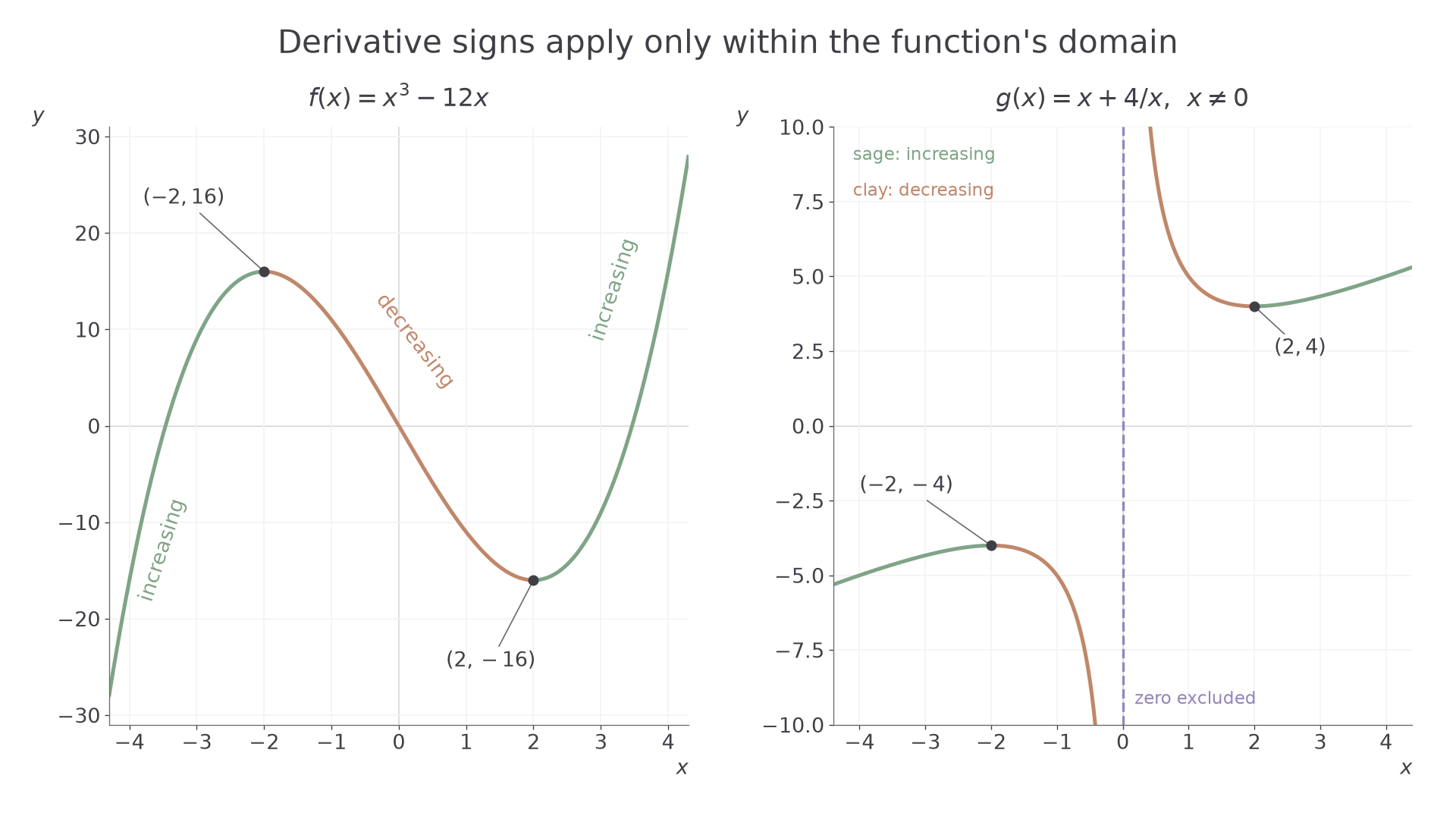
The opening question is answered by the distinction between a chord rate and a tangent rate. The same derivative also tells us where a model's quantity is rising or falling.
Exam tip
Give intervals, including any excluded inputs. A list of derivative zeros is not a complete answer to “find where the function is decreasing”. Keep the original domain even after simplifying an inequality.
Restrict a reciprocal example to its stated positive domain.
Quick Recap
- A derivative gives an instantaneous rate, with output units divided by input units.
- A negative time rate means a quantity is decreasing.
- Connected rates multiply through the chain rule, using values from the same instant.
- Use the derivative's sign to identify intervals of increase or decrease.
- Split intervals at excluded inputs as well as sign-changing zeros.
The current filling rate need not equal the average rate over the time since filling began.