2.3, 3.3 - Combining sine and cosine
A sum of sine and cosine with the same angle is another shifted sine or cosine. In the shared trigonometry of 2.3 and 3.3, you will find its amplitude and angle shift, use them to determine attainable extreme values, and solve equations in a specified interval.
Matching coefficients
Can ever be larger than ? Taking gives , but gives . The two terms can combine to give more than either coefficient. Their separate maxima do not occur at the same angle, so adding does not give the true maximum either.
Expand a shifted sine before choosing any constants:
To make this equal for every , match the sine coefficients and the cosine coefficients separately. These two functions cannot substitute for each other: setting isolates cosine, and setting isolates sine.
Amplitude and auxiliary angle
For real , not both zero, write
Matching coefficients gives
Choose with both required signs, in any range specified by the question.
Not in the formula booklet: derive it by expanding the supplied compound-angle formula.
Squaring and adding the coefficient equations gives , which proves the amplitude formula. The zero expression has amplitude zero and no unique shift; it is excluded from the convention .
Worked example 1: a positive sine shift
Question. Express as , where and . Give to decimal places.
Plan. Expand the requested form, match coefficients, and use both signs to choose the angle.
Both sine and cosine of are positive, agreeing with the required acute angle.
Answer. , with the exact shift specified by , .
Check. Expanding with the unrounded shift gives , exactly the original expression.
Change only the sign of the cosine term. Use a minus shift to keep the auxiliary angle acute.
Worked example 2: a negative sine shift
Question. Express as , where and . Give to decimal places.
Plan. Expand the minus-shift form before matching its coefficients.
Answer. , retaining the unrounded shift in later calculations.
Check. At , the original is , and . The expansion checks equality for every angle.
A cosine form works in exactly the same way, but its sine and cosine coefficients swap places. This table comes from expanding each requested form; it is safer than memorising a single inverse-tangent ratio.
| Requested form | Coefficient of | Coefficient of |
|---|---|---|
For any of these forms, . The equations determine the quadrant of the shift, including when a coefficient is negative or zero. For example, needs both and , so in . Taking only the principal value of would give the wrong signs.
Worked example 3: a cosine with a minus shift
Question. Express as , with and acute .
Plan. Expand the requested cosine form and match its two coefficients.
Answer. , where the shift is quoted to decimal places.
Check. At , the original is , and . Expansion checks both coefficients exactly.
Change only the sine coefficient's sign. The cosine form then needs a plus shift.
Worked example 4: a cosine with a plus shift
Question. Express as , with and acute .
Plan. Match the minus sign in the cosine expansion to the negative sine coefficient.
Answer. .
Check. At , the original is , and the new form gives . At , both give .
The requested form determines which coefficient belongs to which ratio.
Watch out
For , ; for , it is . These quotients apply only when their denominators are nonzero, and neither quotient alone determines the quadrant. Expand and match first.
Try the cosine plus-shift form with fresh coefficients.
Ranges and extreme values
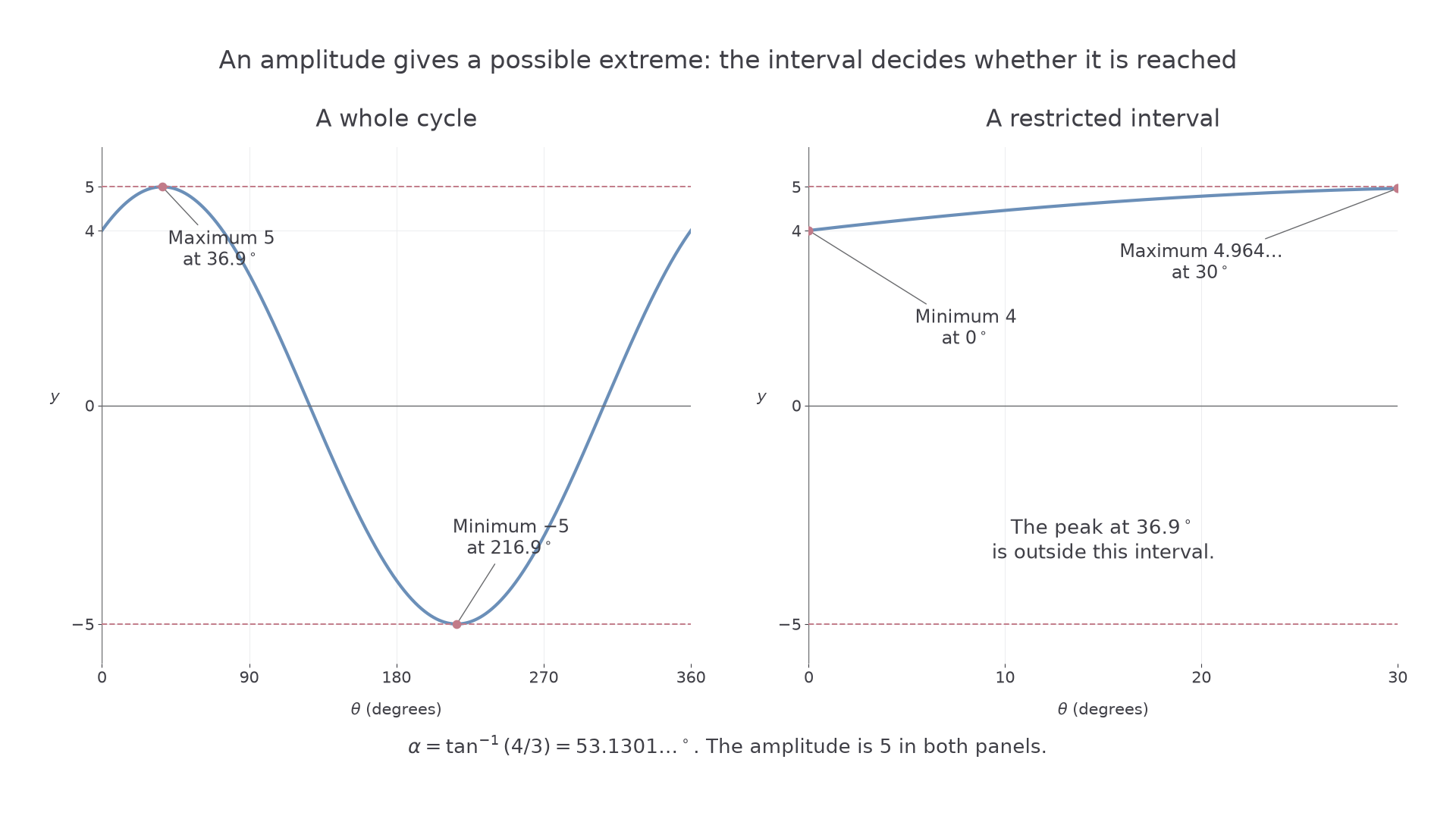
The amplitude gives possible highest and lowest values, but the allowed angles decide whether they occur. Since , the expression , with , lies between and . A full cycle reaches both extremes; a restricted interval may reach neither.
Amplitude
The amplitude of or , where , is : its maximum distance from the horizontal midline. Adding a constant moves that midline without changing the amplitude.
For , the full-cycle range is . To check attainment, solve for the maximum and for the minimum, then see whether the corresponding original angles are permitted. In degrees, these occur at and . For cosine, the corresponding angles are and .
[DIAGRAM: asset_name: Full and restricted ranges; asset_slug: auxiliary-angle-range; caption: The same amplitude can give different attainable extreme values on different intervals; description: Two exact plots of 3 sine theta plus 4 cosine theta. The full-cycle panel from 0 to 360 degrees reaches 5 at 36.9 degrees and minus 5 at 216.9 degrees. The panel restricted to 0 through 30 degrees rises from 4 to 4.964 and does not reach the amplitude 5. Dashed horizontal lines mark plus and minus 5.]
Continue this lesson.
You’re previewing NovaLearn without an account. Create a free account to read the rest.
Create free account