4.1 - Components and resultants
Two forces can point in quite different directions yet combine into one force. You will resolve forces into perpendicular components, calculate a resultant's magnitude and direction, and find unknown forces that keep a particle in equilibrium. The diagram helps you choose the equations; calculation supplies the answer.
Choosing axes
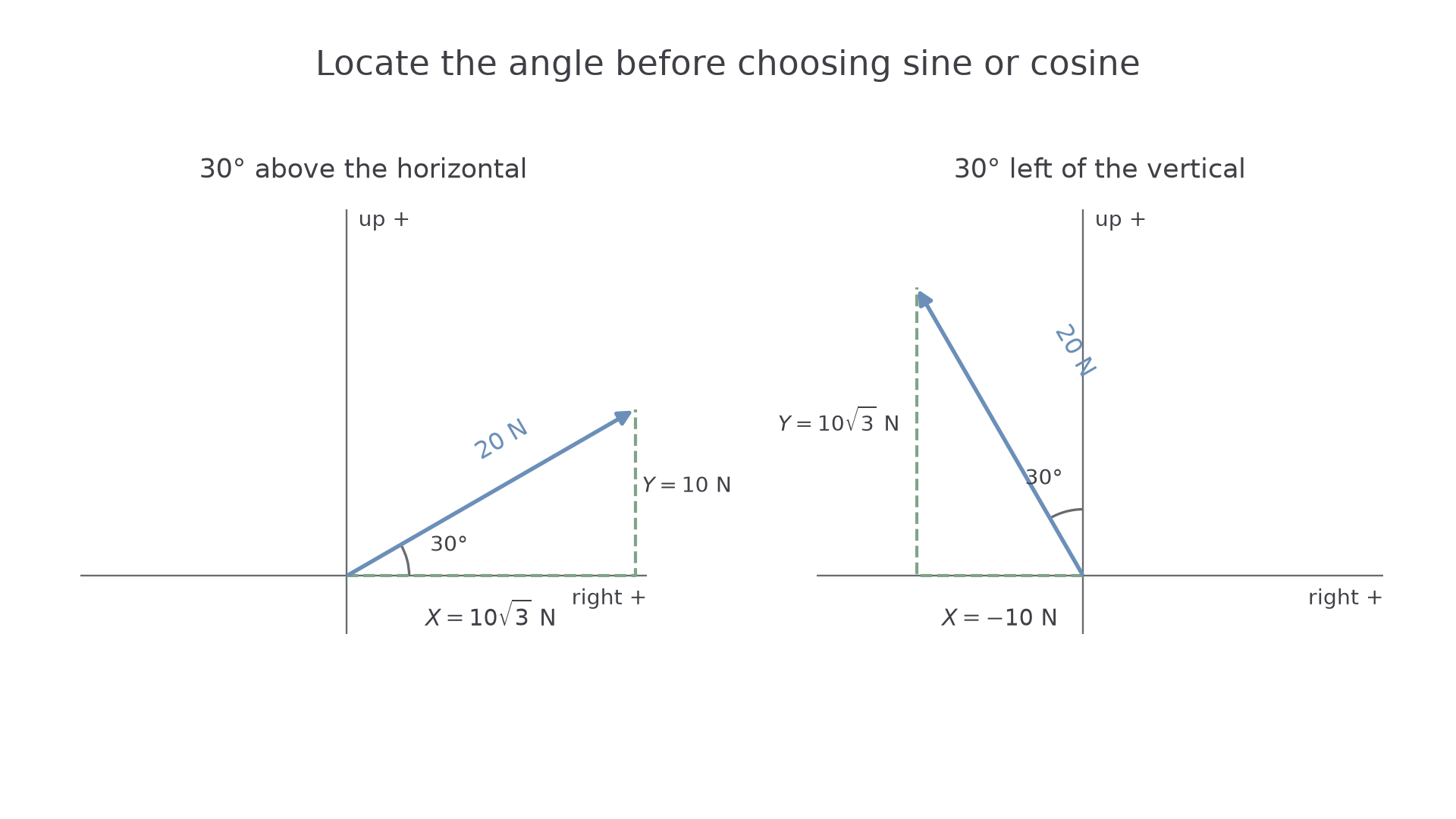
A pull acts at above the horizontal. How much of its effect is horizontal? Imagine replacing it by one horizontal force and one vertical force with the same combined effect. They form the two perpendicular sides of a right-angled triangle; the original force is its hypotenuse.
Components of a force
The components of a force in two perpendicular directions are forces in those directions whose combined effect is the original force. A component has a sign once you choose a positive direction along its axis.
The component adjacent to the given angle uses cosine; the opposite component uses sine. First locate the angle, then choose the trig ratio. “Horizontal means cosine” is unreliable when an angle is measured from the vertical.
Resolving a force
For a force of magnitude at angle above the positive horizontal direction,
The signs describe right/left and up/down. A different choice of axes gives different components of the same force.
Not in the formula booklet: learn it.
The same right triangle can be drawn with a horizontal or vertical angle marked.
[DIAGRAM: asset_name: Resolving from the marked angle; asset_slug: mechanics-force-components; caption: The component adjacent to the marked angle uses cosine; description: Two exact right-triangle force diagrams show a 20 N force 30 degrees above rightward horizontal and a 20 N force 30 degrees left of upward vertical. Horizontal right and vertical up are positive. First components are 10 square root 3 right and 10 up. Second are 10 left and 10 square root 3 up. Dashed component sides and marked angles show the adjacent and opposite choices.]
Worked example 1: angle from the horizontal
Question. Find the rightward and upward components of a force acting above the rightward horizontal.
Plan. Use the horizontal angle in a right triangle with hypotenuse .
Answer. rightwards and upwards.
Check. , recovering the original magnitude.
Now keep the magnitude and angle, but measure the angle left of the upward vertical. This swaps the trig roles and makes the horizontal component negative.
Worked example 2: angle from the vertical
Question. A force acts to the left of the upward vertical. Find its components, taking right and up as positive.
Plan. The vertical component is adjacent to the marked angle; the horizontal component points left.
Answer. , .
Check. The force is closer to vertical than horizontal, so its vertical component is larger. Its length is again .
For a plane inclined at to the horizontal, axes along and perpendicular to the plane are often simpler. Vertical weight has component down the plane and into it. The angle between weight and the inward normal is . For example, a weight on a plane gives down the plane and into it.
Watch out
Do not decide between sine and cosine by the axis name. Mark the angle, identify the hypotenuse, then find the adjacent and opposite sides. Add the component signs afterwards.
Use an angle from the vertical in this check.
Combining forces
A resultant is the single force with the same combined effect as the forces being replaced. Forces add by direction, so adding their magnitudes alone is usually wrong.
Choose perpendicular axes and add signed components separately. If the total components are and , the resultant's magnitude follows from Pythagoras. Its direction comes from the same right triangle.
Magnitude of a resultant
For nonzero horizontal component, the acute angle to the horizontal satisfies
Use the signs of and to state the correct direction. If or , read the direction directly; a zero resultant has no direction.
Not in the formula booklet: learn it.
A force already on an axis needs no trigonometry. Several forces pointing in different directions simply contribute to the same two totals.
Worked example 3: a resultant pointing right
Question. Forces of rightwards and upwards act on a particle. Find their resultant's magnitude and direction.
Plan. Use the perpendicular forces as the total components.
Answer. , at above the rightward horizontal.
Check. Resolving at the unrounded angle gives horizontal and vertical .
Continue this lesson.
You’re previewing NovaLearn without an account. Create a free account to read the rest.
Create free account