2.3, 3.3 - Reciprocal trigonometric functions
Taking the reciprocal of a trigonometric function changes its graph and its permitted inputs. In the shared trigonometry of 2.3 and 3.3, you will use secant, cosecant and cotangent, explain their asymptotes, and derive identities that turn unfamiliar equations into familiar quadratics.
Secant, cosecant and cotangent
If cosine stays between and , how can its reciprocal ever equal ? At , , so its reciprocal is indeed . At , however, cosine is zero: its reciprocal has no value.
Reciprocal trigonometric functions
The secant, cosecant and cotangent functions are defined by
Secant requires . Cosecant and cotangent require .
Where both tangent and its reciprocal exist, . The cosine-over-sine definition also gives , even though is undefined. It is the definition with sine in the denominator that gives cotangent its full domain.
You already know
An inverse function reverses a function: is an angle. A reciprocal reverses a nonzero number: is a ratio. Here means inverse cosine, never secant.
Use quadrant signs before taking a reciprocal. Taking a reciprocal preserves the sign of a nonzero number.
Worked example 1: secant in the second quadrant
Question. Find the exact value of .
Plan. Find cosine using the reference angle , then take its reciprocal.
Answer. .
Check. Multiplying by gives , as a reciprocal must.
Keep the angle and change only the function to cosecant. The quadrant stays the same, but the underlying ratio and its sign change.
Worked example 2: cosecant in the second quadrant
Question. Find the exact value of .
Plan. Find sine using the same reference angle, then take its reciprocal.
Answer. .
Check. ; a positive sine has a positive reciprocal.
For example, cotangent at this same angle is . Always identify which original function is underneath the reciprocal.
Watch out
is undefined, not . There is no real number that multiplies to give .
Try a cosecant value with a different reference angle.
Their graphs
A zero of sine becomes a gap in the domain of cosecant, with a vertical asymptote there. Near that zero, a very small positive sine gives a very large positive reciprocal; approaching from a negative side gives a very large negative reciprocal.
First recall the three original graphs. Sine and cosine have period , range , and are defined for every real angle. Tangent has period , range all real values, and is undefined at . Its branches rise from negative to positive values between consecutive asymptotes. Here and below, denotes any integer, including negative integers and zero; radians is .
Sine and tangent have zeros at ; cosine has zeros at . Sine and tangent are odd, with rotational symmetry about the origin; cosine is even, with symmetry about the vertical axis. Sine and cosine have no vertical asymptotes.
[DIAGRAM: asset_name: Six trigonometric graphs; asset_slug: six-trigonometric-graphs; caption: Zeros of sine and cosine become asymptotes of their reciprocals; cotangent has falling branches; description: Six labelled radian graphs from minus 2 pi to 2 pi show sine above cosecant, cosine above secant, and tangent above cotangent. Dashed pink lines mark tangent and secant asymptotes at odd multiples of pi over 2 and cosecant and cotangent asymptotes at multiples of pi. Secant and cosecant have branches at or outside heights plus and minus 1. All periods and ranges are labelled.]
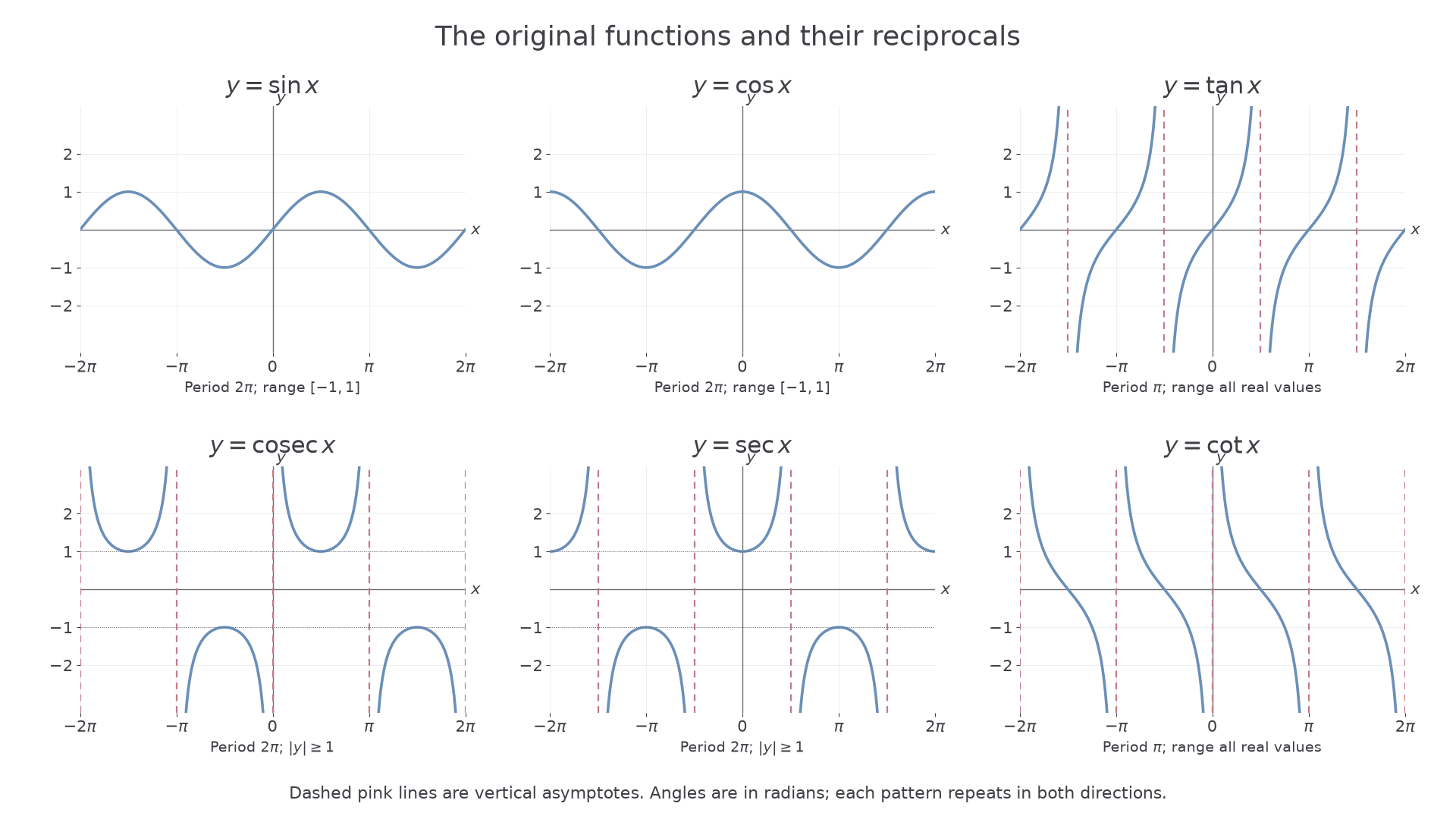
For a reciprocal graph, retain the sign of the original function and reciprocate its height. The points with height or stay fixed. There are no secant or cosecant values strictly between and : a reciprocal of a nonzero number of magnitude at most has magnitude at least .
| Function | Excluded inputs and vertical asymptotes | Period | Range and zeros |
|---|---|---|---|
| or ; no zeros | |||
| or ; no zeros | |||
| All real ; zeros at |
Secant is even, so its graph is symmetric about the vertical axis. Cosecant and cotangent are odd, so their graphs have rotational symmetry about the origin. Cotangent is positive where sine and cosine have the same sign, negative where their signs differ. It falls from positive unbounded values to negative unbounded values between consecutive asymptotes. Periodicity extends all six graphs to angles of any magnitude.
Worked example 3: locating secant branches
Question. Describe the graph of for , giving its vertical asymptotes, its points at height or , and the signs of its branches.
Plan. Use the zeros, extreme values and signs of cosine.
Answer. Asymptotes at . The marked points are , and . Branches are positive on and , and negative on . They lie outside the strip .
Check. At , cosine is , so the first branch passes through height . It cannot cross the horizontal axis.
Continue this lesson.
You’re previewing NovaLearn without an account. Create a free account to read the rest.
Create free account