3.9 - Argand diagrams and polar form
A complex number can be located by two coordinates or by a distance and a direction. You will use an Argand diagram to connect these descriptions, interpret addition and subtraction as displacements, and convert between Cartesian, polar and exponential notation.
The Argand plane
Where should be placed in a picture? Give the real part its own horizontal axis and the imaginary part its own vertical axis. The point is : two units right and one unit up.
Argand diagram
An Argand diagram represents by the point with coordinates . The horizontal axis is labelled , the vertical axis . Use the same scale on both axes when interpreting lengths and angles.
The vertical coordinate is a real number, even though it records an imaginary component. A point labelled lies at height , on the imaginary axis; it is not a third coordinate.
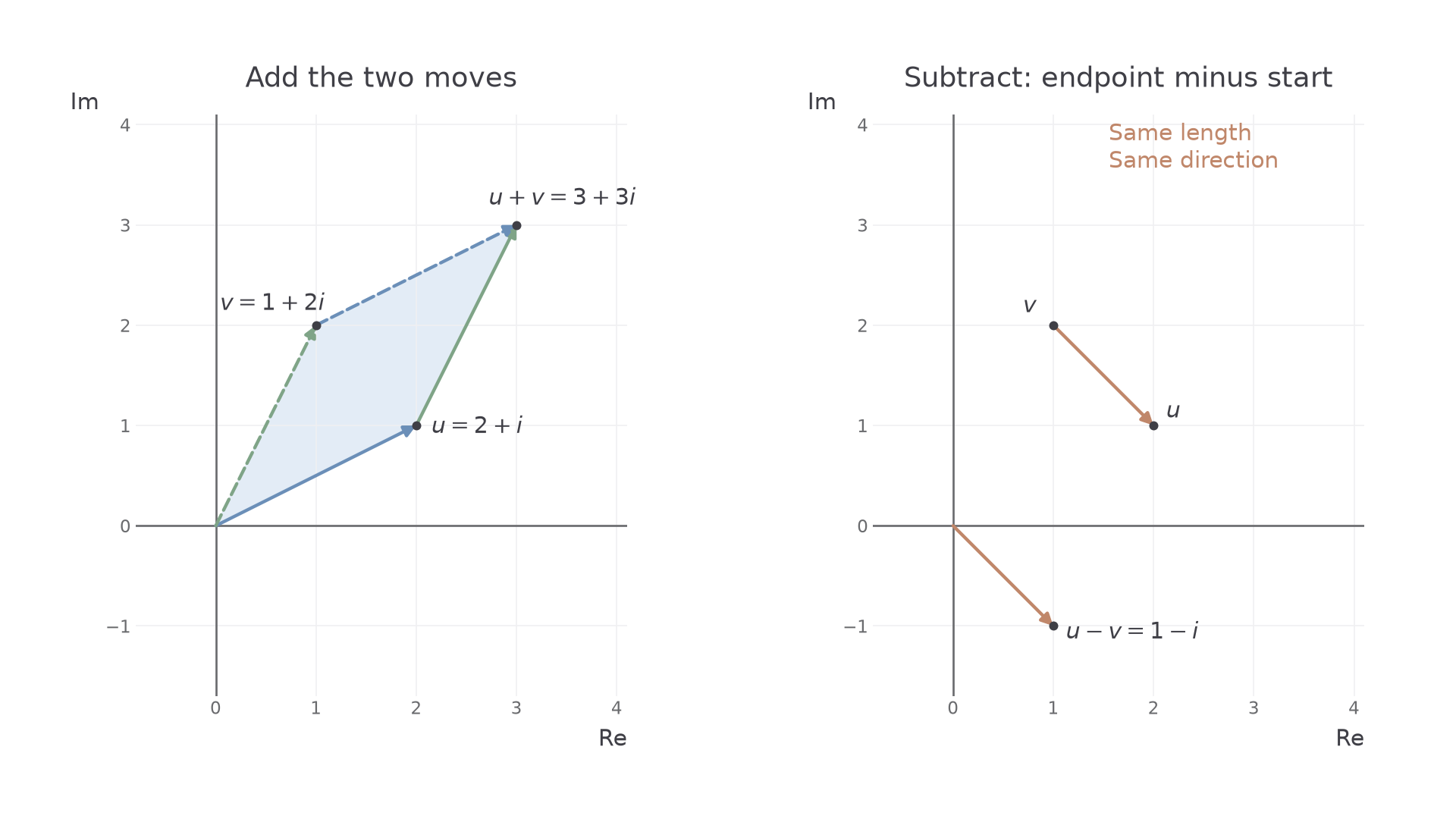
An arrow from , representing , to , representing , has horizontal and vertical changes given by . An arrow from the origin to has the same length and direction. This is the geometric meaning of complex subtraction.
Worked example 1: addition as two moves
Question. Points represent and . Find and describe its position using the two moves from the origin.
Plan. Add the horizontal and vertical components, then interpret the result as a point.
Move right and up to . From , move another right and up. The endpoint is .
Answer. , represented by .
Check. The arrow from to has change , exactly the coordinates of . Reversing the order of the two moves reaches the same endpoint.
Keep the two numbers but replace addition by subtraction. The order of the subtraction now determines the arrow's direction.
Worked example 2: subtraction as a directed difference
Question. For the same and , find . State the relationship between the arrow from to and the arrow from the origin to the point representing .
Plan. Subtract coordinates in the order “endpoint minus start”.
From to , the change is right and down.
Answer. ; both arrows have equal length and the same direction.
Check. . Using instead would reverse the arrow.
The copied arrows in the picture explain why addition uses a parallelogram and why subtraction uses the displacement between the original points.
[DIAGRAM: asset_name: Addition and directed subtraction; asset_slug: argand-add-subtract; caption: Addition joins two moves, while u minus v is the displacement from v to u; description: Two equal-scale Argand panels show u at 2 comma 1 and v at 1 comma 2. The left shows origin to u to u plus v at 3 comma 3, with a pale parallelogram. The right shows the arrow from v to u and an equal parallel arrow from the origin to u minus v at 1 comma minus 1.]
Use the endpoint-minus-start order with new points.
Modulus and argument
Coordinates describe a point by horizontal and vertical changes. A second description uses the length of the line from the origin and its direction from the positive real axis.
Modulus and argument
The modulus of is its distance from the origin:
For , an argument is an angle from the positive real axis to the ray through , measured anticlockwise when positive. We normally choose
These complex-number definitions are not listed in MF19.
Pythagoras gives the modulus; it is always non-negative, and only zero has modulus zero. The angle is not defined at zero because there is no ray from the origin to itself.
Use a reference triangle and then choose the quadrant. A calculator's alone cannot distinguish opposite directions: both and give .
Worked example 3: above the negative real axis
Question. Find the modulus and argument of , giving the argument in .
Plan. Find the distance by Pythagoras, then use the quadrant-II reference angle.
The reference angle satisfies , so . The point is above the negative real axis:
Answer. Modulus , argument .
Check. and , recovering both coordinates.
Change only the imaginary sign. The distance remains the same, but the direction is now below the real axis.
Worked example 4: below the negative real axis
Question. Find the modulus and argument of , giving the argument in .
Plan. Keep the distance and reference angle, then choose the clockwise direction in the required range.
Answer. Modulus , argument .
Check. Cosine is negative and sine is negative at this angle. Its positive coterminal angle reaches the same point but lies outside the requested interval.
Continue this lesson.
You’re previewing NovaLearn without an account. Create a free account to read the rest.
Create free account