1.6 - Sums to infinity
An endless sum can have a finite value, provided its partial totals settle towards one number. In this final part of 1.6, you will explain when a geometric series converges, calculate its sum to infinity and use the convergence condition to accept or reject possible ratios. Alternating signs can still lead to a well-defined total.
Why an infinite sum can converge
Can add up to , even though another positive term is always waiting? After four terms the total is . The next term fills half the gap to , and every later term fills half the remaining gap. The total never reaches after finitely many terms, but it gets as close as we wish.
The objects approaching a total are the partial sums, not the individual terms. Here the terms approach , while their totals approach .
Convergence and partial sums
The partial sum is the sum of the first terms. An infinite series converges if its partial sums approach one fixed finite number as increases without bound. That number is its sum to infinity, written .
If the partial sums do not approach one fixed finite number, the series diverges.
Shrinking terms alone do not settle the question for every possible series. For a GP, however, its finite-sum formula gives a precise condition: powers of a ratio whose magnitude is less than shrink to zero, and the partial sums settle.
Geometric convergence
For a GP with nonzero first term, its infinite series converges exactly when
The absolute value allows negative ratios as well as positive ones.
In the formula booklet.
The nonzero-first-term condition excludes a harmless special case: , whatever multiplier is chosen to describe it. For and any first term , the sequence is , whose sum is .
Worked example 1: approaching from below
Question. Find the first four partial sums of , and describe how they approach their limiting value.
Plan. Add terms successively and compare each total with .
The gaps to are , halving each time. The ratio is , whose magnitude is less than .
Answer. Partial sums ; they increase towards .
Check. The finite-sum formula gives . Thus , a positive gap that can be made arbitrarily small. It also gives .
Now change only the sign of the ratio. The terms still shrink in magnitude, but successive totals land on opposite sides of their limiting value.
Worked example 2: alternating around a limit
Question. Find the first four partial sums of . Explain whether the infinite series converges.
Plan. Add the signed terms and check the magnitude of the common ratio.
The ratio is , so . Using the finite-sum expression,
The power tends to zero, giving a fixed limiting total .
Answer. Partial sums ; the series converges to , alternating above and below that value.
Check. Their differences from are . Each signed difference is times the previous one, so their magnitudes halve.
The plots show partial sums at integer indices. The positive-ratio totals approach from below; the negative-ratio totals approach from alternating sides.
[DIAGRAM: asset_name: Two ways for partial sums to settle; asset_slug: geometric-partial-sums; caption: Both series converge because the ratio has magnitude one half, although only the positive-ratio partial sums increase throughout; description: Two coordinate plots show partial sums S_n for n from 1 to 9, with the same vertical scale. The left has first term 8 and ratio 1 over 2, with initial partial sums 8, 12, 14 and 15 and a dashed horizontal limit 16. The right has first term 8 and ratio minus 1 over 2, with initial partial sums 8, 4, 6 and 5 and a dashed horizontal limit 16 over 3. Dots mark integer indices and guide lines connect them. The alternating totals approach the limit from opposite sides.]
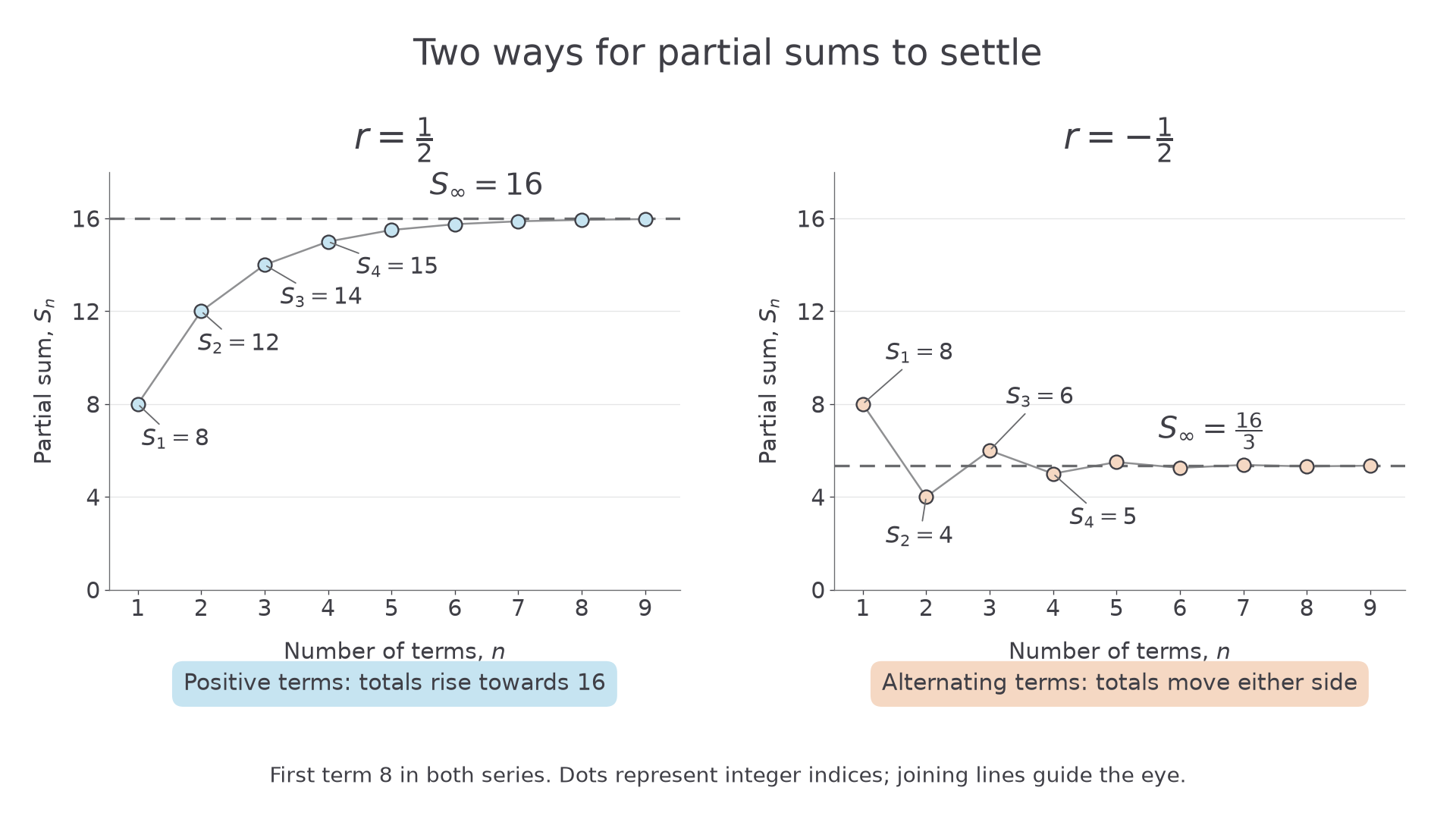
Convergence requires getting close and staying close; it does not require the totals to increase at every step.
Key idea
A sum to infinity is a limit of finite totals. For a nonzero geometric series, makes the remaining change shrink away, even when its sign alternates.
Explain that distinction for two fresh series without needing their limiting totals.
Finding a sum to infinity
The finite sum explains the infinite one. For , the power approaches zero as grows, so
We are taking a limit of valid finite sums, rather than treating infinity as an ordinary term number to substitute into a power.
The sum to infinity of a GP
Here is the first term and the common ratio. Check the condition before using the formula as a sum.
In the formula booklet.
For example, has total , resolving the opening question. Its alternating partner has total .
The formula can also recover missing information. If both and are unknown, combine it with another term condition. More than one convergent progression can fit the information.
Worked example 3: recovering the first term
Question. A GP has common ratio and sum to infinity . Find its first and second terms.
Plan. Rearrange the infinite-sum formula for , then multiply by .
Since ,
Answer. First term , second term .
Check. Removing the first term leaves a copy of the full series scaled by . Its total is therefore , and .
Keep the sum and the second term, but hide the ratio. Solving for it reveals another possible progression as well.
Worked example 4: two unknown parameters
Question. A GP has sum to infinity and second term . Find the possible first terms and common ratios.
Plan. Express in terms of using the total, then use .
Thus or . Both have magnitude below .
For , . For , .
Answer. or .
Check. The second terms are and . The self-similarity equations and verify the two totals, with convergence already checked.
A sum condition does not automatically identify a unique ratio.
Watch out
Keep every root until you have checked it against and the original data. Choosing only the smaller positive root would lose a valid progression in the example above.
Find both possible progressions in this new problem.
Interpreting convergence
The expression can produce a number even when the series has no sum to infinity. Its algebraic value is not enough: the convergence condition belongs to the method.
For a nonzero first term, the boundary cases show why the inequalities must be strict.
| Ratio | What happens to the partial sums? | Sum to infinity? |
|---|---|---|
| grow in magnitude | No | |
| keep switching between two values | No | |
| $ | r | >1$ |
| $ | r | <1$ |
Why must the terms approach zero? Each term is the difference between consecutive partial sums. If both totals are settling at the same finite value, the change between them must shrink to zero. The ratios in the first three rows fail this necessary test.
Worked example 5: rejecting one algebraic root
Question. A GP has sum to infinity and second term . Find its first term and common ratio.
Plan. Solve the two parameter equations, then check each ratio for convergence before accepting it.
The possible algebraic ratios are and . The first has magnitude greater than , so reject it. For ,
Answer. , .
Check. The terms begin , and their partial sums alternate towards . The second term is correct, and . The rejected pair has terms , which do not tend to zero.
Change only the specified second term. This time neither algebraic root meets the convergence requirement.
Worked example 6: incompatible information
Question. Can a GP have sum to infinity and second term ? Justify your answer.
Plan. Find the ratios the information would require, then test both, including the boundary value.
Thus or . Neither satisfies .
Answer. No such GP exists.
Check. The candidate gives partial sums . The candidate gives partial sums . Neither settles at , although substituting either pair into misleadingly produces .
The opening sum has ratio , safely inside the interval. Its total is . A ratio exactly equal to or would change that conclusion completely.
Exam tip
A parameter equation may give more ratios than the original infinite-sum problem allows. Show the algebraic solutions, then apply the strict condition and state which are valid.
Test a final set of proposed information.
Quick Recap
- A sum to infinity is the finite limit of the partial sums, not a last term.
- A geometric series with nonzero first term converges exactly when , including negative ratios in that interval.
- For a convergent GP, ; combine this with term information to recover parameters.
- Check every candidate ratio. The boundaries and diverge for nonzero first terms.
The endless sum converges to : each new term halves the remaining gap.