3.4, 3.5 - Inverse tangent in calculus
Inverse tangent connects a familiar angle function to a new kind of rational integral. In this lesson, 3.4 supplies its derivative and the chain rule extends it to composite functions; 3.5 reverses that derivative to integrate positive quadratic denominators. Principal radian values will then give exact definite integrals.
Differentiating inverse tangent
Which function has derivative ? It is not a power of : differentiating such a power introduces a factor of . The answer comes from reversing the tangent function.
Inverse tangent
, also written , means that and
The inverse tangent takes any real input and returns the unique angle in this principal interval. Here, and throughout calculus with trigonometric functions, angles are in radians.
For example, and . Although also has tangent , it is not the principal inverse-tangent value. The notation means an inverse function, whereas means a reciprocal.
To find the derivative, start with . Differentiating with respect to and retaining the chain-rule factor gives
Since , divide by this positive quantity.
Inverse-tangent derivative
In the formula booklet. For a differentiable inside function , the chain rule therefore gives
The composite form follows from the supplied derivative.
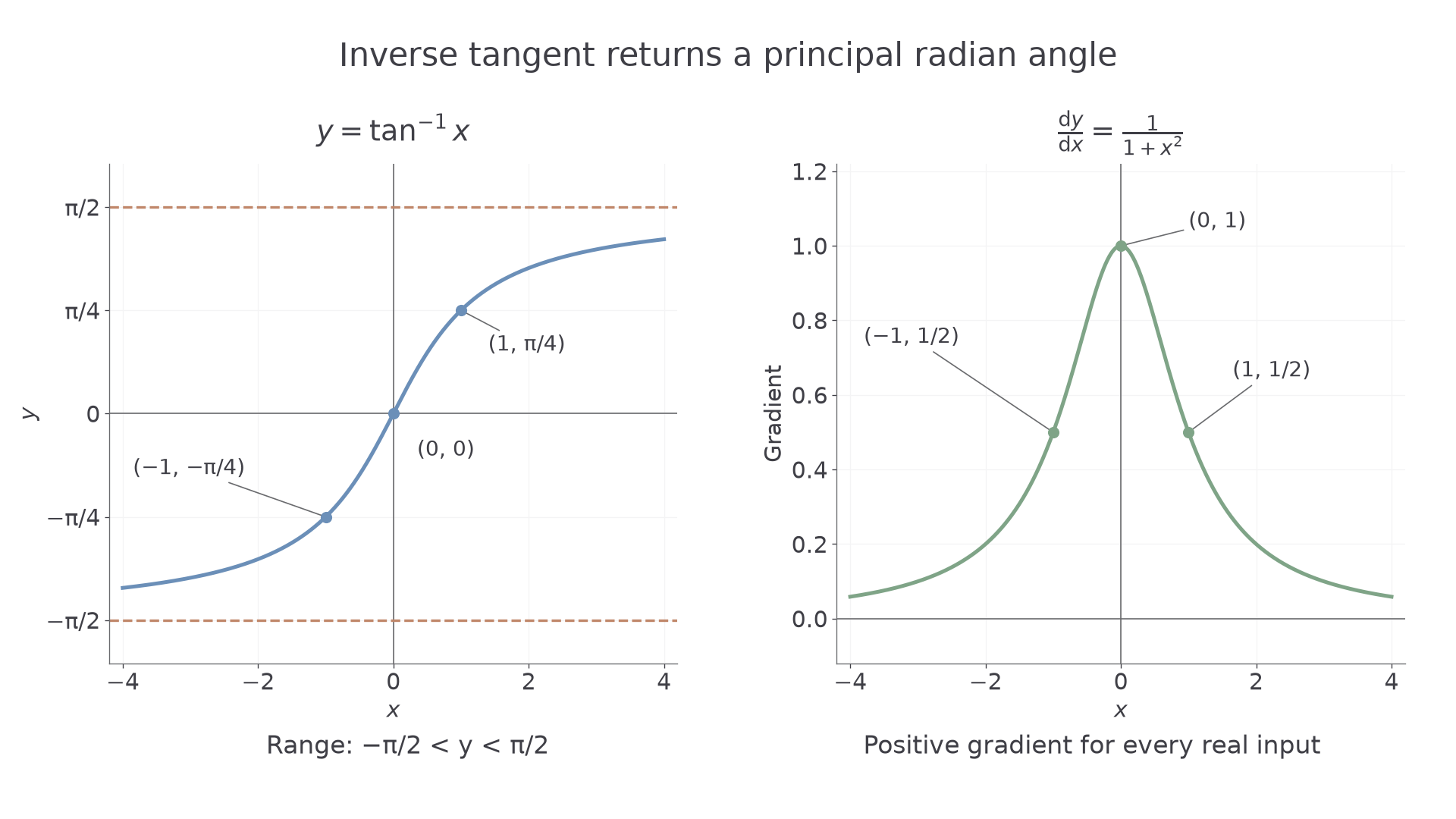
For , the derivative is always positive but tends towards zero for large positive or negative inputs. The graph rises throughout, flattening towards its horizontal asymptotes.
[DIAGRAM: asset_name: An angle function and its gradient; asset_slug: inverse-tangent-gradient; caption: Inverse tangent rises between two horizontal asymptotes, with a positive gradient that decreases away from zero; description: Two coordinate panels share horizontal inputs from minus four to four. The left shows y equals inverse tangent x, points minus one comma minus pi over four, zero comma zero, and one comma pi over four, with dashed horizontal asymptotes y equals plus and minus pi over two. The right shows its gradient 1 over 1 plus x squared, with maximum one at zero and value one half at both minus one and one.]
Worked example 1: a linear input
Question. Differentiate .
Plan. Use the inverse-tangent derivative with inside function , then multiply by .
Answer. , for all real .
Check. At , the central difference is approximately , agreeing with the derivative value .
Change only the input from to . Its derivative changes, and the whole input still has to be squared in the denominator.
Worked example 2: a quadratic input
Question. Differentiate .
Plan. Use , so , in the same chain-rule form.
Answer. , for all real .
Check. The original function is even, so its gradient changes sign under , as this odd derivative does. At , a central difference with step is approximately , agreeing with .
Constant multiples and sums use the usual rules. For example, the derivative of is . Products and quotients can combine this new derivative with the rules already learnt.
Watch out
For , the denominator is , not . Keep the entire inside expression in brackets before squaring it.
Differentiate another quadratic input before evaluating its gradient.
An inverse tangent integral
Reversing the basic derivative gives . A different positive constant in the denominator requires a scale factor inside the inverse tangent and a matching factor outside.
For , differentiate :
Dividing that result by gives the desired integrand.
A positive quadratic denominator
For a positive constant ,
In the formula booklet, with the arbitrary constant omitted there. The denominator is positive for every real .
This is the sum-of-squares pattern. A difference such as does not have this antiderivative. Also distinguish in the denominator from in the outside factor and inside quotient.
Continue this lesson.
You’re previewing NovaLearn without an account. Create a free account to read the rest.
Create free account