4.2 - Displacement and velocity graphs
A particle can travel a long way and finish back where it started. You will distinguish total travel from signed change of position, read velocity and acceleration from graph gradients, and find displacement and distance from a velocity–time graph. Throughout this lesson, motion is along one straight line.
Scalars and signed quantities
Walk east and then west. Have you travelled zero metres? Your final change of position is zero, but the route you walked has length . Mechanics needs both descriptions.
Choose an origin and a positive direction, such as east. A position then means west of the origin. It does not by itself tell you which way the particle is currently moving.
Distance and displacement
Distance travelled is the total length of the path, a non-negative scalar. Displacement is the directed change of position. In one dimension, displacement is represented by a signed number relative to a chosen positive direction.
Speed describes how fast distance accumulates. Velocity describes how position changes, so its sign identifies direction. The speed is the magnitude of velocity, . Acceleration is the rate of change of velocity, measured in ; it too is signed in one dimension. Displacement, velocity and acceleration are vector quantities, although signed numbers suffice here.
Average speed and velocity
Over a time interval of duration ,
These are interval averages, not necessarily the instantaneous values at any particular time.
Not in the formula booklet: learn it.
Add path lengths for distance; add signed changes for displacement.
Worked example 1: finishing on the positive side
Question. A particle travels east and then west in a total of . Find its displacement, distance, average velocity and average speed, taking east as positive.
Plan. Use a negative change for the westward leg, but a positive length in the distance total.
Answer. Displacement east; distance ; average velocity east; average speed .
Check. The final position is east of the start. Distance is at least the magnitude of displacement: .
Change only the return-leg length, while keeping the same total time. The particle now passes its starting point.
Worked example 2: finishing on the negative side
Question. A particle travels east and then west in . Find the same four quantities, taking east as positive.
Plan. Retain the signs for displacement and velocity, and positive lengths for distance and speed.
Answer. Displacement ; distance ; average velocity ; average speed .
Check. Negative average velocity identifies the net westward change, while the positive average speed describes how much ground was covered per second.
Changing the positive direction would reverse the displacement and velocity signs. It would leave distance and speed unchanged.
Watch out
Average speed is not generally the magnitude of average velocity. Reversing direction makes the total distance exceed the magnitude of displacement.
Keep signed change and total travel separate.
Gradients on motion graphs
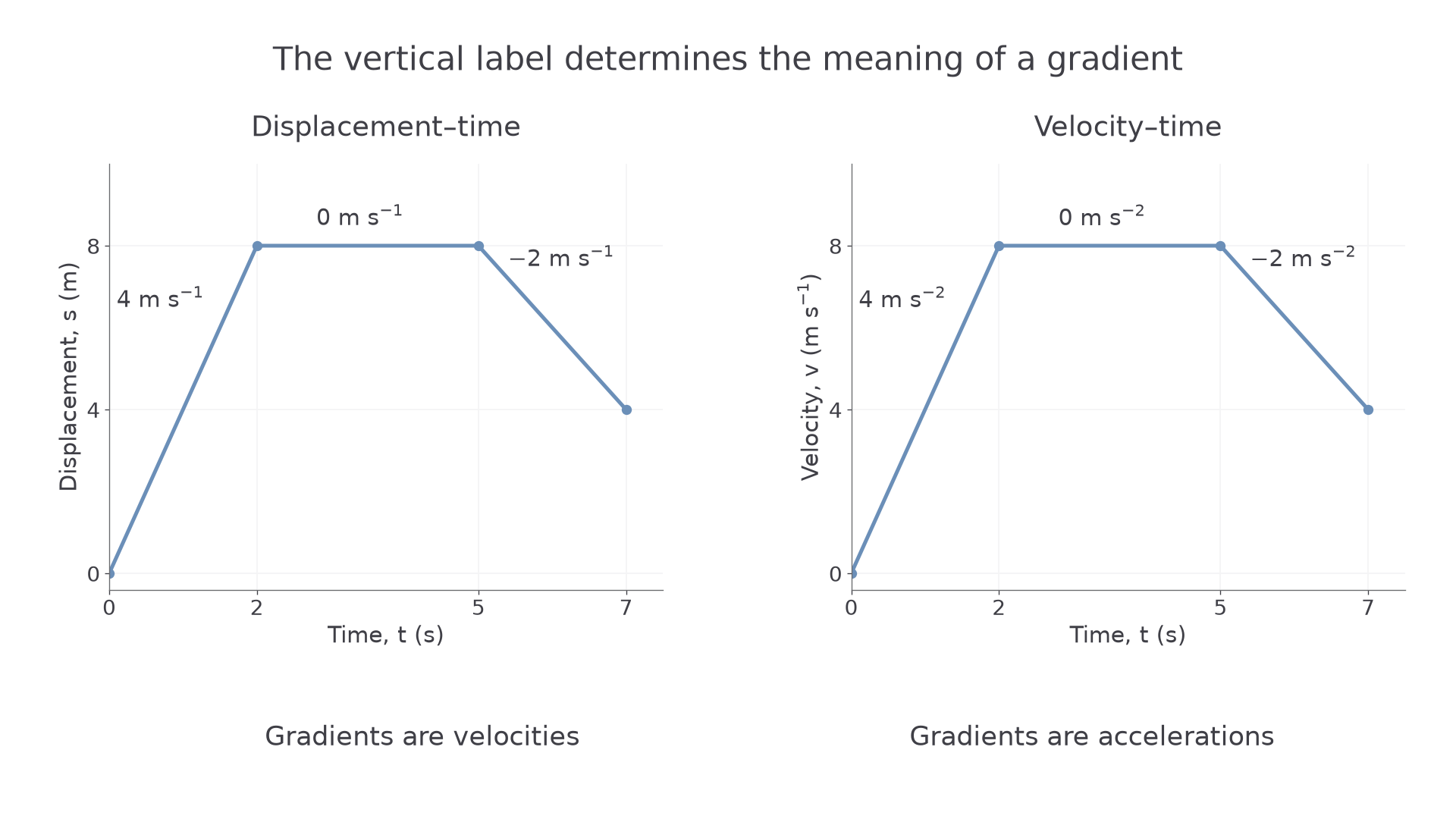
A graph's vertical label determines what its gradient means. On a displacement–time graph, change in displacement divided by change in time is velocity. On a velocity–time graph, the same calculation gives acceleration.
Motion graph gradients
For a straight segment use rise divided by run. For a smooth curve, the instantaneous value is the gradient of its tangent at that time.
Not in the formula booklet: learn it.
A horizontal displacement–time segment means rest. A horizontal velocity–time segment means constant velocity, which need not be zero. On a displacement graph, increasing steepness in either direction means increasing speed; height itself is position, not speed.
[DIAGRAM: asset_name: Same shape, different gradients; asset_slug: mechanics-motion-gradients; caption: The vertical quantity decides whether a segment's gradient is velocity or acceleration; description: Two graphs with the same joined coordinates 0 comma 0, 2 comma 8, 5 comma 8 and 7 comma 4 have time in seconds horizontally. Left vertical axis is displacement in metres, with segment velocities 4, 0 and minus 2 metres per second. Right vertical axis is velocity in metres per second, with segment accelerations 4, 0 and minus 2 metres per second squared.]
Worked example 3: gradients give velocities
Question. A displacement–time graph consists of straight segments joining , , and , with time in seconds and displacement in metres. Find the velocity on each segment and describe the corresponding velocity–time sketch.
Plan. Calculate rise over run for each straight segment.
Answer. The velocity–time sketch has horizontal segments at , and on those intervals. The particle moves forwards, rests, then moves backwards.
Check. The changes of position are , and , recovering the given graph points. At the idealised sharp corners, a unique gradient is not defined.
Continue this lesson.
You’re previewing NovaLearn without an account. Create a free account to read the rest.
Create free account