1.4 - Areas and perimeters of sectors
A curved region's area and its perimeter come from different pieces of geometry. In this part of 1.4, you will derive the sector-area formula, separate a segment from its triangle, and trace boundaries involving arcs and straight edges. The same chord will lead to two very different areas: a small segment and the rest of the circle.
Sector area
A sector with central angle radians occupies the fraction of a circle. Its area is that same fraction of :
The angle is a ratio, so the remaining length factor is . Area is measured in square units, whereas arc length is measured in length units.
Sector area
This formula is supplied in MF19. For an ordinary sector, . Since its arc length is , you can also use ; this rearrangement is not separately listed.
Keep the square on the radius: doubling the radius at fixed angle multiplies area by four, while multiplying the angle by a factor multiplies area by that factor.
Worked example 1: a sector's area
Question. A sector has radius and angle radians. Find its area.
Plan. Substitute the radius squared and the radian angle into the sector formula.
Answer. .
Check. Its arc length is , so .
Now keep the area but reduce the angle to one quarter of its previous value. The radius must increase.
Worked example 2: finding a radius from area
Question. A sector has area and angle radians. Find its radius.
Plan. Rearrange for , then take the positive square root because the radius is a length.
Answer. .
Check. The radius has doubled from to , multiplying its square by four; the angle has been divided by four, so the area stays .
If the angle is supplied in degrees, convert it before using either radian formula. Alternatively, use the fraction of a full circle directly; do not put a degree value into .
Segments and triangles
A chord cuts off a different region from a pair of radii. The radii make a triangle inside the smaller sector; removing that triangle leaves the region between the chord and the shorter arc.
Circular segment
A segment is bounded by a chord and an arc. For a chord that is not a diameter, the minor segment uses the shorter arc and the major segment uses the longer arc. Together they fill the circle. A sector is bounded by two radii and an arc.
To calculate the triangle's area, use , where is the included angle between sides and . It comes from : the height is . For an obtuse , the altitude meets an extension of the base and has length . Here the two sides are both radii, so the triangle's area is .
Minor and major segment areas
For a circle of radius , let be the smaller central angle subtended by the chord, measured in radians. Then
The sector formula is in MF19; the triangle-area and segment-area formulae are not. Use radian mode for .
The same two endpoints determine both segments. Keep the smaller angle for the minor-segment calculation; find the major segment by subtraction from the whole circle.
[DIAGRAM: asset_name: Two segments from one chord; asset_slug: minor-and-major-segments; caption: The minor segment is a sector minus its triangle; the major segment is the rest of the circle; description: Two panels show the same radius-7 circle with chord AB subtending a smaller central angle of 1.2 radians. Left: only the small region between the chord and shorter arc is shaded sage. Right: the complementary major segment is shaded lavender. Both show the two radii and chord, distinguishing the segment from its central triangle.]
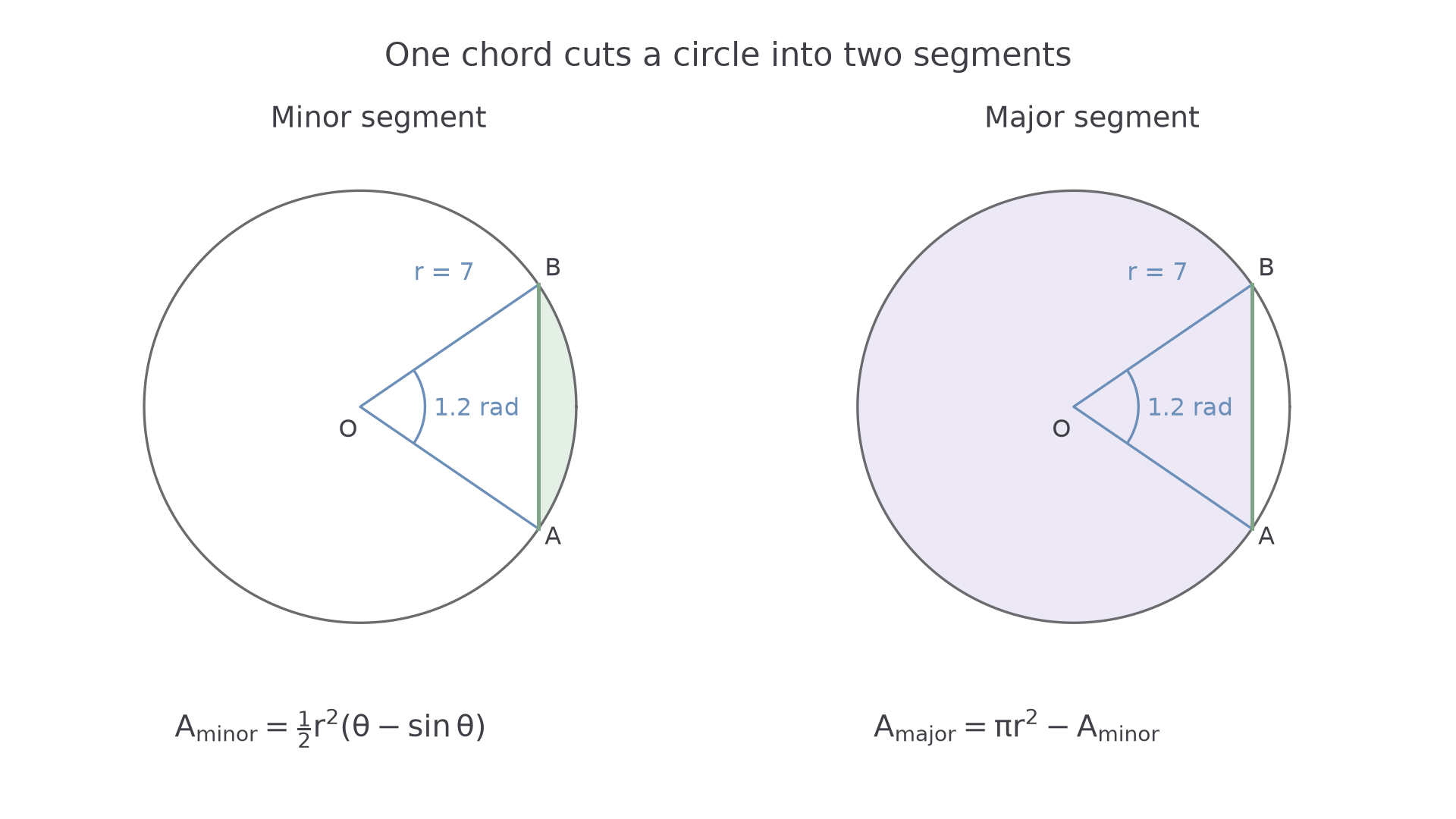
Use the smaller sector first.
Worked example 3: the minor segment
Question. A chord in a circle of radius subtends a smaller central angle of radians. Find the minor segment's area to significant figures.
Plan. Subtract the triangle area from the sector area, keeping calculator precision until the end.
Answer. .
Check. , so the triangle's height above a radius used as base is . The base-height calculation gives the same triangle area, smaller than the sector's .
Keep the circle and chord unchanged, but choose the other region.
Worked example 4: the major segment
Question. Find the major segment's area for the same radius and smaller central angle radians, to significant figures.
Plan. Subtract the unrounded minor-segment area from the whole circle.
Answer. .
Check. The same region is the major sector plus the central triangle:
The major central angle is , but the major segment includes the triangle as well as that major sector. Drawing or identifying the region prevents a wrong subtraction. If the chord is a diameter, each segment is a semicircle and its area is .
Mixed perimeter problems
A region's perimeter follows its outside boundary. For a segment that means one chord and one arc. For a strip between two concentric arcs, it means two arcs and two straight joining edges. Radii used to calculate an angle may lie inside the picture and contribute nothing to its perimeter.
Join a chord's endpoints to the centre and bisect the isosceles triangle. The perpendicular from the centre halves both the chord and the central angle, by congruence of the two right triangles. In a right triangle, sine is opposite side divided by hypotenuse. In either half here, . The inverse-sine operation returns the angle with a given sine; it does not mean the reciprocal of sine. Thus a chord of length gives
For , this gives the smaller central angle . Use radian mode for the inverse sine. The two other angles of the isosceles triangle are each , since a triangle's angles sum to radians.
Worked example 5: a chord determines the angle
Question. A minor segment lies in a circle of radius and has chord length . Find the smaller central angle in radians and the segment's perimeter, giving the perimeter to significant figures.
Plan. Bisect the chord to make a right triangle, find half the angle, and add the chord to the corresponding arc.
Answer. radians; perimeter .
Check. Pythagoras gives the centre-to-chord distance . Hence half the angle is also radians, agreeing with the sine calculation.
In a different shape, even an inner arc is part of the outside boundary of the shaded region: it borders the empty central region.
[DIAGRAM: asset_name: Segment and annular-sector boundaries; asset_slug: sector-boundaries; caption: A segment uses an arc and a chord, while an annular sector uses two arcs and two radial differences; description: Left: a circle sector of radius 10 is drawn around a shaded minor segment with chord 12 split into halves 6 and 6; dashed radii and centre-to-chord perpendicular show the right triangle used for the half-angle. Right: a shaded annular sector has radii 10 and 6, central angle 1.2 radians, and two straight joining edges each of length 4. Only the actual boundaries are drawn with thick coloured lines.]
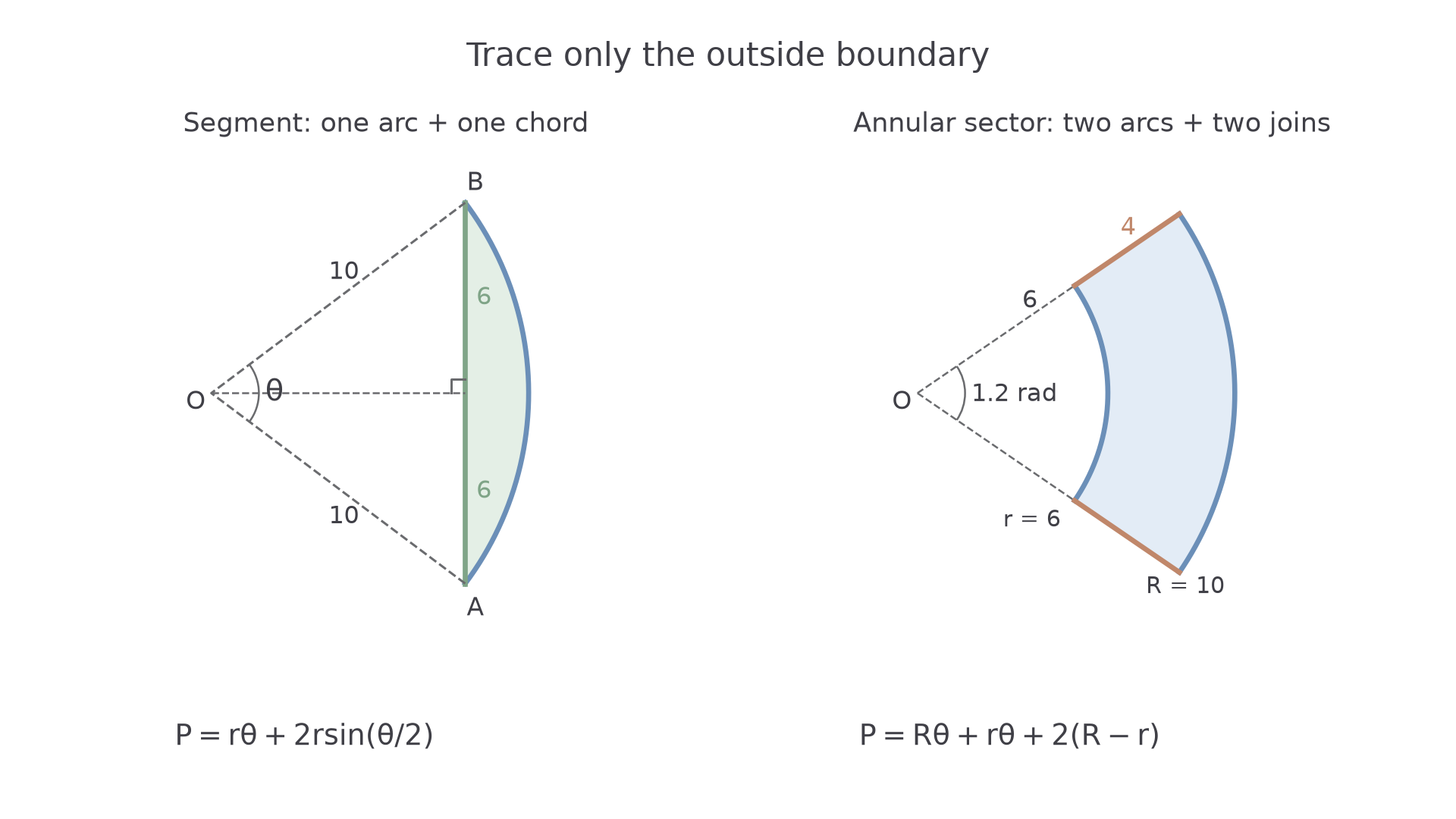
An annular sector is the portion between two concentric circular arcs and two rays from their common centre. Use the same angle for both arcs.
Worked example 6: a sector with its centre removed
Question. An annular sector has outer radius , inner radius and angle radians. Find its area and perimeter.
Plan. Subtract the two sector areas. For perimeter, add both arcs and two edges of length .
Answer. Area ; perimeter .
Check. Separately, the sector areas are and , whose difference is . Tracing the boundary gives four pieces of lengths , adding to .
The radius is neither the arc length nor the chord length. Label each length by its role before substituting, and keep the full angle until the final rounding.
Key idea
Area combines regions; perimeter combines boundary lengths. A line used to split a region for an area calculation may be an internal line, so it need not contribute to the perimeter.
Use both radii in each calculation for a new annular sector.
Quick Recap
- Sector area is when is in radians.
- A minor segment is its sector minus its central triangle; a major segment is the rest of the circle.
- Bisecting the chord triangle connects its length with half the central angle.
- Trace each boundary once for perimeter; combine the correct regions for area.