3.7 - Vectors and coordinates
A journey has a direction as well as a length. In this part of 3.7, you will describe directed movements in two and three dimensions, connect points using position vectors, and calculate lengths and unit vectors. The same language will let us describe entire lines in space.
Vector notation and operations
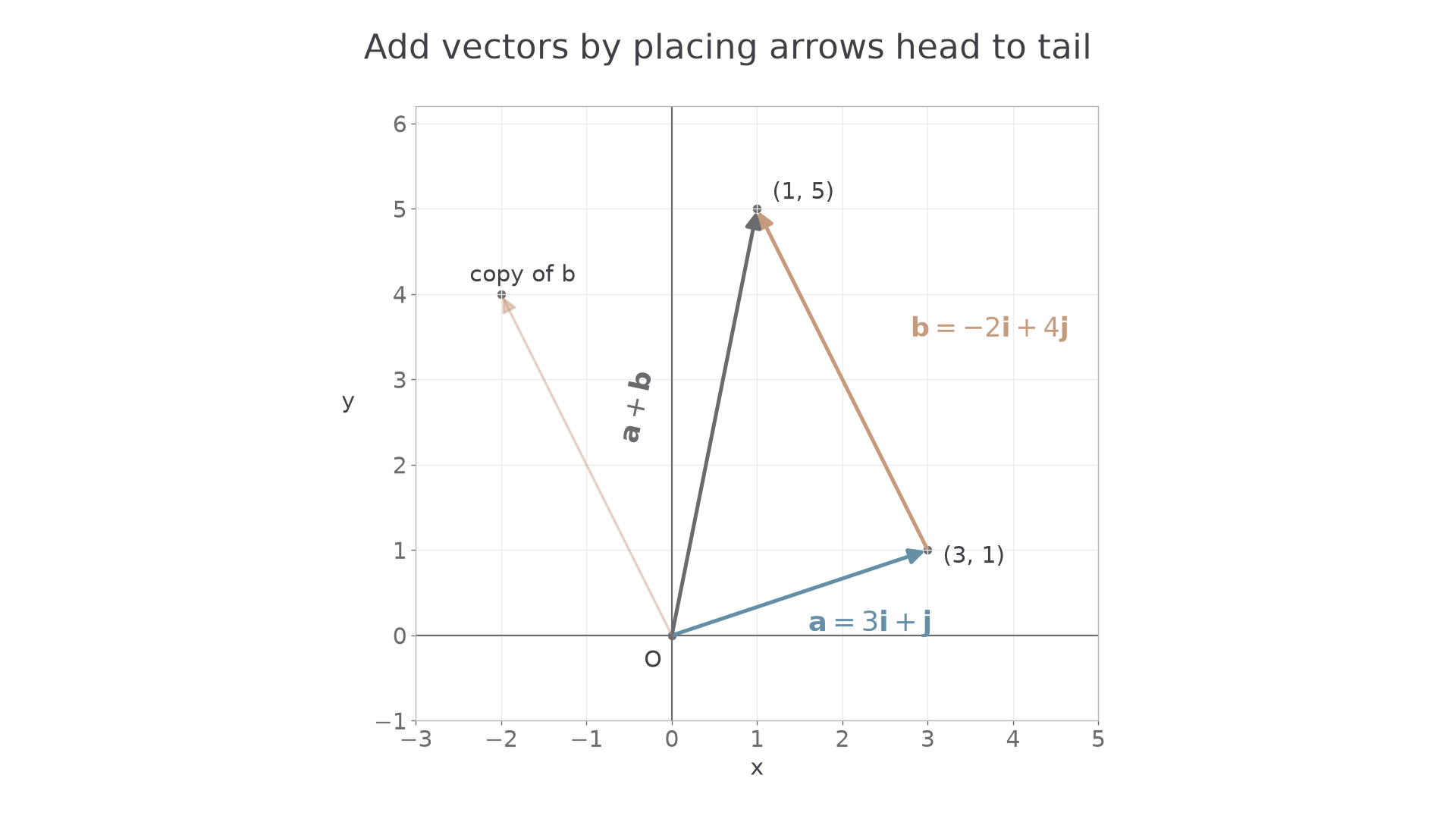
If you move three units east and one north, then two west and four north, where do you finish relative to your starting point? Keep the east and north movements separate: the total is one east and five north. A vector records precisely that directed movement.
Vector
A vector has magnitude and direction. In Cartesian coordinates, means a movement of in the positive -direction and in the positive -direction. Equal vectors have the same components, wherever their arrows are drawn.
The unit vectors , and point along the positive coordinate axes. Thus
Bold letters such as name vectors. The notation names the vector directed from to . Its reverse is .
Add or subtract corresponding components. Multiplication by a scalar multiplies every component: a positive scalar stretches or shortens an arrow without reversing it; a negative scalar also reverses it. Multiplying by zero gives the zero vector , which has zero magnitude and no direction.
[DIAGRAM: asset_name: Adding directed movements; asset_slug: vector-addition; caption: A second arrow can be translated to the end of the first without changing its vector; description: Equal-scale coordinate axes show a equals 3 i plus j from the origin to 3 comma 1, and b equals minus 2 i plus 4 j translated from that point to 1 comma 5. The resultant a plus b runs from the origin to 1 comma 5. A separate pale copy of b begins at the origin.]
Worked example 1: two components
Question. Given and , find and .
Plan. Combine matching components, distributing the subtraction to both components of .
Answer. and .
Check. Adding back to the second answer gives , as required.
Now add a third component. The operations are unchanged; there is simply one more coordinate to track.
Worked example 2: three components
Question. Given and , find and .
Plan. Apply the same component operations in the -direction too.
For example, the last component of the second result is .
Answer. and .
Check. Their difference, , agrees with calculated directly.
Subtraction means adding a reversed arrow.
Watch out
. Changing only the first sign would give a different vector.
Use fresh vectors in the same operation.
Positions and displacements
A point is a location; a vector is a directed displacement. Choosing an origin connects them: the position vector of is . If , then .
To travel from to , first reverse the journey from to , then travel from to . Hence .
Displacement and midpoint
If and have position vectors and , then
where is the midpoint of .
Not in the formula booklet: learn these results.
The midpoint result follows by moving halfway from to : . Both formulas work in two or three dimensions.
Continue this lesson.
You’re previewing NovaLearn without an account. Create a free account to read the rest.
Create free account