2.1, 3.1 - Modulus graphs and equations
Two numbers can have the same distance from zero without being equal. In this shared part of 2.1 and 3.1, you will turn that observation into graphs, equations and inequalities involving modulus. Splitting a straight line at its zero will make each problem ordinary linear algebra.
Distance from zero
Which inputs make exactly as far from zero as ? Before solving that puzzle, we need a way to describe distance without a sign. Both and are five units from zero, so .
Modulus
The modulus or absolute value of a real number is its distance from zero:
It is always non-negative. In particular, .
For , first find where the inside changes sign: gives . To the right, keep the line . To the left, negate it to make its output positive. The two rays meet at the vertex, .
Worked example 1: a positive coefficient
Question. Describe a sketch of , giving its vertex, -intercept and two linear rules.
Plan. Locate the zero of the bracket, then decide its sign on each side.
The left ray has gradient ; the right ray has gradient . At , .
Answer. A V-shaped graph with vertex and -intercept , using the rules above.
Check. At and , the original modulus gives in both cases, confirming symmetry about .
Change only the sign of the coefficient of . Find the new zero rather than guessing where the V moves.
Worked example 2: a negative coefficient
Question. Describe the same features of .
Plan. Solve , then check which side makes the bracket non-negative.
The zero is . The bracket is non-negative when , so
Answer. Vertex , -intercept , with descending left ray and ascending right ray as above.
Check. At and , both the modulus and the appropriate rules give .
Both graphs open upwards: changing the sign inside a modulus does not produce negative distances.
[DIAGRAM: asset_name: Splitting a line at its zero; asset_slug: modulus-linear-pair; caption: The zero of the expression gives the vertex of each V-shaped graph; description: Two equally scaled coordinate plots show y equals modulus of 2x minus 4, with vertex 2 comma 0, and y equals modulus of minus 2x minus 4, with vertex minus 2 comma 0. Both have y-intercept 0 comma 4. Each left ray has gradient minus 2 and each right ray gradient 2.]
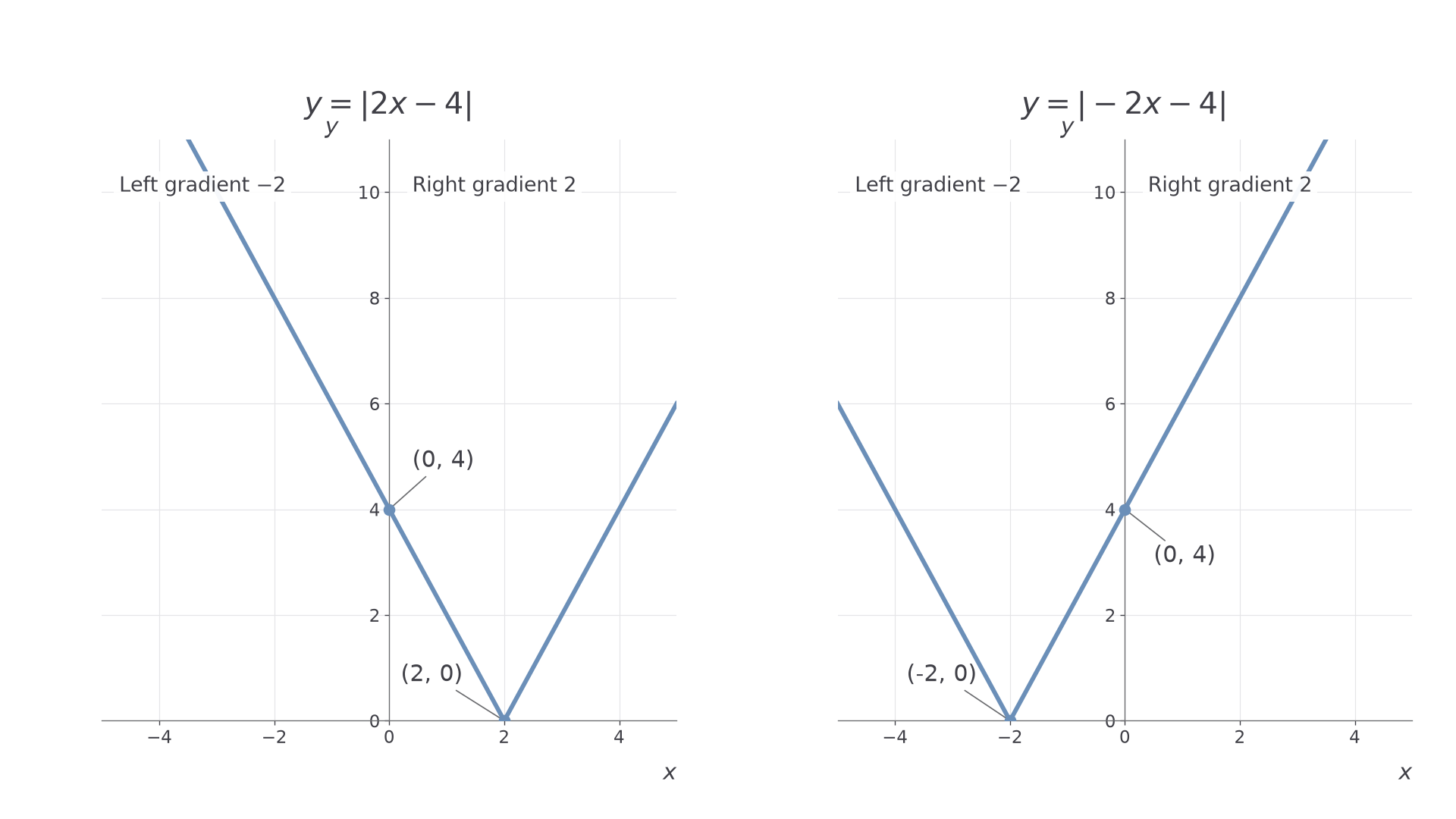
For , has vertex , -intercept , and ray gradients and . If , the graph is the horizontal line , rather than a V.
Watch out
is not for every input. At , that would give . Negate the whole expression wherever it is negative.
Locate a new vertex and write the two rules.
Equating two distances
A distance of can come from or . Thus means or . More generally, two real numbers have equal moduli exactly when they are equal or opposite.
Equal moduli
For real ,
The squared equation factors as . Not in the formula booklet: learn it.
The signed cases usually avoid expanding squares. If an equation instead has , the right side must be non-negative; squaring alone can otherwise introduce false answers.
Worked example 3: one fixed distance
Question. Solve .
Plan. Set the bracket equal to both possible signed values.
Solving the first gives ; solving the second gives .
Answer. or .
Check. The brackets are respectively and , each with modulus .
Continue this lesson.
You’re previewing NovaLearn without an account. Create a free account to read the rest.
Create free account