2.4, 3.4 - Differentiating trigonometric functions
A sine curve is steepest where it crosses its centre line and flat at its peaks. You will connect that picture to the derivatives of sine, cosine and tangent, then differentiate composite functions and locate stationary points within a stated interval. All calculus angles in this lesson are in radians.
Radian derivatives
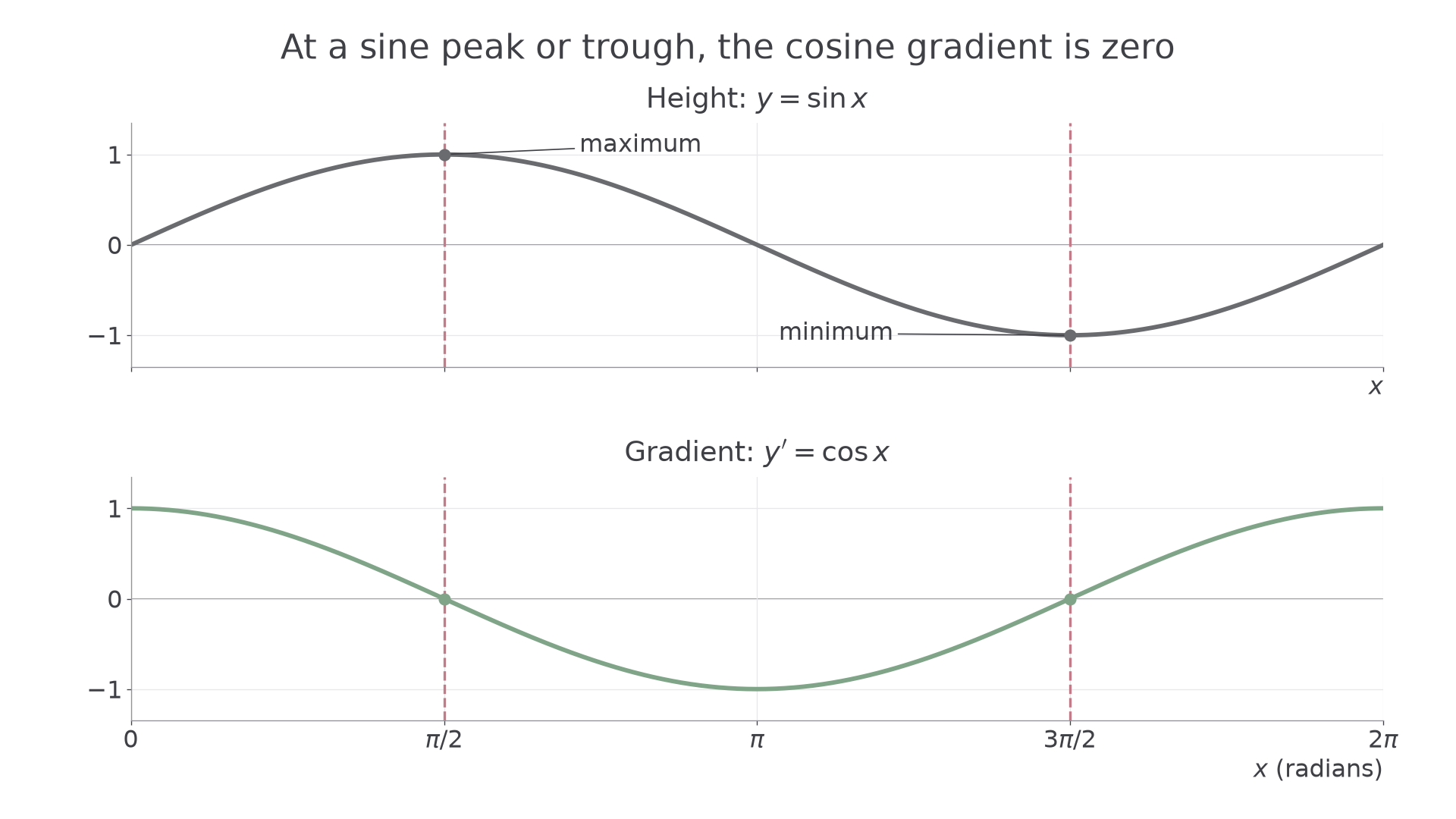
Why is a sine wave flat at its highest points? Its gradient follows a cosine wave: where sine reaches , cosine is . Where sine crosses upwards through , cosine is .
Near the origin, a radian angle gives . For example, . This is why the limiting gradient of at is . Measuring the same numerical input in degrees would stretch the horizontal scale and change the gradient.
Trigonometric derivatives in radians
The angle is in radians. The tangent formula applies where . These derivatives are in the formula booklet.
Sine and cosine are defined and differentiable for every real radian input. Tangent is undefined at , where is an integer; a derivative cannot supply a gradient at one of those missing points.
[DIAGRAM: asset_name: A wave and its gradient; asset_slug: sine-and-gradient; caption: Sine has zero gradient at its peaks and troughs, and its gradient is cosine; description: Aligned coordinate panels from zero to two pi show y equals sin x above and its gradient cos x below. Vertical dotted guides at pi over two and three pi over two connect the turning points of sine to zeros of cosine.]
Worked example 1: differentiating a sine sum
Question. Differentiate and find its gradient at .
Plan. Differentiate term by term, then use the exact radian value of cosine.
Answer. ; the requested gradient is .
Check. At , sine is increasing. Its contribution to the gradient is positive, so the answer should exceed the straight-line contribution ; it does.
Replace sine with cosine, keeping the multiplier, linear term and input. The negative sign now matters.
Worked example 2: differentiating a cosine sum
Question. Differentiate and find its gradient at .
Plan. Use the negative sine derivative of cosine, then substitute.
Answer. ; the requested gradient is .
Check. Near , a central difference with step gives approximately , agreeing with .
Tangent follows the same constant-multiple rule: for , the derivative is . At , , giving gradient .
Watch out
, not . Also use radian mode when evaluating a calculus expression numerically. For a degree input , , so its derivative with respect to includes .
Use all three basic derivatives in this short check.
Composite trigonometric functions
Changing to compresses its wave horizontally. The function now moves through the same heights three times as quickly, so the derivative needs a factor of .
The chain rule with trigonometric functions
For a differentiable radian angle ,
The last result requires . The basic derivatives are in the formula booklet; these forms follow by the chain rule.
The inside angle need not be linear: . Keep inside the sine and multiply by its derivative .
Worked example 3: a linear angle
Question. Differentiate .
Plan. Differentiate sine, keep its angle, then multiply by the angle's derivative.
Answer. .
Check. At , the angle is zero. A small change in gives , so the gradient is , agreeing with the derivative.
Continue this lesson.
You’re previewing NovaLearn without an account. Create a free account to read the rest.
Create free account