1.1 - Counting real roots
You can often decide how many real solutions a quadratic has without finding either solution. You will use the discriminant, apply it to equations containing a parameter and connect the result to where graphs cross or touch. The distinction between two roots and a repeated root will matter throughout.
The discriminant
How can you tell whether has two, one or no real solutions while is still unknown? In the quadratic formula, just one expression controls whether the two answers separate, coincide or fail to be real.
For , the formula is
When the square root is positive, the plus and minus signs give different numbers. When it is zero, both signs give . A negative number has no real square root.
Discriminant
The discriminant of is . For the quadratic equation , with , it distinguishes the possible numbers of real roots.
The word “real” matters. We are counting solutions on the real number line.
Discriminant and real roots
For , where ,
The quadratic formula containing is in the formula booklet; learn these interpretations.
Here are two members of the opening family.
Worked example 1: a positive discriminant
Question. Determine the number of real roots of .
Plan. Calculate and use its sign.
Answer. There are two distinct real roots.
Check. Factorising gives , with the two different roots and .
Change only the constant from to . The discriminant reaches the boundary value zero.
Worked example 2: a repeated root
Question. Determine the number of real roots of .
Plan. Use the same calculation with the new constant.
Answer. There is one repeated real root.
Check. The equation is , so the only distinct solution is .
If the constant rises to , then . Completing the square gives , confirming that no real input works. Thus the three cases come from the same family, with the constant moving its minimum through zero.
Watch out
means a repeated root, not no roots. Also, uses the signed coefficient: if , then .
Calculate the sign before drawing a conclusion.
Conditions on a parameter
A parameter is a constant whose value is allowed to vary between different equations. Treat it as a coefficient while calculating the discriminant, then solve the condition the question asks for.
“Real roots” includes a repeated root and therefore requires . “Two distinct real roots” requires . Before either test, check that the coefficient of is nonzero: otherwise the equation is no longer quadratic.
Worked example 3: a parameter in the constant
Question. Find the set of values of for which has two distinct real roots.
Plan. The leading coefficient is always , so impose .
Answer. .
Check. gives , two roots. The boundary gives , so it must be excluded.
Now move the varying coefficient to the leading term. The extra check is whether that term can disappear.
Worked example 4: a parameter in the leading coefficient
Question. Find the set of values of for which has two distinct real roots.
Plan. Require , then calculate the discriminant.
Answer. , with .
Check. At , the original is : only one root, despite the positive value obtained for . At , it is , the excluded repeated-root boundary. At , and the equation remains quadratic.
If asked for a repeated root in the second example, solve , giving , then check . If asked for at least one real root, the answer is : the exceptional linear case also has a real solution. Always interpret the original question after checking the exceptional case.
Watch out
A positive value of does not guarantee two roots when . The quadratic formula divides by , so its root-count rule requires .
Include the exceptional leading-coefficient value in your reasoning.
A graph interpretation
A root of is the horizontal coordinate of a point where meets the -axis. Two roots give two crossings; a repeated root gives one point where the parabola touches the axis; no real roots give no meeting points.
The same reasoning applies to a horizontal line at another height. To find where meets , solve . The roots now locate the meetings with that line, rather than necessarily the -axis.
[DIAGRAM: asset_name: Crossing, touching and missing; asset_slug: discriminant-intersections; caption: The same parabola has two, one or no intersections as a horizontal line moves; description: Three equal-scale plots show y equals x squared minus 4x plus 3. The lines y equals 0, y equals minus 1 and y equals minus 2 give two crossings at x equals 1 and 3, a touch at vertex 2 comma minus 1, and no intersections respectively.]
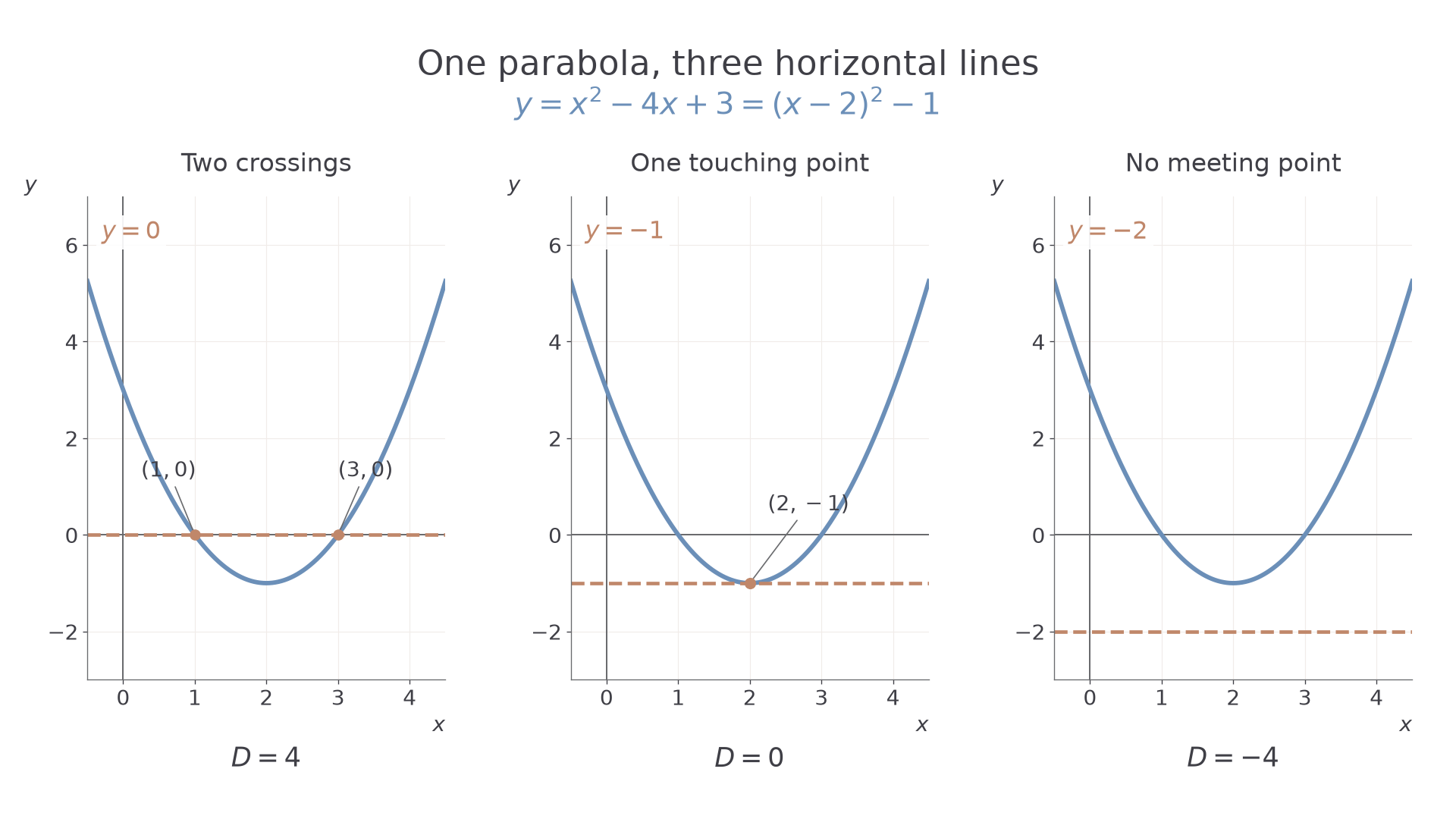
The picture makes the algebra's boundary visible. Touching here means one common point with a repeated horizontal coordinate; no differentiation is needed to find it.
Worked example 5: two intersections
Question. Determine the number of points where meets .
Plan. Equate the two heights and count the roots.
Answer. There are two points of intersection.
Check. The roots are , giving the two points and . The vertex lies below the line, consistent with two crossings.
Move only the horizontal line, from height to height .
Worked example 6: a touching line
Question. Determine the number of points where meets .
Plan. Move all terms of the equality to one side before using the discriminant.
Answer. There is one point of contact; the line touches the parabola.
Check. gives . Substitution gives , so the common point is exactly the vertex .
At height , the reduced equation would be , with no real solution. For the opening family , the discriminant is : two roots for , a repeated root for , and none for .
Key idea
Count roots of the equation obtained by equating the two graph heights. Using the discriminant of the curve's original expression alone counts its meetings with the -axis, not with an arbitrary line.
Use the appropriate equality for a different horizontal line.
Quick Recap
- The discriminant is ; its sign counts real roots when .
- A zero discriminant gives a repeated root and a touching point.
- For a parameter, state the discriminant condition and check any value that removes the quadratic term.
- For graph intersections, first equate the two expressions for the height.
The opening family is controlled by , with as its repeated-root boundary.