4.4 - Forces causing acceleration
The direction a particle moves need not be the direction it accelerates. You will use force diagrams to calculate acceleration, resolve motion on rough planes, and connect vertical force equations to constant-acceleration motion. The resultant force, rather than any one force, determines how velocity changes.
Resultant equals mass times acceleration
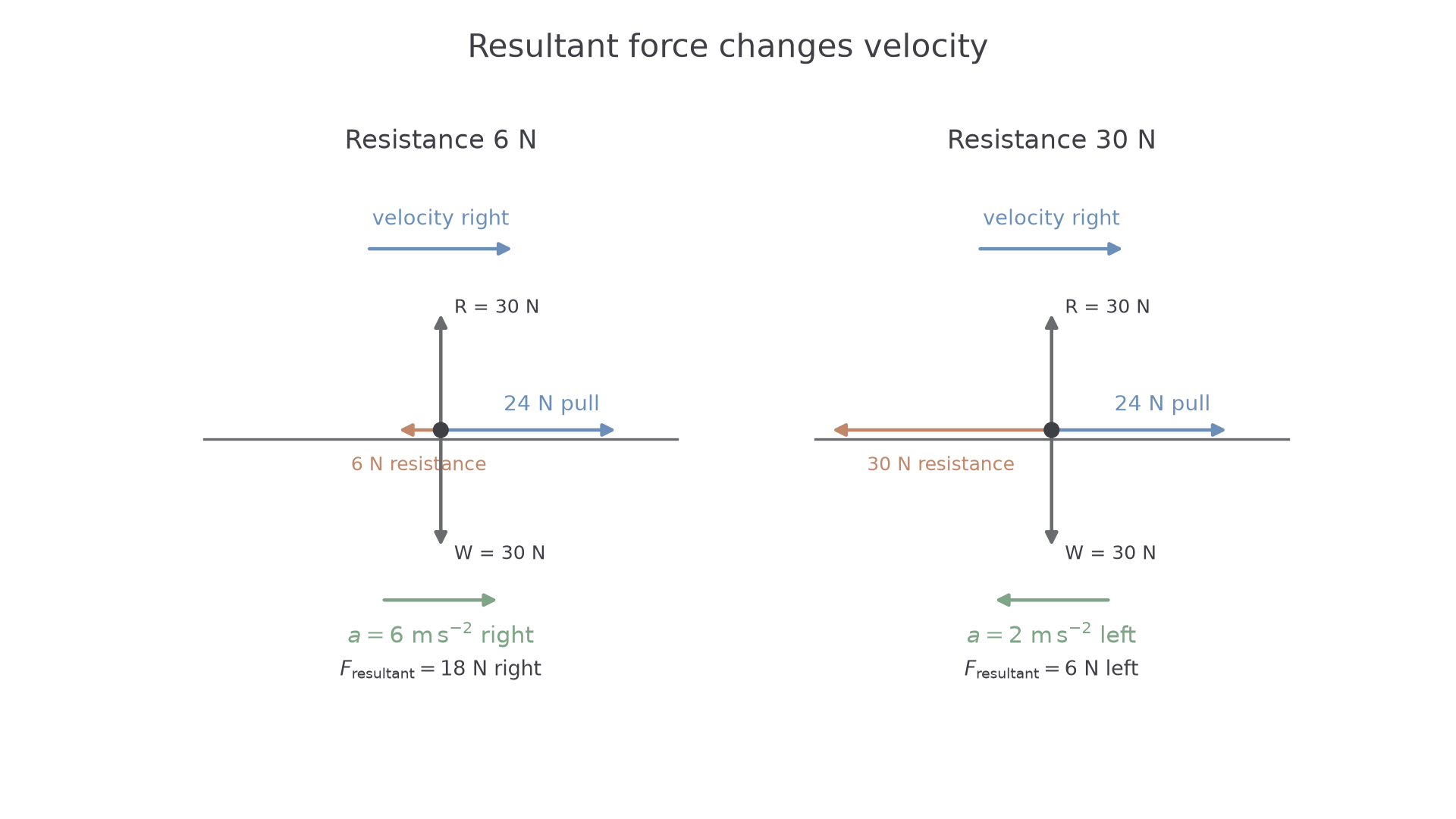
A trolley moves right while a larger force pulls it left. Must it immediately move left? No: its velocity changes towards the left, so it first slows down. Forces determine acceleration; the initial velocity also matters.
For a concrete calculation, a trolley pulled right by against resistance has resultant right. Each kilogram has of resultant force, giving acceleration right.
Newton's second law
For a particle of constant mass, in a chosen positive direction,
Force is in newtons, mass in kilograms and acceleration in . One newton is the force that gives acceleration .
Not in the formula booklet: learn it.
Newton's first law describes the zero-resultant case: a particle remains at rest or moves with constant velocity unless acted on by a nonzero resultant. A force is not needed merely to maintain motion. Where forces act in two dimensions, resolve along perpendicular axes and apply the law separately. An axis with zero acceleration gives an equilibrium equation even while the other axis has acceleration.
[DIAGRAM: asset_name: Velocity and acceleration can oppose; asset_slug: newton-resultant-sign; caption: The same rightward velocity can accompany rightward or leftward acceleration; description: Two horizontal particle force diagrams for a 3 kilogram trolley show a 24 newton pull right. The first has 6 newtons resistance left and resultant 18 newtons right, giving acceleration 6 metres per second squared right. The second has 30 newtons resistance left and resultant 6 newtons left, giving acceleration 2 metres per second squared left. Both have separate rightward velocity arrows. Equal weight and normal arrows are shown in each.]
Worked example 1: a forward resultant
Question. A trolley moves right on a horizontal track. A constant force of acts right and a constant resistance of acts left. Find its acceleration.
Plan. Choose right as positive, then subtract the opposing force before dividing by mass.
The normal force and weight balance vertically because the trolley has no vertical acceleration.
Answer. Acceleration rightwards.
Check. Mass times acceleration is , equal to the measured force difference, rather than the pull alone.
Increase only the resistance. The trolley can still be moving right while its acceleration is leftwards.
Worked example 2: a backward resultant
Question. The same trolley now has resistance left, with the pull unchanged. Initially it moves right at . Find its acceleration, velocity and displacement after .
Plan. Find the signed acceleration from forces, then use the known initial velocity.
Answer. Acceleration left; velocity right; displacement right.
Check. The stop would occur at , later than this interval. The mean velocity over the first is , confirming .
A constant resultant on a constant mass gives constant acceleration, so the motion equations apply until a force or constraint changes. If resistance depends on speed, the force calculation gives acceleration at the specified instant; it does not justify constant acceleration over a whole journey.
Watch out
Writing in Example 1 omits resistance. Draw all forces on the chosen particle, form their signed sum, and then set that sum equal to .
Find the force difference before calculating the change in velocity.
Motion on a rough plane
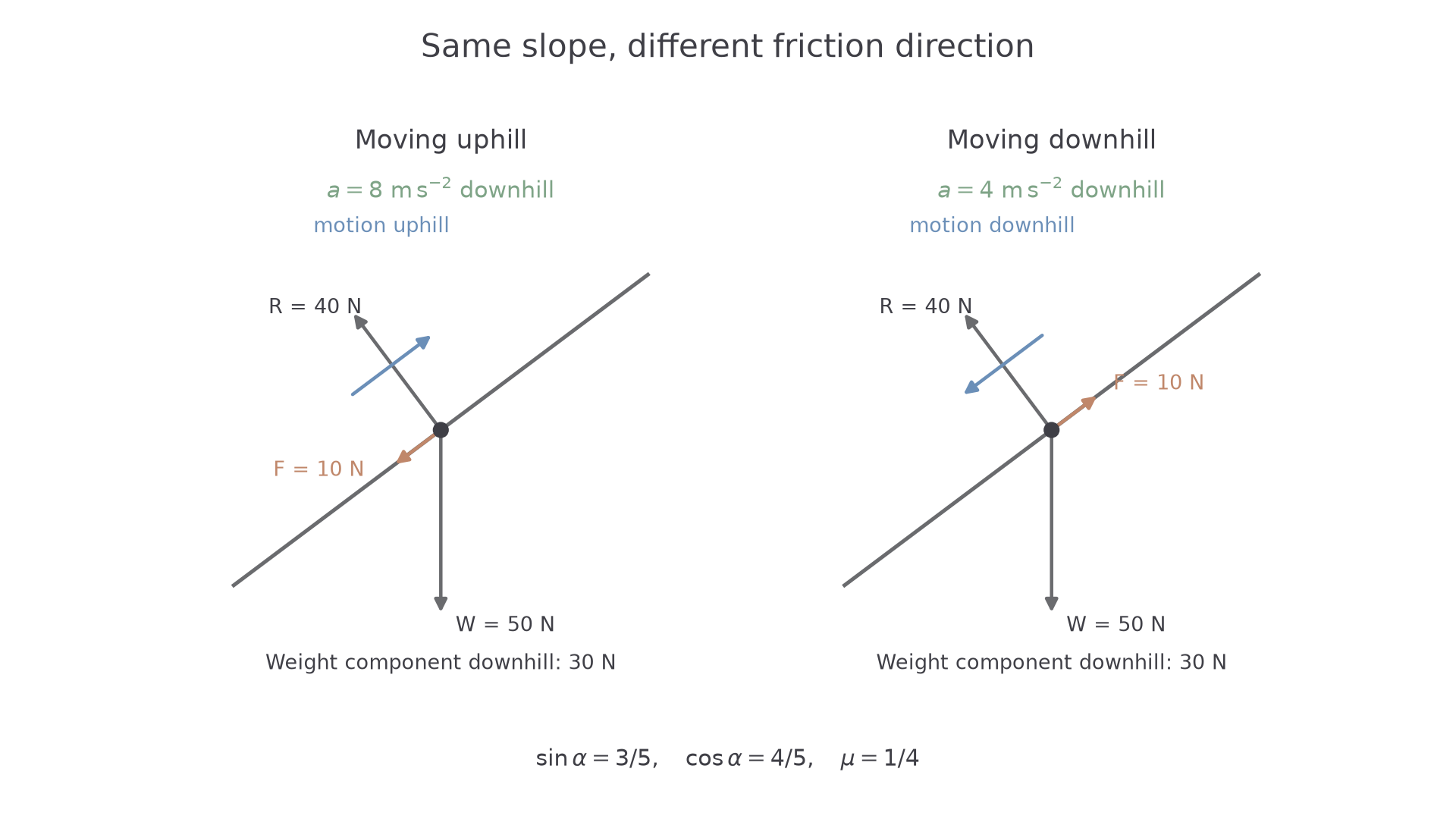
On a rough slope, weight always has a downhill component, but friction changes direction when the sliding reverses. The acceleration uphill and the acceleration downhill therefore need not have equal magnitudes.
In this model, a particle sliding on a rough plane has friction of magnitude , opposing its motion. At rest, retain the static bound unless the particle is in limiting equilibrium. Do not carry the sliding equation through a stop without considering whether it remains at rest.
For a plane inclined at , with no other perpendicular force,
Weight contributes downhill. Resolving along the plane includes that component and friction; resolving perpendicular gives , since the particle remains in contact without perpendicular acceleration.
Sliding friction
For sliding in the rough-contact model,
with friction opposite the relative sliding and . Use the actual normal contact force, including other forces' perpendicular components.
Not in the formula booklet: learn it.
[DIAGRAM: asset_name: Friction reverses on the return; asset_slug: newton-rough-return; caption: Gravity stays downhill. Friction reverses when the particle slides back; description: Two matching inclined-plane force diagrams have slope with sine three fifths and cosine four fifths. A 5 kilogram particle has weight 50 newtons vertically down, normal contact 40 newtons perpendicular out, and friction 10 newtons along the plane. The left panel has motion uphill and friction downhill, producing 40 newtons downhill resultant. The right has motion downhill and friction uphill, producing 20 newtons downhill resultant. A note labels the downhill weight component 30 newtons without adding it as an extra force arrow.]
Continue this lesson.
You’re previewing NovaLearn without an account. Create a free account to read the rest.
Create free account