4.1, 4.4 - Modelling forces
A box can have several forces acting on it even while it stays still. You will turn physical situations into particle models, distinguish mass from weight, and identify the two bodies in a Newton's third-law pair. These ideas from 4.1 and the mass–weight relationship in 4.4 are the starting point for calculating with forces.
A particle model
A box rests on a table. Gravity pulls it down, so why does it stay there? The table also pushes on the box. A useful model must include both interactions.
In mechanics, first choose the body you are studying. Then ask what other bodies interact with it. Earth provides weight; a touching surface provides contact force; a taut string provides tension. An applied push or pull must also appear if one is stated. Include air resistance only when the model specifies it.
Particle model
A particle model treats a body's mass as concentrated at one point and models all forces on it as acting at that point. Its size, shape and rotation are ignored. A large box can be treated as a particle when these details do not matter to the question.
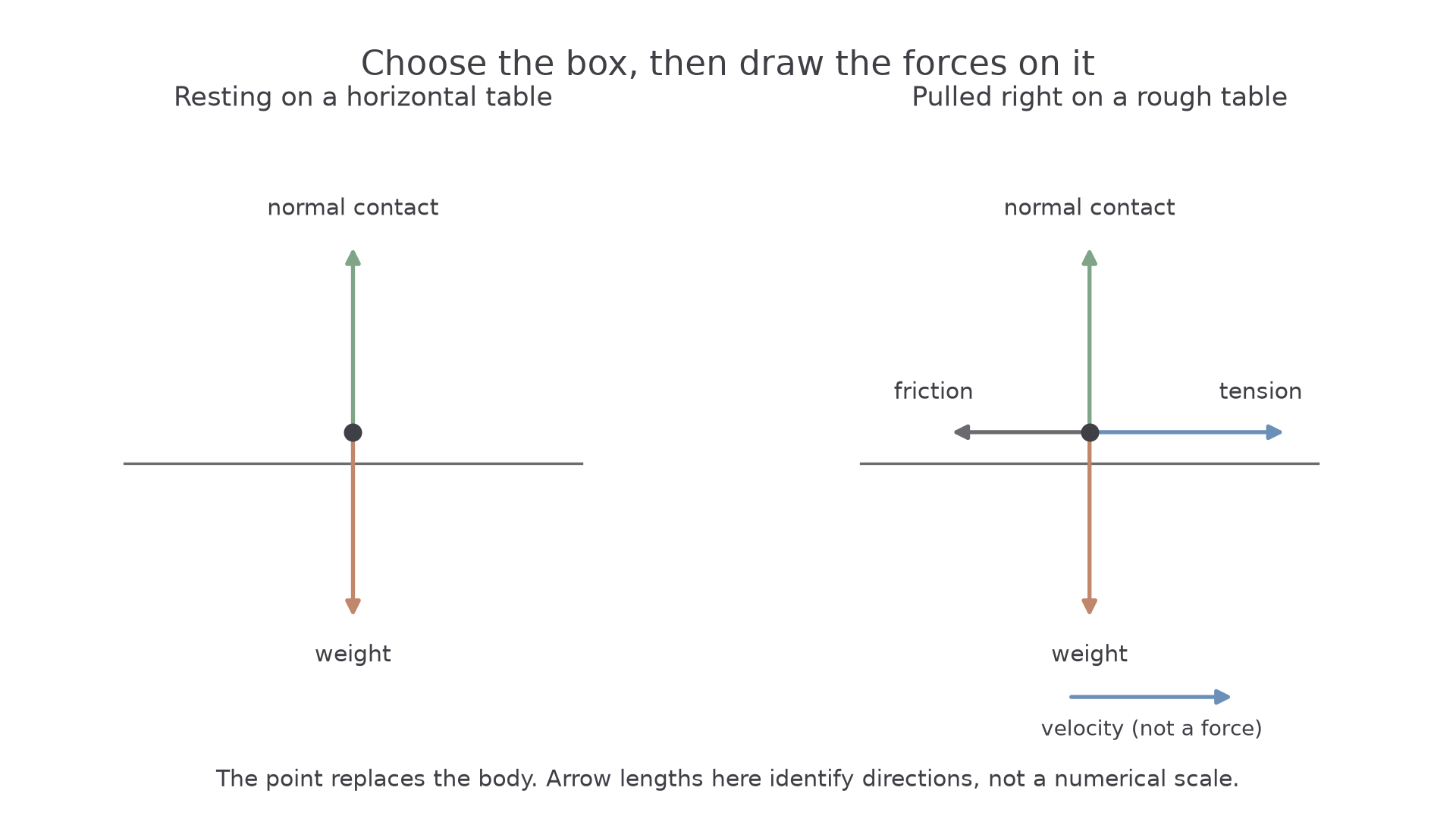
A force has a magnitude, measured in newtons, and a direction. Draw it as an arrow pointing in the direction of the force on the chosen body. A force diagram contains these force arrows and labels. A velocity arrow, if useful, should be separate and clearly identified: motion itself is not a force.
For a box on a horizontal table, draw weight vertically down and the table's normal contact force vertically up. If a taut rope pulls the box to the right, add tension to the right. If the table is rough and the box slides right, add friction to the left. The diagram below compares the first two situations; it does not imply that every force is equal.
[DIAGRAM: asset_name: Forces on the chosen box; asset_slug: mechanics-particle-forces; caption: Draw the forces on the box at one point, adding only interactions present in the model; description: Two particle force diagrams show a box resting on a horizontal table and a box pulled right along a rough horizontal table. Both show weight vertically down and normal contact vertically up. The pulled box also has tension right and friction left. A separate rightward motion arrow is explicitly labelled velocity, not force.]
A string pulls along its length, away from the body: this pull is tension. A compressed rigid rod can push along its length: this push is thrust. These directions come from the interaction, rather than from an assumption about which way the body moves. A slack string exerts no tension.
Watch out
Do not add a “force of motion” to a moving body's diagram. List the actual interactions. A moving box can have weight, normal contact, tension and friction; its velocity is a description of its motion.
Test which arrows belong to a specified body.
Mass, weight and contact
Mass tells you how much matter is in the model; weight is the gravitational force on that mass. A mass of has weight when .
Mass and weight
Here is mass in kilograms, is weight in newtons and is gravitational acceleration. Use in this course's numerical mechanics questions unless another value is specified.
Not in the formula booklet: learn it.
Weight acts vertically down. A surface's contact force can have two components: the normal contact force , perpendicular to the surface, and friction, parallel to the surface. “Normal” means perpendicular, so a tilted plane's normal force is tilted too.
Smooth contact
A smooth contact is modelled as having no friction. Its contact force is perpendicular to the surface. It can still exert a normal force. This approximation is unsuitable when friction has an important effect, such as a rough slope holding a box in place.
For a particle at rest, its forces balance. With only one upward force and one downward force, their magnitudes must be equal. This lets us calculate a contact force without introducing an acceleration equation.
Continue this lesson.
You’re previewing NovaLearn without an account. Create a free account to read the rest.
Create free account