1.3 - Equations of circles
A circle is made of points that are all the same distance from one fixed point. In this part of 1.3, that simple description will become an equation, and completing the square will uncover a hidden centre and radius. You will also use diameters, right angles and symmetry to connect circle geometry with coordinates.
Centre and radius
Take a fixed point and a point . Their horizontal and vertical separations are and . Pythagoras says that , so fixing the distance gives a circle.
Circle
A circle is the set of points in a plane at a fixed positive distance, its radius, from a fixed point, its centre. A diameter joins two points on the circle through its centre and has length .
The equation records the squared distance, so the number on its right is the radius squared.
Standard circle equation
For a circle with centre and radius ,
This equation is not listed in MF19: learn it from the distance formula.
Read the centre by finding the values that make both brackets zero. For example, measures displacement from .
Worked example 1: a centre and one point
Question. A circle has centre and passes through . Find its radius and equation.
Plan. Use the centre-to-point distance to find ; put that value into standard form.
Thus , and
Answer. Radius ; equation .
Check. The point , five units vertically above the centre, satisfies the equation: .
The reverse task starts with the equation. You can then decide whether a stated point belongs to the circle.
Worked example 2: reading and testing an equation
Question. State the centre and radius of . Determine whether lies on the circle.
Plan. Match each bracket to a displacement from the centre, then substitute the proposed point.
The centre is , and , so . At ,
Answer. Centre , radius . The point lies on the circle.
Check. Its horizontal and vertical distances from the centre are and , giving distance , as required.
More generally, compare a point's squared distance from the centre with . Smaller means inside; equal means on the circle; larger means outside. This avoids unnecessary square roots.
Completing two squares
Expanding a circle equation hides its centre, but the squared terms retain equal coefficients. Complete one square in and one in to recover the distance interpretation. Keep the constant corrections from both squares.
Starting from , group the terms and use the completing-square identity:
Expanded circle equation
The centre is . A circle exists when , with radius . This result is not listed in MF19.
The left side of the completed form is a sum of real squares. If the right side is zero, the equation describes just the centre point, rather than a circle of positive radius. If it is negative, there are no real points at all.
Worked example 3: uncovering a circle
Question. Find the centre and radius of .
Plan. Complete the -square and -square separately, then collect their corrections.
Answer. Centre , radius .
Check. Expanding the answer gives , hence the original constant term after rearrangement.
Changing the constant can change whether a circle exists, even when the two bracket centres remain the same.
Worked example 4: no real circle
Question. Determine whether represents a circle.
Plan. Complete the squares and examine the sign of the proposed squared radius.
Answer. There is no real circle and no real point satisfying the equation, because two non-negative squares cannot sum to .
Check. The smallest possible value of the original left side is , attained at , so it cannot equal zero.
With the same - and -terms but constant , the right side would be zero and only would remain. With a constant less than , the right side would be positive. Existence is a condition to check before taking a square root.
Watch out
In expanded form, halve each linear coefficient before reading the centre. The centre has the opposite signs to the constants inside the completed brackets.
Test the positive-radius condition with an unknown constant.
Circle geometry in coordinates
A diameter gives both the centre and the radius: its midpoint is the centre, and half its length is the radius. Other circle facts become useful once you can express their distances and directions in coordinates.
Key idea
An angle subtended by a diameter at any other point on the circle is a right angle: the angle in a semicircle. The line from the centre to the midpoint of a chord is perpendicular to that chord, provided the chord is not itself a diameter.
Here is why these facts fit the geometry. Joining a point on a semicircle to the centre makes two isosceles triangles. If their base angles at the point are and , the two central angles sum to ; hence , giving . For a chord midpoint, the two triangles formed have equal radii, equal half-chords and the same centre-to-midpoint side. They are congruent, so their adjacent angles at the midpoint are equal and sum to : each is .
Worked example 5: a diameter and a right angle
Question. A circle has diameter endpoints and . Find its equation. Verify that lies on it and that and are perpendicular.
Plan. Find the diameter's midpoint and half-length; then check the point and the two gradients.
Thus , giving . For , . Also,
Answer. ; lies on the circle and .
Check. , and . Pythagoras independently confirms the right angle at .
The same circle also shows how a chord's midpoint controls its direction.
[DIAGRAM: asset_name: A diameter and a chord; asset_slug: circle-diameter-and-chord; caption: A diameter produces a right angle on the circle, while a chord is symmetric about the perpendicular from the centre; description: Two equal-scale panels show the circle with centre C at 2 comma 2 and radius 5. Left: diameter A minus 2 comma minus 1 to B 6 comma 5 and the point P 5 comma minus 2 form a right triangle, with its right angle marked at P. Right: the vertical chord x equals 5 has endpoints 5 comma 6 and 5 comma minus 2, midpoint M 5 comma 2 and horizontal segment CM of length 3. Its two half-chords are length 4.]
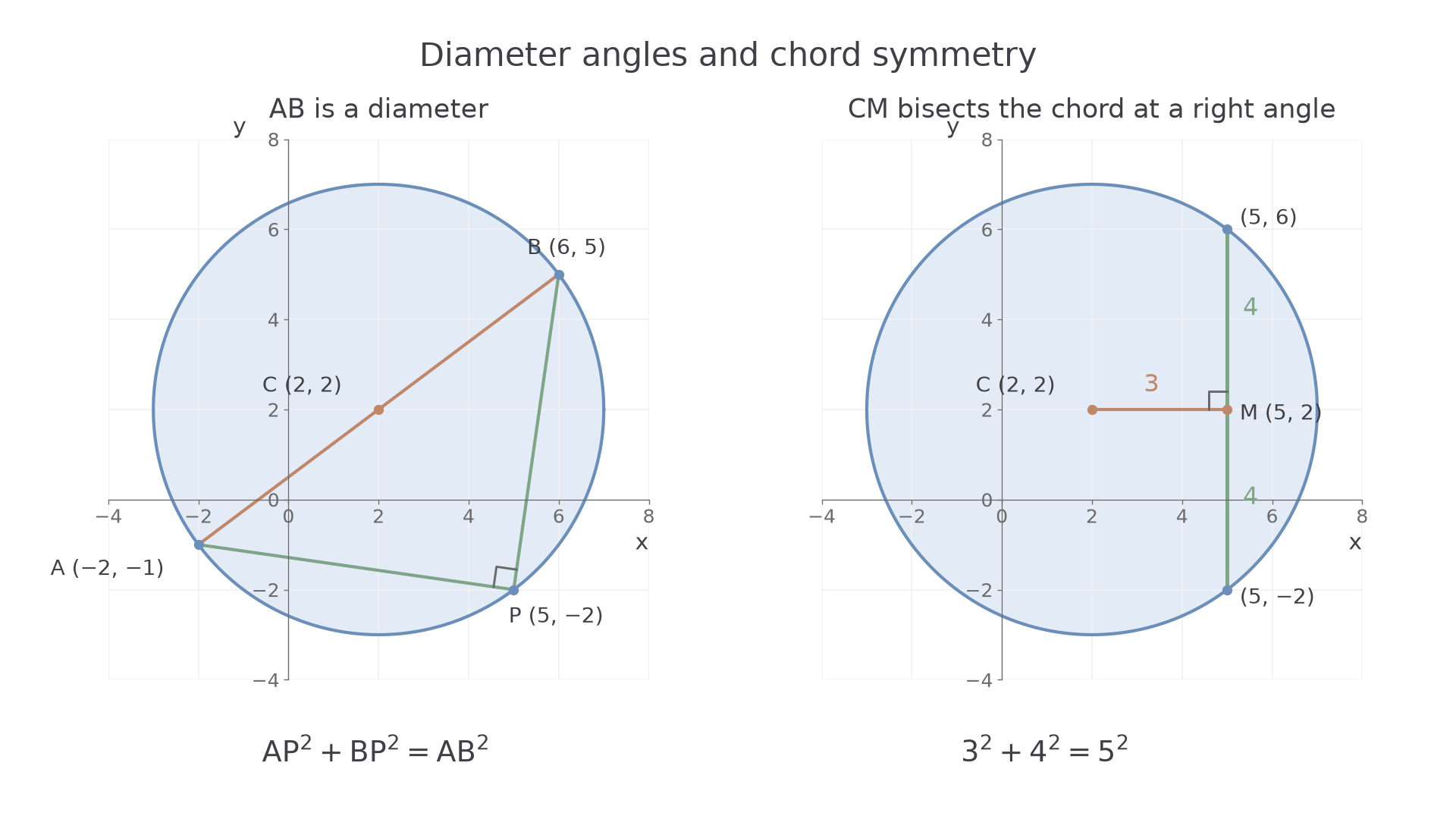
Use the centre-to-chord distance to find the half-chord length.
Worked example 6: chord symmetry
Question. Find the endpoints and length of the chord on .
Plan. The chord is vertical. Its midpoint is level with the centre ; use Pythagoras to find its two symmetric endpoints.
The midpoint is , so . If a half-chord has length ,
The endpoints are and .
Answer. Endpoints and , chord length .
Check. Substituting directly gives , so , confirming both endpoints.
Reflection in the horizontal line exchanges these endpoints and leaves the circle unchanged. The positive half-length matters: ; the two signs belong to the coordinates above and below the midpoint.
Quick Recap
- A circle equation is a fixed squared distance from its centre.
- Complete both squares to recover the centre and squared radius from expanded form.
- A positive squared radius gives a circle; zero gives one point; a negative value gives no real points.
- Diameter midpoints, right angles and chord symmetry turn geometric information into coordinates.