1.8 - Integration as reverse differentiation
Differentiation turns a curve into its gradient function. Integration reverses that process, but a gradient cannot tell you how far up the curve sits. You will recover families of functions, integrate rational powers and linear brackets, and check each result by differentiating it.
Antiderivatives
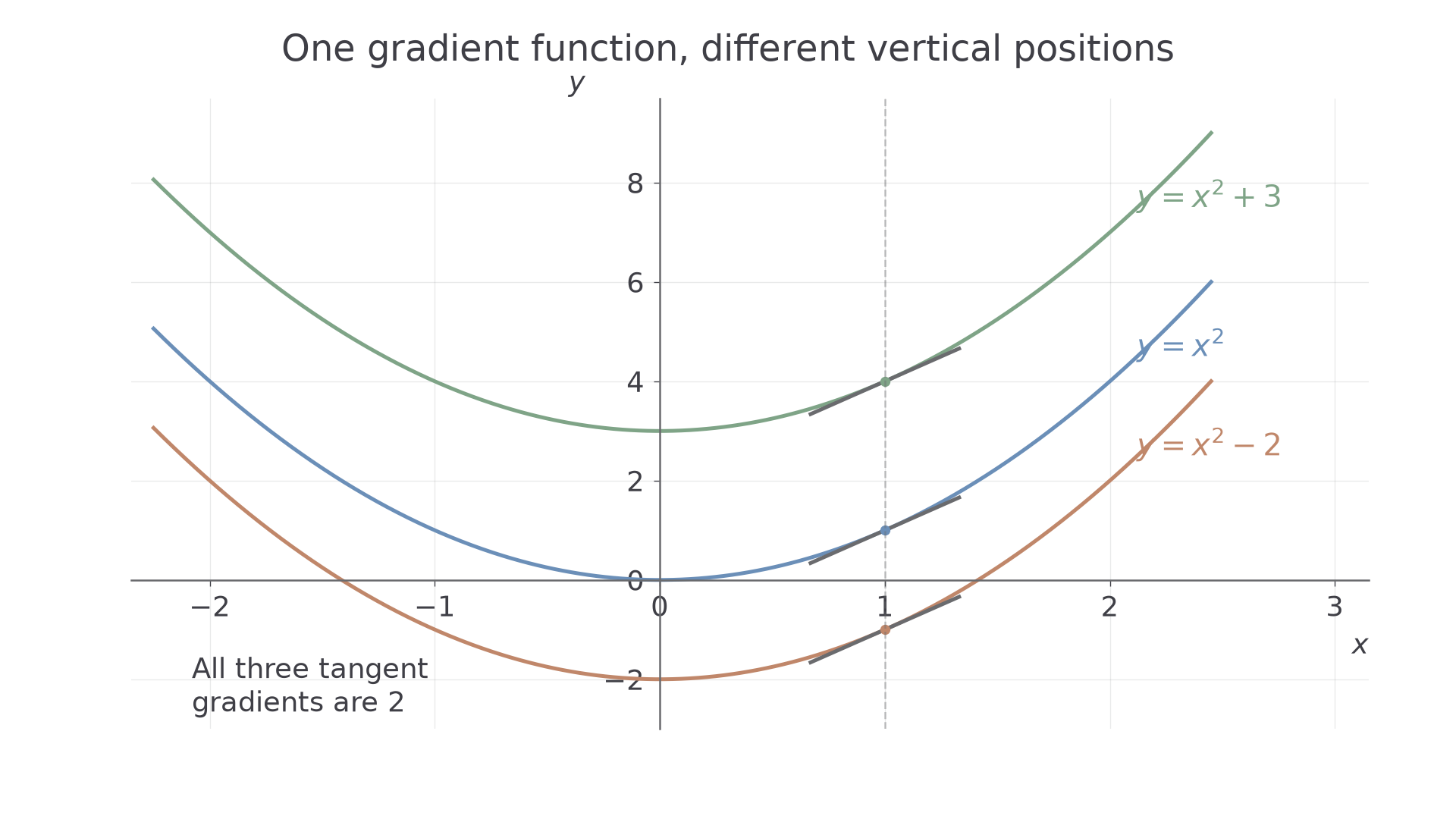
If a curve has gradient everywhere, must its equation be ? The curves and also have derivative . Moving a graph vertically changes its height, but leaves its gradients unchanged.
Antiderivative
An antiderivative of is a function whose derivative is . The indefinite integral denotes the family , where is an arbitrary constant, on a connected interval where the functions are defined.
The integral sign asks you to reverse differentiation; names the variable. For example, . Each choice of gives one member of the family. The surprise is that infinitely many different curves have exactly the same gradient function.
[DIAGRAM: asset_name: One gradient, many heights; asset_slug: antiderivative-family; caption: Vertical translations have the same gradient at each input; description: Coordinate graph showing y equals x squared minus 2, x squared and x squared plus 3. At x equals 1, three parallel tangent segments all have gradient 2. Each curve is labelled with its equation.]
To reverse , divide by the multiplier .
Integrating a power
For rational ,
Use an interval on which the real powers are defined. Negative powers exclude ; roots may restrict the domain further.
In the formula booklet; the booklet omits arbitrary constants, so add for an indefinite integral.
Increase the power by , then divide by that new power. A constant integrates to a multiple of : for example, , because .
Worked example 1: a positive fractional power
Question. Find , for .
Plan. Increase the exponent by , then divide by .
Answer. .
Check. Differentiating gives ; the constant differentiates to zero.
Change only the exponent's sign. The new exponent is still positive, but its reciprocal is different.
Worked example 2: a negative fractional power
Question. Find , for .
Plan. Calculate before dividing.
Answer. , on .
Check. , the original integrand.
The excluded exponent would make the denominator zero. This rule cannot integrate ; do not write . Its integration requires a different method.
Watch out
For integration, use the new power as the divisor: , not . Differentiate your answer to distinguish the two.
Try another negative power, keeping its domain.
Linear inner functions
A bracket such as changes twice as fast as . Differentiating a power of that bracket therefore produces an extra factor . For instance, expanding and differentiating gives .
More generally, differentiating gives : the usual power derivative is multiplied by the bracket's gradient . Reversing this step requires division by as well as the new power.
Integrating a linear bracket
For and rational ,
Work on an interval where the integrand and antiderivative are real and defined. If , integrate the resulting constant directly.
Not stated separately in the formula booklet: learn the adjustment by .
You do not need to expand a high or fractional power. Keeping the bracket intact often makes the calculation shorter.
Continue this lesson.
You’re previewing NovaLearn without an account. Create a free account to read the rest.
Create free account