1.5 - Exact values and reference angles
Why can two different angles have the same sine, yet a calculator return just one of them? This part of 1.5 develops exact trigonometric values from two simple triangles, extends them around the unit circle, and explains what an inverse-trigonometric answer means. You will work in both degrees and radians while keeping exact fractions and surds.
Exact acute values
For an acute angle in a right-angled triangle, sine compares the opposite side with the hypotenuse, cosine compares the adjacent side with the hypotenuse, and tangent compares the opposite side with the adjacent side. Similar triangles preserve these ratios: their values depend on the angle, rather than the triangle's size.
Right-triangle ratios
For an acute angle ,
These right-triangle definitions and the exact-value table below are not listed in MF19.
Take a right-angled isosceles triangle with perpendicular sides and . Pythagoras gives hypotenuse ; each acute angle is . Thus sine and cosine are both , while tangent is .
Next bisect an equilateral triangle of side . Each half has hypotenuse , short side and other side . Its acute angles are and . Swapping between them swaps the opposite and adjacent sides.
[DIAGRAM: asset_name: Two triangles give six ratios; asset_slug: exact-trig-triangles; caption: Pythagoras gives the lengths that make the 30, 45 and 60 degree ratios exact; description: Left is a right-angled isosceles triangle with perpendicular sides 1 and 1, hypotenuse square root of 2 and both acute angles 45 degrees. Right is a right triangle obtained by halving a side-2 equilateral triangle, with sides 1, square root of 3 and 2 and angles 30 and 60 degrees. Right angles and side labels are clear.]
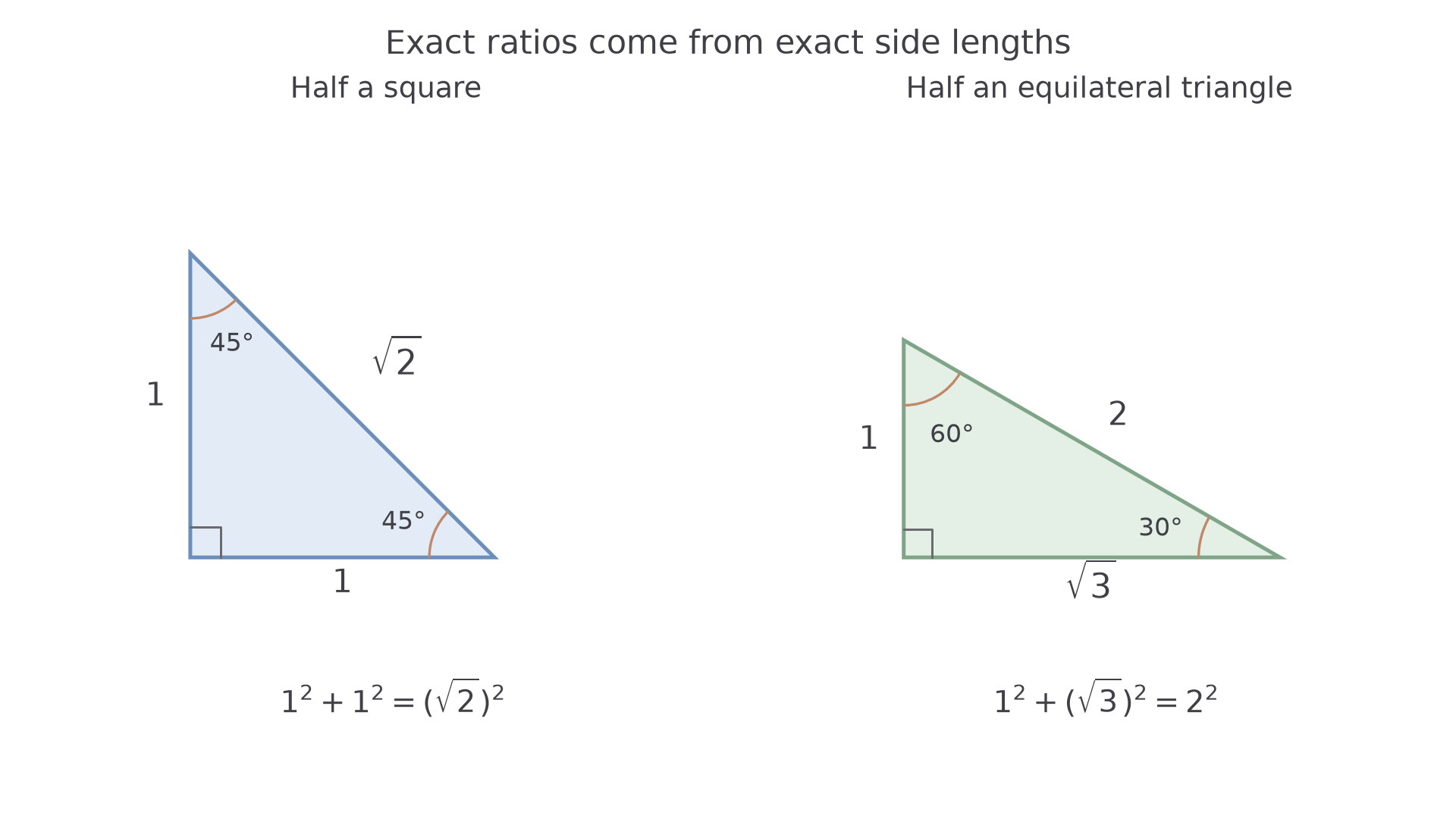
The ratios give the following table. Read the angle unit from the heading: the degree and radian entries name the same angle.
| Degrees | Radians | |||
|---|---|---|---|---|
An exact value retains a fraction or surd instead of replacing it with a rounded decimal. For instance, and are the same exact number: multiply numerator and denominator by .
Worked example 1: two different ratios
Question. Find exactly.
Plan. Read each ratio from the half-equilateral triangle and combine over a common denominator.
Answer. .
Check. The individual values are approximately and , so their sum is about , agreeing with the exact expression.
At , the corresponding sine and cosine are equal. Keep the surd until the end.
Worked example 2: two equal ratios
Question. Find exactly.
Plan. Use the isosceles right triangle and add the two identical fractions.
Answer. .
Check. Twice is . This also shows why adding two ratios can give a number greater than , even though each ratio here is at most .
The triangle is a way to reconstruct a forgotten value: decide which side is opposite the stated angle before dividing.
Angles of any size
A triangle's acute angles do not describe a turn past . The unit circle, centred at the origin with radius , extends the definitions to any angle. Start on the positive -axis; a positive angle turns anticlockwise and a negative angle turns clockwise. If the turning radius ends at , define and .
Unit-circle trigonometry
The point reached at angle on the unit circle is
Also wherever . Cosine and sine are defined for every real angle; tangent is undefined at the top and bottom of the circle, where the horizontal coordinate is zero.
For an acute angle, the radius is the hypotenuse of a right triangle of length , so these definitions agree with the earlier ratios. Elsewhere, the coordinates carry signs. A reference angle is the acute angle between the radius and the horizontal axis; use it to find the magnitudes of the ratios. An axis angle such as is read directly from its point instead.
[DIAGRAM: asset_name: Coordinates set the signs; asset_slug: unit-circle-reference-angles; caption: Reflecting a radius preserves ratio magnitudes and changes the signs of its coordinates; description: A unit circle with equal-scale horizontal and vertical axes marks radii at 30, 150, 210 and 330 degrees, each with a 30 degree reference angle to the horizontal axis. The point at 150 degrees is labelled minus square root of 3 over 2 comma one half. A panel lists the signs of sine, cosine and tangent in the four quadrants.]
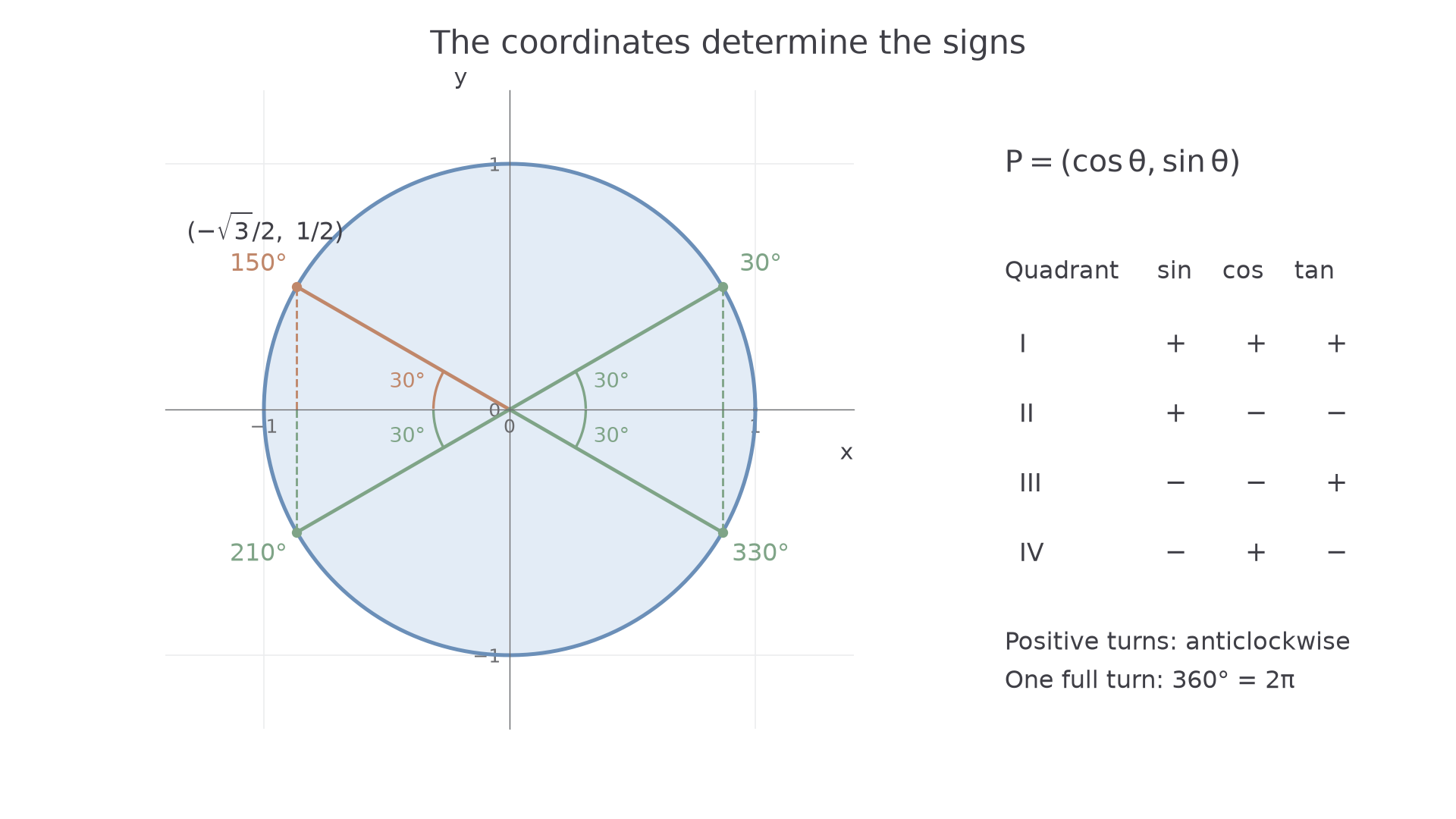
The quadrants are the four regions between the axes, numbered anticlockwise from the top right. Reading horizontal and vertical signs gives:
| Quadrant | Angle in one positive turn | |||
|---|---|---|---|---|
| I | ||||
| II | ||||
| III | ||||
| IV |
For reference angle , the four positions in one turn are , , and . In radians, replace the half-turn by and the full turn by . The signs come from the quadrant, rather than from the reference angle itself.
Worked example 3: a second-quadrant angle
Question. Find and exactly.
Plan. Use reference angle , then the coordinate signs in quadrant II.
Answer. and , respectively.
Check. Reflecting the point in the vertical axis changes its horizontal coordinate's sign but preserves its vertical coordinate. The quotient therefore becomes negative.
Crossing into quadrant III keeps cosine negative but changes the sign of sine, so tangent changes sign.
Worked example 4: a third-quadrant radian angle
Question. Find and exactly.
Plan. Write , giving reference angle in quadrant III.
Answer. and , respectively.
Check. The point is opposite the point, so both coordinates reverse sign. Their quotient is unchanged, agreeing with positive tangent.
At the four axis positions, the coordinates give sine and cosine without a reference triangle:
| undefined | undefined |
A whole turn leaves the endpoint unchanged. Reduce angles greater than a turn, or negative angles, by adding or subtracting whole turns before choosing a quadrant. For example, , so . Also , so .
Watch out
A negative angle does not make every ratio negative. For instance, ends in quadrant IV: cosine is positive, while sine and tangent are negative.
Choose the reference angle and sign separately in this check.
Inverse trigonometric values
An inverse operation asks for the input that produced an output. But many angles have the same sine: and both give . To return one answer, the inverse sine uses a restricted angle interval on which sine is one–one. Its chosen answer is the principal value.
Principal inverse values
These principal-value ranges are supplied in MF19. In degrees, the corresponding endpoints are and .
Inverse sine and inverse cosine have no real value for an input outside , because a unit-circle coordinate cannot exceed in magnitude. Tangent can take any real value, but its principal angle cannot equal either or , where tangent is undefined.
The notation , also called , means an angle. It does not mean . In contrast, means . Calculator inverse keys use the selected degree or radian mode; state the intended unit.
Worked example 5: different inverse ranges
Question. Find and in radians.
Plan. Use the exact reference values, then choose the angle inside each inverse's principal range.
Sine is at , which lies in . Cosine is at , which lies in .
Answer. and , respectively.
Check. by reflection below the horizontal axis, and by the quadrant-II reference angle . Both answers satisfy their required ranges.
Applying a function and then its inverse recovers the original angle only if that angle already lies in the chosen principal interval.
Worked example 6: returning a principal angle
Question. Find and .
Plan. Evaluate the inner ratio first, then find its principal inverse angle.
Answer. and , respectively.
Check. The answers have the required tangent and sine. The original angles and lie outside their respective principal intervals, while the returned angles lie inside them.
A principal value is a starting point for solving an equation, rather than a list of all its roots. The unit-circle symmetries explain how another angle can share that value.
Quick Recap
- Reconstruct exact values from the and triangles.
- On the unit circle, cosine is horizontal, sine is vertical, and their quotient gives tangent where cosine is nonzero.
- Use a reference angle for the magnitude and a quadrant for the sign; whole turns preserve the endpoint.
- An inverse-trigonometric value is one principal angle, with its own specified range.