4.1 - Friction and limiting equilibrium
A gentle pull on a rough surface may produce no motion at all: friction can adjust to the force needed for balance. You will determine its direction and magnitude, check whether rest is possible, and use limiting equilibrium when a particle is about to slip. Resolving perpendicular to the surface matters just as much as resolving along it.
Normal and frictional contact
A box rests on a rough slope, held by an uphill pull. Does friction act uphill or downhill? It depends on which way the box would tend to slide without friction, rather than simply on the direction of the pull.
The contact force has a normal component , perpendicular to the plane and away from it, and a frictional component , along the plane. For a body at rest, friction opposes the tendency for relative sliding. For a body sliding along a fixed plane, it opposes that sliding. Friction can be zero if no tangential force is needed.
Frictional contact
Friction is the tangential component of contact between surfaces. The normal contact force is the perpendicular component. Together they form the total contact force; on a rough surface that total need not be perpendicular to the plane.
Take axes along and perpendicular to the plane. Weight contributes downhill and into a plane inclined at to the horizontal.
[DIAGRAM: asset_name: Contact and weight on a slope; asset_slug: mechanics-friction-plane; caption: Weight resolves into a downhill component and an inward normal component. friction depends on the tendency to slide; description: Exact geometry for a 30 degree slope shows a particle with weight 100 N vertically down, normal contact perpendicular away from the slope, a 20 N pull uphill along the slope and friction uphill. A separate component triangle resolves weight into 50 N downhill and 50 square root 3 N into the plane. The force diagram contains weight itself rather than also adding its components as extra forces.]
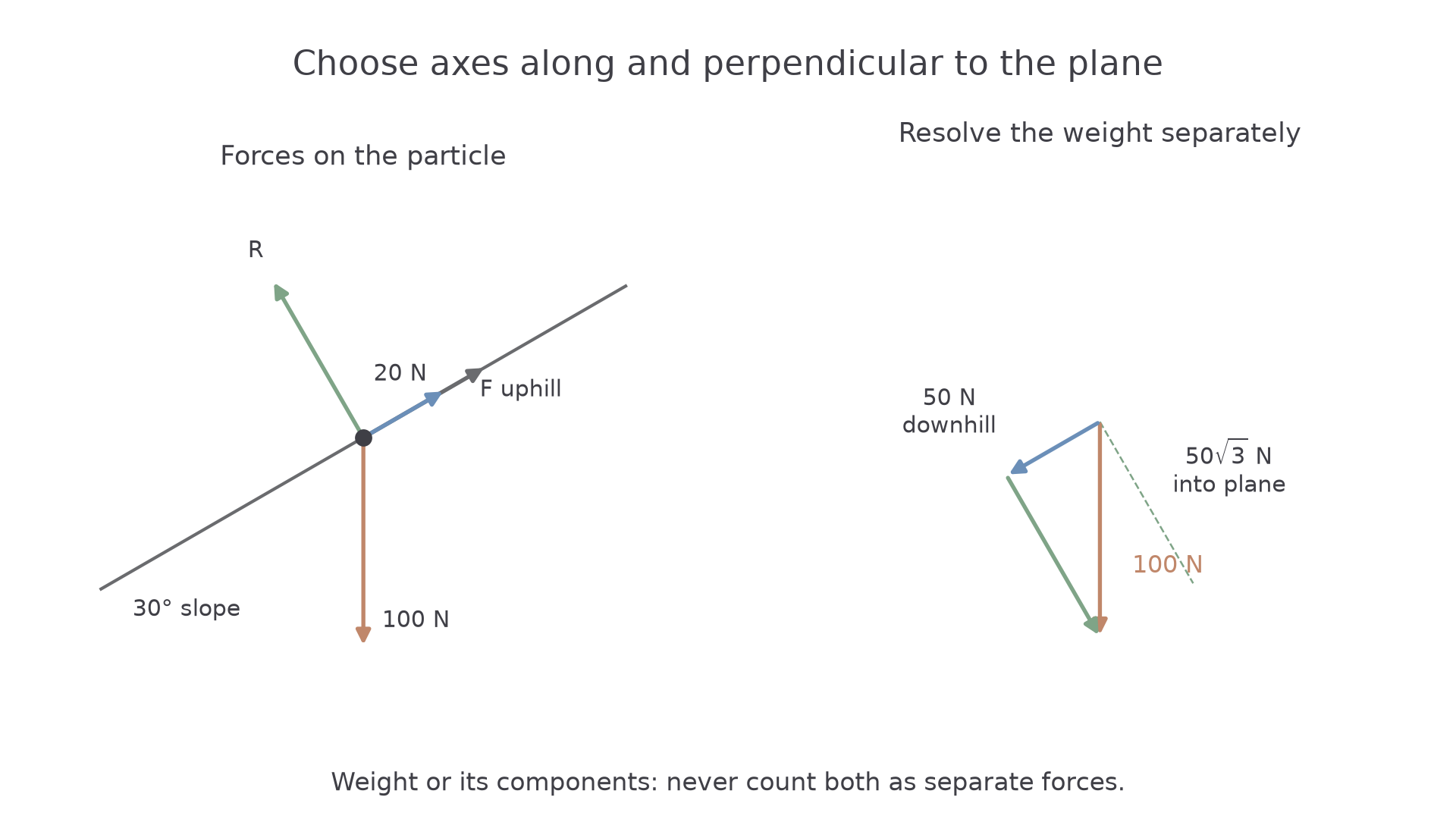
Worked example 1: friction acts uphill
Question. A particle of mass rests on a rough plane inclined at to the horizontal. A force of pulls it directly up the plane. Find and the friction needed for rest.
Plan. Resolve perpendicular to the plane, then compare the pull with the downhill weight component.
Answer. ; friction uphill is required.
Check. The uphill components total , balancing the downhill component. Whether the surface can supply this friction is a separate question.
Change only the pull to . It now exceeds the downhill weight component, so the required friction reverses.
Worked example 2: friction acts downhill
Question. The same particle rests on the same plane, now pulled directly uphill by . Find and the friction needed for rest.
Plan. The perpendicular balance is unchanged; use downhill friction to balance the excess pull.
Answer. ; friction downhill is required.
Check. Omitting friction would leave uphill. Downhill friction opposes precisely that tendency.
If you assume a direction and obtain a negative signed friction, reverse your assumed arrow and report the positive magnitude. Do not discard a valid calculation just because the initial guess was wrong.
Watch out
Do not draw weight and both of its components as three separate forces on the same diagram. The components replace weight in the equations; they are not extra interactions.
Compare the uphill pull with the weight component in a fresh situation.
Friction below the limit
For a particle at rest, first calculate the friction required by equilibrium. Then check whether the surface can provide it. The maximum available friction is not automatically the actual friction.
Coefficient of friction
The coefficient of friction is the ratio of the limiting friction to the normal contact force, for . It has no units. In this model it is a property of the pair of contacting surfaces.
For example, if and , the limiting friction is . A required friction of is possible; a required friction of is not.
Static friction bound
For a particle remaining at rest in rough contact,
where is the magnitude of friction. Below the limit, use balance to find . At the limit, .
Not in the formula booklet: learn it.
An impossible equilibrium tells you that the particle will begin to slip under the model. The bound alone does not calculate its acceleration.
Worked example 3: enough friction is available
Question. A particle is on a rough horizontal plane with . A horizontal force of pulls it rightwards. Determine whether it can remain at rest and find the friction if it does.
Plan. Find the normal force, calculate the friction bound and compare with the required force.
Answer. Rest is possible because . Friction is leftwards.
Check. Horizontal resultant is . Using would instead give an unbalanced leftward force and contradict rest.
Continue this lesson.
You’re previewing NovaLearn without an account. Create a free account to read the rest.
Create free account