2.2, 3.2 - The functions exp and ln
The natural exponential and natural logarithm undo one another. In this shared part of 2.2 and 3.2, you will connect their graphs, solve equations with unknown exponents and handle exponential inequalities, including decreasing powers. The sign of a logarithm will explain when an inequality reverses.
Natural exponential growth
Can an exponential curve approach zero without ever reaching it? Powers such as suggest how: increasingly negative exponents produce increasingly small positive numbers. The natural exponential has the same essential behaviour, using a special base called .
Natural exponential
The number is a mathematical constant, approximately . The natural exponential function is . Its domain is all real numbers and its range is .
Like every positive-base power, , and . Because , increases as increases. Negative exponents give positive values below , never negative values.
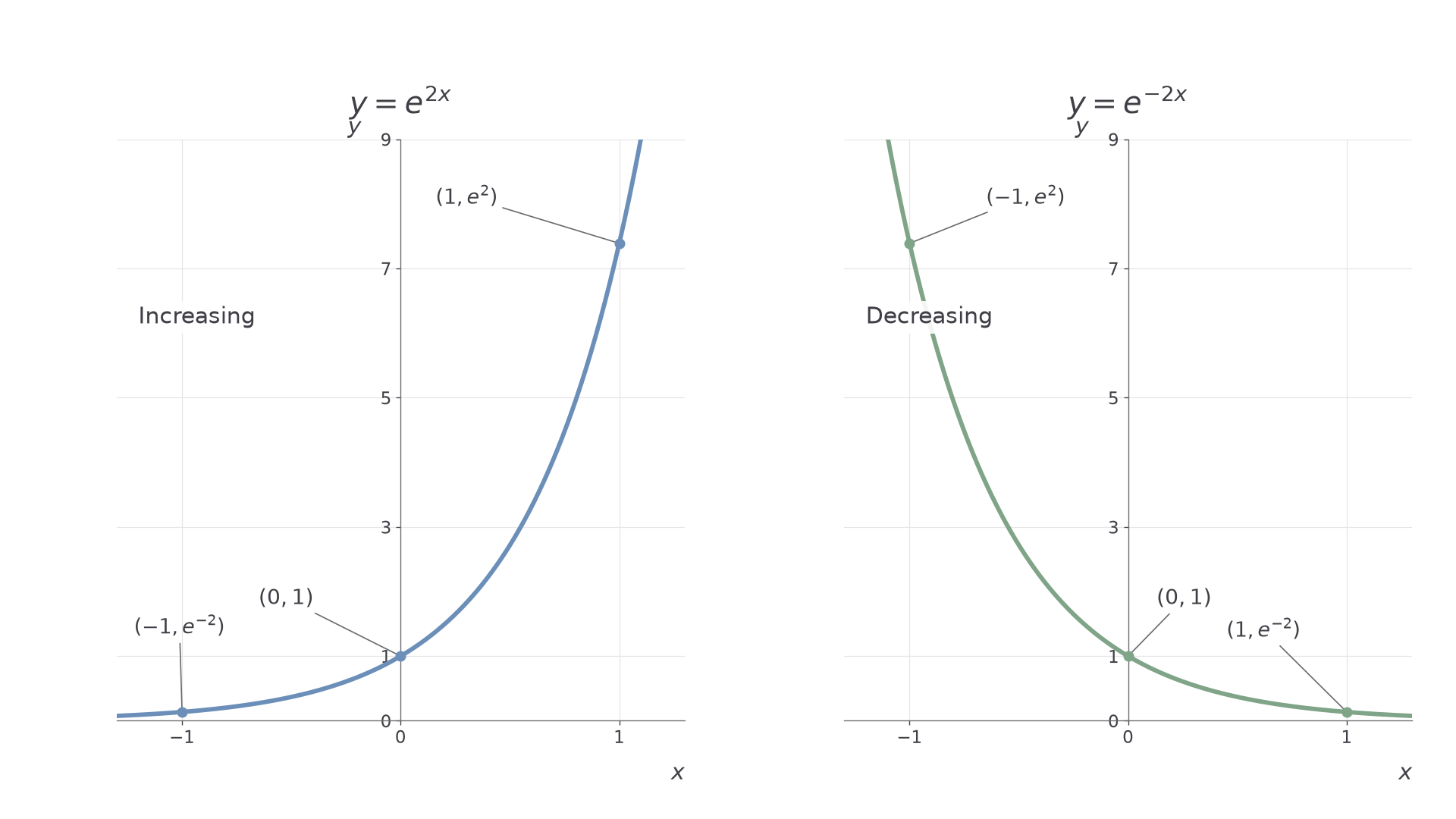
For , the sign of determines the direction: positive makes the graph increase; negative makes it decrease. Both pass through . When , the rule is simply .
Worked example 1: an increasing exponential
Question. Describe a sketch of , identifying its intercept and horizontal asymptote.
Plan. Use three exact values and examine increasingly negative inputs.
These values are approximately . As decreases without bound, tends to zero while remaining positive.
Answer. An increasing curve through , with horizontal asymptote to the left and no -intercept.
Check. Increasing by multiplies the output by , confirming the direction for every input.
Change only the sign of . This exchanges the left and right behaviour.
Worked example 2: a decreasing exponential
Question. Describe the same features of .
Plan. Use the same inputs and recognise the reciprocal of the previous outputs.
As increases without bound, tends to zero from above.
Answer. A decreasing curve through , with horizontal asymptote to the right and no -intercept.
Check. Each unit increase of multiplies the output by , so the positive outputs decrease. The graph is the reflection of in the -axis.
The curves share a range and intercept, but approach zero in opposite directions.
[DIAGRAM: asset_name: Growth and decay with the same intercept; asset_slug: exponential-growth-decay; caption: Changing the sign in the exponent reverses the direction while every output stays positive; description: Two equal-scale panels show y equals e to the power 2x and y equals e to the power minus 2x. Both pass through 0 comma 1. Exact points at x equals minus 1 and 1 are labelled using e squared and e to the power minus 2. The horizontal axis is the asymptote y equals 0.]
Watch out
is , not . At , the first is , while the second would be .
Use the sign of the coefficient and one exact input.
Natural logarithms
Every positive number is the output of for exactly one real input. Reversing that function gives the natural logarithm, written . It answers “what power of gives this positive number?”
Natural logarithm
The natural logarithm is the logarithm to base :
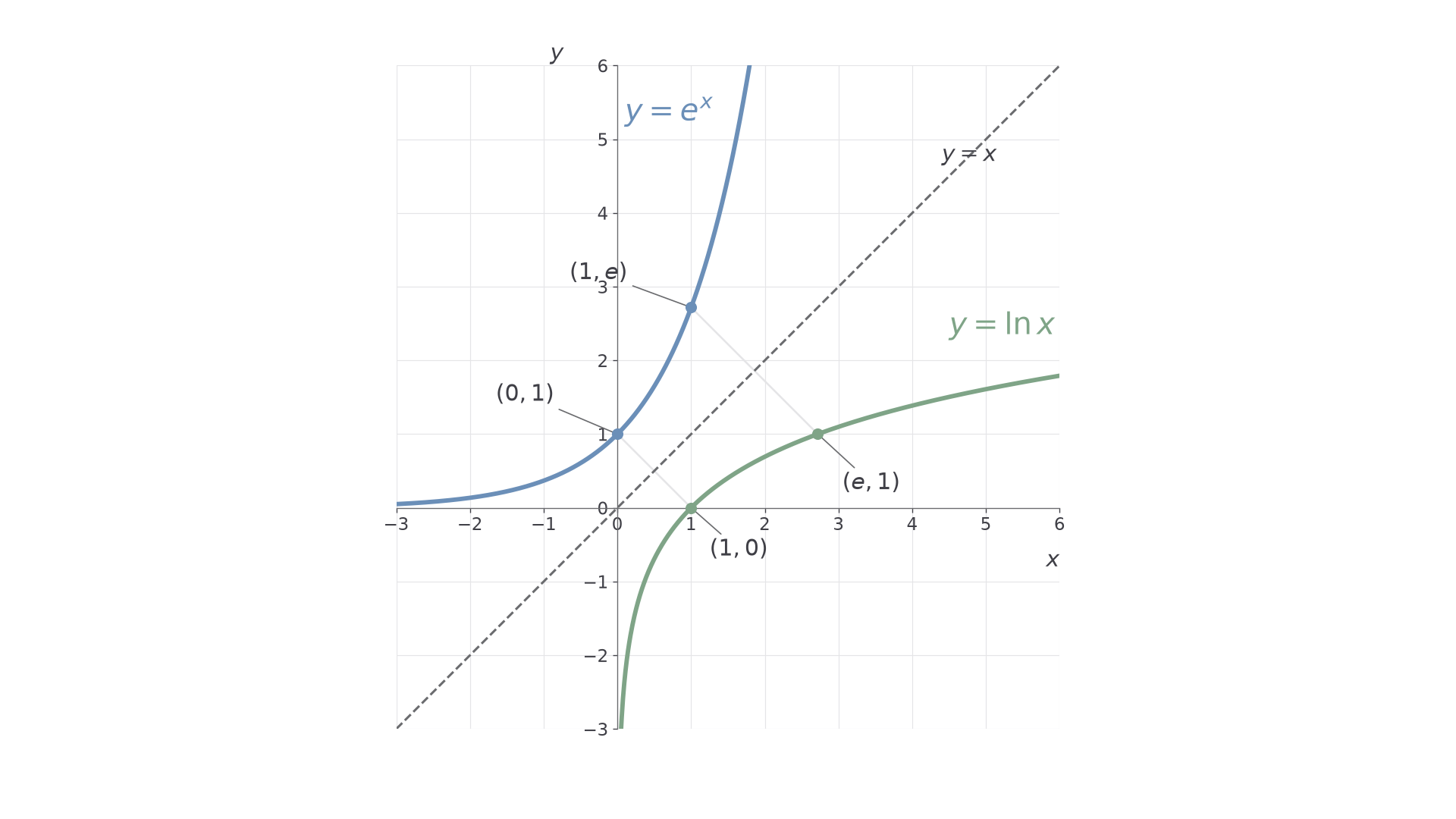
The graph of is the reflection of in . Its domain is and its range is all real numbers.
Reflection swaps with . It also swaps the exponential's horizontal asymptote with the logarithm's vertical asymptote . The logarithm increases: it is negative for , zero at , and positive for . It has no -intercept.
[DIAGRAM: asset_name: An exponential and its inverse; asset_slug: exponential-log-inverse; caption: Reflection in y equals x swaps exponential inputs and outputs; description: Equal-scale axes show y equals e to the x in blue, y equals ln x in sage, and a dashed mirror line y equals x. The points 0 comma 1 and 1 comma 0, and 1 comma e and e comma 1 are marked as reflected pairs. The exponential approaches y equals 0 on the left; the logarithm approaches x equals 0 from the right.]
The inverse relationship supplies two cancellation rules.
Natural inverse identities
The usual logarithm laws also apply to . These identities are not listed in the formula booklet: learn them.
Choose the inverse operation according to the outside function.
Continue this lesson.
You’re previewing NovaLearn without an account. Create a free account to read the rest.
Create free account