2.5 - The trapezium rule
How can you estimate an integral when you know some curve heights but do not have a convenient antiderivative? The trapezium rule joins those heights by straight lines and adds the resulting strips. You will build its formula, apply it to functions and tables, and use the curve's shape to judge an overestimate or underestimate.
Adding trapezia
Suppose a positive curve has heights and at the ends of an interval of width . Replace the curve between those points by a straight chord. The region under that chord is a trapezium whose parallel sides are the two vertical heights:
This is the average of the endpoint heights multiplied by the width. It is an estimate for the curved strip, not a claim that the curve itself is straight.
Now use equally wide intervals. There are ordinates, or function heights, . Adding neighbouring trapezia gives
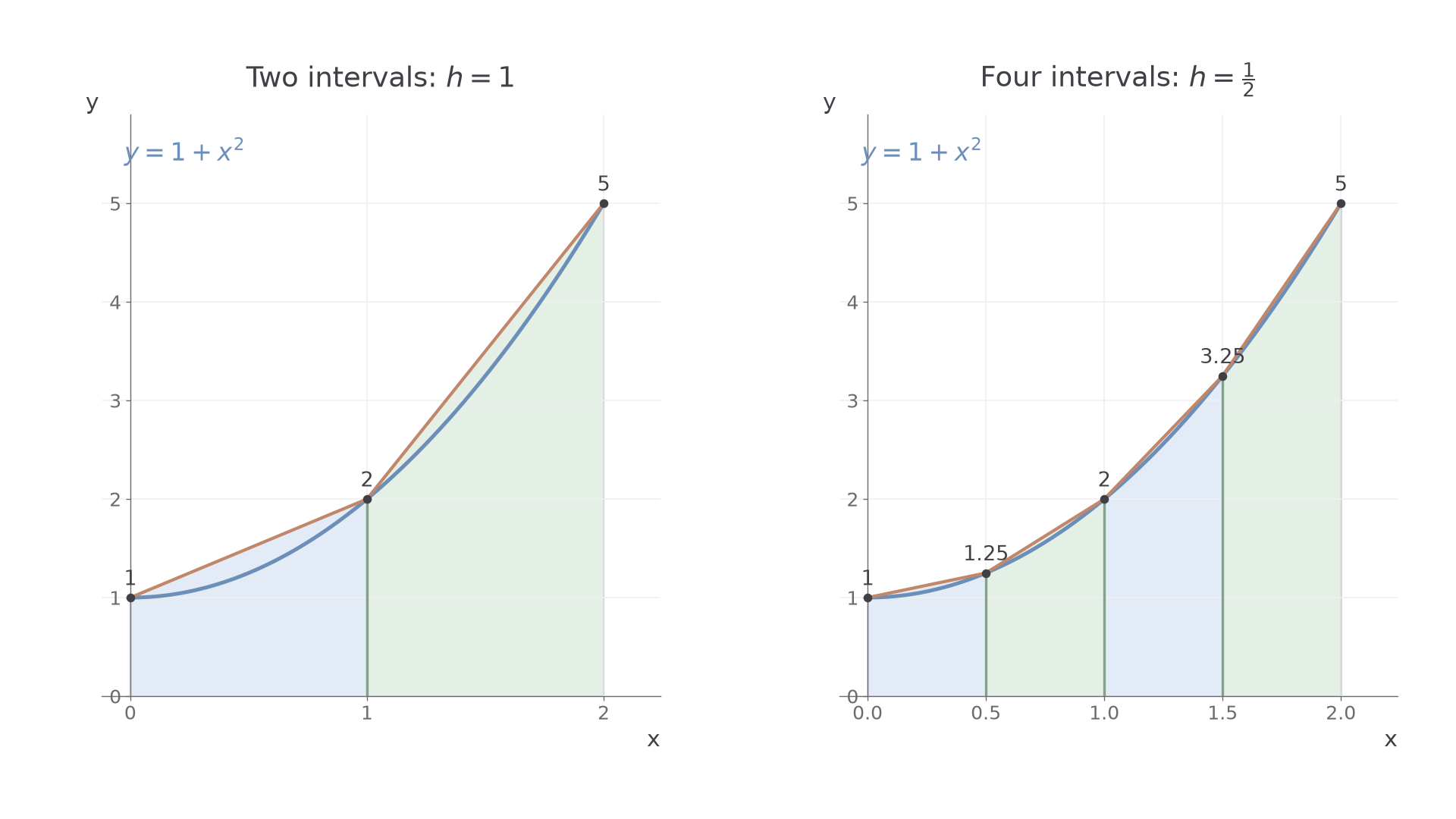
Each interior ordinate belongs to two strips, while each outer endpoint belongs to only one. That is the reason for the different weights.
Trapezium rule
For equal intervals from to , let
Then
The trapezium rule is not listed in MF19: learn the weights and their reason.
The sketch shows the same region with two different strip widths.
[DIAGRAM: asset_name: Adding neighbouring trapezia; asset_slug: trapezium-strip-weights; caption: Interior ordinates occur in two strips, and halving the strip width follows the curve more closely; description: Two coordinate panels plot y equals 1 plus x squared from 0 to 2. The left replaces the curve by two chords through heights 1, 2 and 5 with width h equals 1. The right uses four chords through heights 1, 1.25, 2, 3.25 and 5 with width h equals one half. The trapezia have alternating pale fills, and the shared interior ordinates are highlighted.]
Worked example 1: two intervals
Question. Use the trapezium rule with two intervals to estimate .
Plan. Find the width and three heights, then give the middle height weight .
Answer. The estimated integral is .
Check. Adding the two areas separately gives .
Keep the function and interval, but double the number of strips. The width halves, and there are five heights rather than three.
Worked example 2: four intervals
Question. Use the trapezium rule with four intervals to estimate the same integral.
Plan. Use and count the two endpoints once, the three interior heights twice.
Answer. The new estimate is .
Check. The four separate strip contributions are ; their sum is .
The difference between and shows that an estimate depends on the strip width. The final part will explain which side of the actual integral these estimates lie on.
Watch out
Four intervals require five ordinates. The width is , not . Count the spaces between the listed inputs.
Build the weights for a new table.
Estimating a definite integral
When a formula is given, make the ordinate table yourself. Calculate at every endpoint of every strip, keeping extra digits until the final weighted sum. When a table is given, check that the input spacing is constant before using the compact formula.
Worked example 3: heights from a function
Question. Use the trapezium rule with four intervals to estimate
Give your answer correct to 3 significant figures.
Plan. Use inputs , evaluate the function at each one, then apply endpoint/interior weights.
Answer. , correct to 3 significant figures.
Check. The separate trapezium areas are , with the same total. The positive estimate is below the area of a width-, height- rectangle, as expected.
Change the source of the heights: now they are supplied in a table rather than generated by a formula. The weights follow the inputs in exactly the same way.
Worked example 4: heights from a table
Question. Use the trapezium rule to estimate from the following table.
Plan. Read the common width , then count the outer heights once and the interior heights twice.
Answer. The estimate from the supplied values is .
Check. The individual strip contributions are , again totalling .
Continue this lesson.
You’re previewing NovaLearn without an account. Create a free account to read the rest.
Create free account