3.2.5.5 - A traded metal ore and extraction impacts
Learn how copper's geology, uses and processing shape global commerce, and use Escondida and its Coloso network to analyse extraction impacts and sustainability.
Copper occurrence and working conditions
Copper is the specified globally traded non-ferrous metal in this case, and its ore must be located, extracted and processed before useful metal is obtained.
An ore contains material that can be worked for a useful product under stated conditions; ore grade is the proportion of valuable material. Copper occurs in several deposit types, including large disseminated porphyry systems and sediment-hosted deposits. Porphyry deposits can contain low grades over large volumes, favouring large-scale open-pit working. Higher grade does not alone mean lower cost: depth, hardness, stripping, water, power and transport also matter.
Sulfide ores commonly undergo crushing, grinding and flotation to create a concentrate, followed by smelting and refining. Some oxide ores can use leaching, solvent extraction and electrowinning. The route depends on mineralogy; a tonne of concentrate is not a tonne of pure copper.
USGS's 2026 copper compilation identifies substantial reserves in countries including Chile, Peru, Australia and Congo (Kinshasa), while country resource estimates and reserve reporting systems differ. A reserve is the recoverable portion under stated conditions, not all copper thought to exist. Changes in price, confidence and technology alter estimates. USGS copper 2026.
At Escondida in northern Chile, arid conditions constrain freshwater and high inland elevation increases the energy required to move coastal water uphill. Remote deposits need workers, roads, power and export links. A large deposit can therefore be commercially important yet costly and environmentally demanding to work.
Uses, demand and global commerce
Copper's conductive, workable properties connect mineral supply to construction, manufacturing and energy systems.
End uses include electrical wiring, motors, power networks, electronics, plumbing and other construction products. Demand changes with new building, replacement and repair, industrial activity, electrification and grid investment. Population is one influence, but income, infrastructure stock, technology and product design affect copper needed per person. Substitution and more efficient design can reduce demand in some uses; performance and cost limit substitution.
Mining, processing and manufacturing occupy different places. ICSG's 2024 qualitative trade diagrams list Chile and Peru among major ores/concentrates exporters and China and Japan among importers. Separate blister/anode and refined-copper diagrams represent later stages. These public figures have no numerical scale: arrows used to describe their participants must not imply tonnages or calibrated widths. ICSG Factbook 2025, pp 29–31.
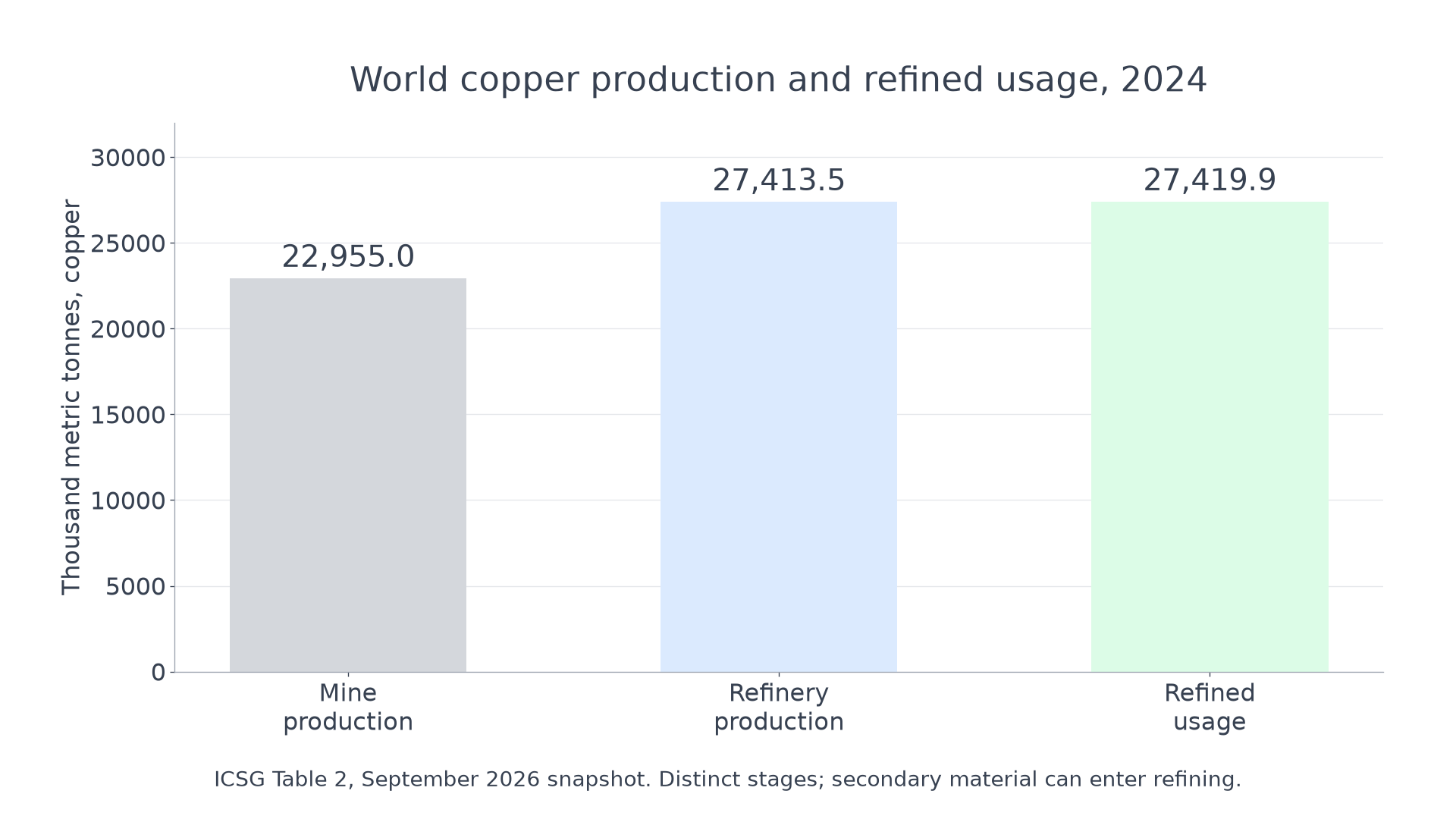
Original plot of ICSG September 2026 Table 2: 2024 mine 22,955.0; refinery 27,413.5; refined usage 27,419.9 thousand metric tonnes copper. These are not trade-flow volumes or a single mine-output balance.
Secondary copper from scrap helps explain why refined output need not equal new mine production. Stocks, trade, reporting and processing-stage boundaries also matter. Refined usage concerns use of refined copper and is not every possible end-use measure; direct-melt scrap is a different route. Global production totals cannot establish the affordability or access of each importing firm. ICSG Table 2.
Escondida–Coloso network and impacts
Escondida's extraction is linked to coastal infrastructure by both a material-export network and a water-supply network.
Continue this lesson.
You’re previewing NovaLearn without an account. Create a free account to read the rest.
Create free account